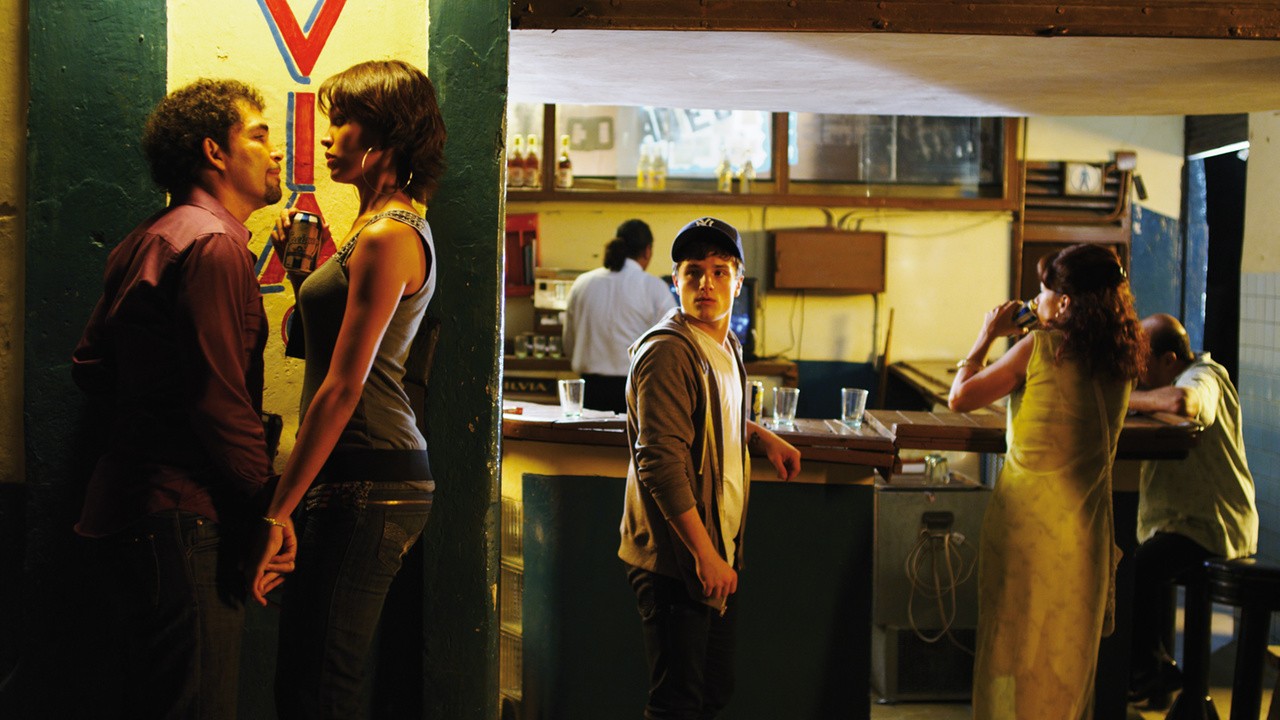
7 Days in Havana is a snapshot of Havana in 2011: a contemporary portrait of this eclectic city, vital and forward-looking, told through a single feature-length movie made of 7 chapters, directed by 7 internationally acclaimed directors.
Each chapter depicts a day of the week through the daily – and extraordinary – lives of its characters. A world away from the familiar touristic clichés, 7 Days in Havana aims to express the soul of this city and its diverse neighborhoods, atmospheres, generations and cultures, in touching, entertaining and funny style.
Seven directors (one from Cuba, six from other countries) share a common purpose: to capture, through their different sensibilities, origins and cinematographic styles, the energy and vitality that make Havana unique. Some have chosen to see the city through foreign eyes; others have preferred a deeper immersion and drawn inspiration from local people.
All seven stories have independent plots, but the many connections between them help to create a powerful dramatic unity. Shared locations play their part: emblematic Havana landmarks like the beach or the Hotel Nacional form the backdrop for some of the chapters. Several characters appear in more than one story – a protagonist in one chapter plays a secondary role in another – subtly connecting the stories and demonstrating that in Havana all social spheres run parallel, intertwine and intersect at various times of the week. —Wild Bunch
Laurent Cantet is a French director, born on June 15, 1961 at Melle (Deux-Sèvres). His parents were schoolteachers in Ardilleux.
On 25 May 2008, he received the Palme d’Or at the Festival de Cannes 2008, for the movie Entre les murs. –Wikipedia
Julio Médem (born 21 October 1958) is a Spanish Basque writer and film director. He was born in San Sebastián, Basque Country and showed an interest in movies since childhood, when he would take his father’s Super 8 camera and shoot at night, while nobody was paying attention. After college graduation (where he earned degrees in Medicine and General Surgery) he worked as a film critic and later as a screenwriter, assistant director and editor. After a few shorts he directed his first full length feature, Vacas (’Cows’) for which he won a Goya Award.
After this film he directed The Red Squirrel and Earth, both receiving good reviews at Cannes. In his next movie, Lovers of the Arctic Circle, which has been compared to the works of Krzysztof Kieślowski, he explored circular narrative and a taste for minimalistic textures that he then overcame in his next film, Sex and Lucia, where the plot dissolves into a very lyrical eroticism. After this film he took a tangent from his style… read more
Baldheaded Franco-Argentine filmmaker Gaspar Noé has made some seriously disturbing films during his relatively short career. He has also won several critical awards and festival acclaim for each of his works. Noé made his first film in 1991 with the short Carne, an introduction to the character of the Butcher, played by Philippe Nahon. An angry man, the Butcher seeks revenge on whoever hurt his disabled daughter. After working as an actor, cinematographer, writer, and director on some other projects, Noé made his first feature film, I Stand Alone, continuing the story of the Butcher after he does time in jail and abandons his daughter. In 2002 he received major public notice and outrage with the controversial Irréversible, mostly due to the much-publicized eight-minute rape scene. Starring real-life married couple Monica Bellucci and Vincent Cassel, the film is a brutal look at male violence shown in reverse chronological order. —allmovie guide
Elia Suleiman is a Palestinian-Israeli film director and actor. He is best known for the 2002 film Divine Intervention, a modern tragic comedy on living under occupation in the Palestinian territories which won the Jury Prize at the 2002 Cannes Film Festival. Between 1982-1993, Suleiman lived in New York City, where he directed two short films: Introduction to the End of an Argument and Homage by Assassination, that won numerous awards.
In 1996, Suleiman directed Chronicle of a Disappearance, his first feature film. It won the Best First Film Prize at the 1996 Venice Film Festival. In 2002, Suleiman’s second feature film, Divine Intervention, subtitled, A Chronicle of Love and Pain, won the Jury Prize at the Festival de Cannes and the International Critics (FIPRESCI) Prize, also receiving the Best Foreign Film Prize at the European Awards in Rome. Suleiman was part of the jury for the 2006 Cannes Film Festival. —World Cinema Foundation
No filmmaker living in Cuba has achieved greater worldwide acclaim than Juan Carlos Tabío, but you’d never guess it from talking with him. He is happy to ascribe the astounding success of a film like Strawberry and Chocolate – and, indeed, of his entire movie career – to mere good fortune.
Tabío was born in Havana in 1943. After the Cuban Revolution his parents were preparing him for a career in the diplomatic service. “I became a filmmaker because of a very lucky situation,” he explains in his interview with Havana Cultura. “The woman who ran the ICAIC [the Cuban Institute of Cinematographic Arts and Industry] was a friend of my family’s and I went to talk to her.” Tabío started working as a production assistant in 1961 and spent the next four decades of his life as a filmmaker. “If that woman wasn’t a family friend I would have done something else in life. You’re carried on by life, life isn’t carried on by you. You can’t tell where life is going to take you.”
No wonder… read more
Pablo Trapero was born in Buenos Aires in 1971. His feature films are Mundo Grúa (1999), shown at Venezia (Critics Award), and El bonaerense (2002), which was presented at the Festival de Cannes 2002 in Un Certain Regard. He also directed Naikor, a short film premiered in 2001, and Sarasa, a documentary for television (2002). In 2002 he created Matanza Cine, an independent film production company, which produced La libertad by Lisandro Alonso, Ciudad de Maria by Enrique Bellande and La mecha by Raul Perrone. –Cannes
Elia Suleiman' s short is terrible.Gaspar Noe' s film is not bad, but it does not suit Cuba . Better for Africa or S.America. L.Cantet seems OK. Finally, film is not telling Cuba. Something else or somewhere else, in directors' idea. Better study about Cuba a little bit, first. Then make a film. I really don' t like second class film directors.
Omnibus roll call: Laurent Cantet, Benicio Del Toro, Julio Medem, Gaspar Noé, Elia Suleiman, Juan Carlos Tabío and Pablo Trapero.