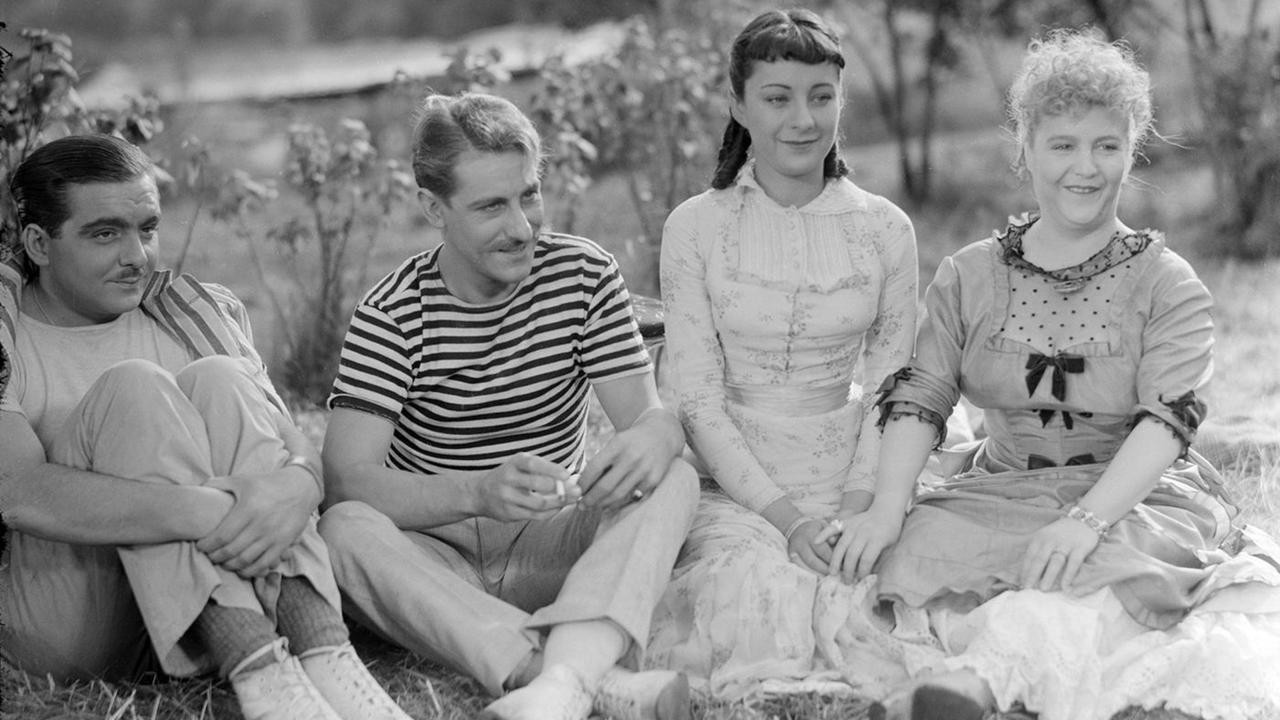
When Partie de campagne (A Day in the Country) was finally released in 1946, ten years after it was shot, it was hailed as an ‘unfinished masterpiece’. Since then, Jean Renoir’s masterly adaptation of a short story by Guy de Maupassant, running at just under 40 minutes, has grown in reputation to the point where it has become his best-loved film.
On an idyllic country picnic, a young girl leaves her family and fiance for a while, and succumbs to an all-too-brief romance. Shot on location on the banks of two small tributaries of the Seine, Renoir’s sensuous tribute to the countryside – and to the river – has seldom been surpassed. Water, and the movement of rivers in particular, flows like a constant theme through Renoir’s films but nowhere in all his work is the river more central to the action than in Partie de campagne.
Author Guy de Maupassant was a friend of Renoir’s father, the Impressionist painter Auguste Renoir. The film sticks closely to his original story, although the tone is altered and the characters are expanded. The main change – imposed on the film-makers by the disastrous weather during the course of the shoot – is that the story is set during a searing heatwave, while the film’s events take place on a fickle day where brief bursts of sunshine give way to clouds and finally to a downpour.
The film was originally intended to run some 50 minutes. However, shooting was constantly delayed by the rain and eventually Renoir quit the production to start his next film. The producer, Pierre Braunberger, was left with the incomplete footage. He considered turning the film into a full-length feature, and commissioned an expanded script, but Renoir refused to have anything to do with it. Not until after the war was Braunberger able to turn the film into a viable release, when it was reconstructed with two intertitles to replace the missing scenes, and a score was commissioned from Joseph Kosma. —BFI
The son of the painter Auguste Renoir, Jean Renoir became one of France’s most important and respected filmmakers during the middle of the 20th century. A Philosophy and Math student, Renoir became a cavalryman, but was invalided out of the army before World War I. Later, he married a model and aspiring actress, and, following the death of his father and the acquisition of an inheritance, set up his own production company to produce movies for his wife. Renoir learned from these early experiences of financing movies and watching other films, and became a director in 1924. With the advent of sound, Renoir’s career was quickly made with a series of profitable films, including La Chienne (1931), a savage and dark drama about a man’s self-destruction, which was later remade by Fritz Lang as Scarlet Street. Renoir’s subsequent films, including The Lower Depths (1936) and Grand Illusion (1937), were among the finest made in France before the war, and were well acknowledged at the time of… read more
At only 45 minutes, it stands as one of the most lyrical films ever made. The scenes that didn't get shot don't deter from the overall power of the central story, nor can they diminish the gorgeous imagery. Renoir was the ultimate humanist, and this is his most touching film. Not only will individual moments (a woman on a swing, the closing) stay with you long after viewing, but the entire piece will as well...
There is some disagreement as to why this adaptation of a de Maupassant story was never properly finished by Renoir but what can't be disputed is that the film is utter perfection as it stands. A Parisian family spend a Sunday in the country and when their men choose to go fishing, a mother and her daughter are courted by two locals who take them for an idyllic trip down river. A beautiful and haunting masterpiece...
Beautiful, poetic, and not unlike a painting by his father, “A Day in The Country” is a true cinematic gem. Pierre-Auguste Renoir always told his son Jean that one should never repeat his themes with… read review