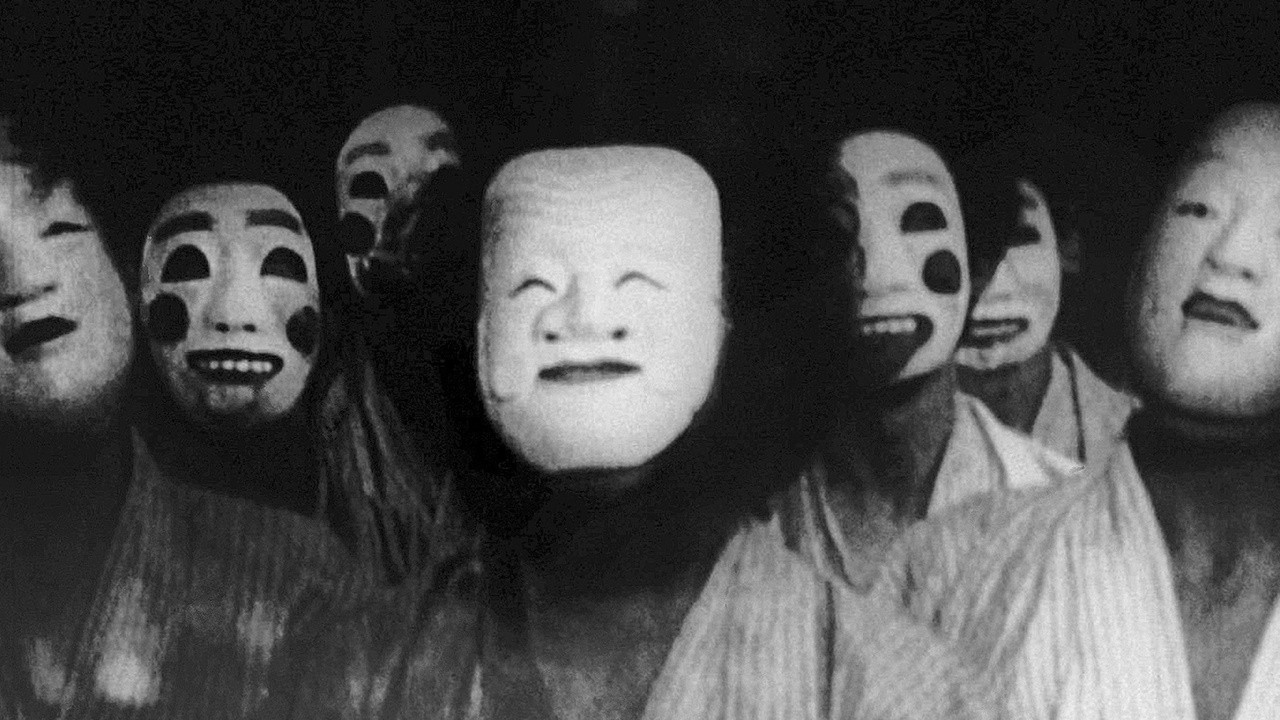
A Page of Madness is the story of a retired sailor who has taken a job as a janitor in a lunatic asylum to look after his insane wife, locked away after attempting to drown their child. A synopsis of the plot can’t begin to explain the power of the film, nor the audacity of its vision.
‘Within minutes, as the rapid montage of the opening storm sequence dissolves into the surrealistic fantasy of the sailor’s wife dressed in an exotic costume dancing in front of art-deco backdrop, A Page of Madness bowls you over with a barrage of startling images utilising every technique in the book known to filmmakers of the time 1927. As eye-popping an experience as anything you’re likely to see released nowadays. Director Kinugasa was way ahead of the game.’ -Midnight Eye
In the raging fires of American retaliation against Japan during WWII, much of the nation’s cinematic history was destroyed. Rarely seen in Australia, A Page Of Madness only survived the war because the original negative was stored in a rice barrel in the director’s country home. A dizzying portrait of an insane asylum boasting an expressionistic aesthetic akin to The Cabinet of Dr. Caligari and elliptical editing that recalled Sergei Eisenstein’s finest work, A Page Of Madness is widely credited as one of the finest examples of international experimental cinema. —Melbourne International Film Festival
During the 1920s, Teinosuke Kinugasa’s startlingly modern experimental movies infused Japanese film with a sophistication that rivalled the best European art films. His innovations, along with those of Kenji Mizoguchi, Yasujiro Ozu, and Sadao Yamanaka, helped Japanese cinema develop a distinct cinematic voice.
Born in 1898, in Mie, Kinugasa entered film in 1917, as an onnagata, a man who specialized in female roles. At the time, Japanese cinema was evolving away from staged performances of Kabuki to become a unique cultural art form unto itself, though conventions from the theater, such as the onnagata, remained. Kinugasa turned to filmmaking in 1922, and managed to crank out several silent features (sadly lost), until the infamous 1923 Kanto earthquake, which leveled Tokyo and killed thousands of people. The quake signaled the beginning of an unprecedented influx of Western ideas into Japan. Bauhaus-inspired buildings rose from the rubble, while Marxism and Freudianism became… read more
I haven’t seen many silent films, but this movie seems unique even compared to some contemporary films. A Page of madness starts off with a very creepy and impressive montage of the various inhabitants… read review
The story of this film’s life is almost as strange as its content – I was told that it had been lost for something like 50 years before Kinugasa found a print of it buried in his backyard shed. There… read review