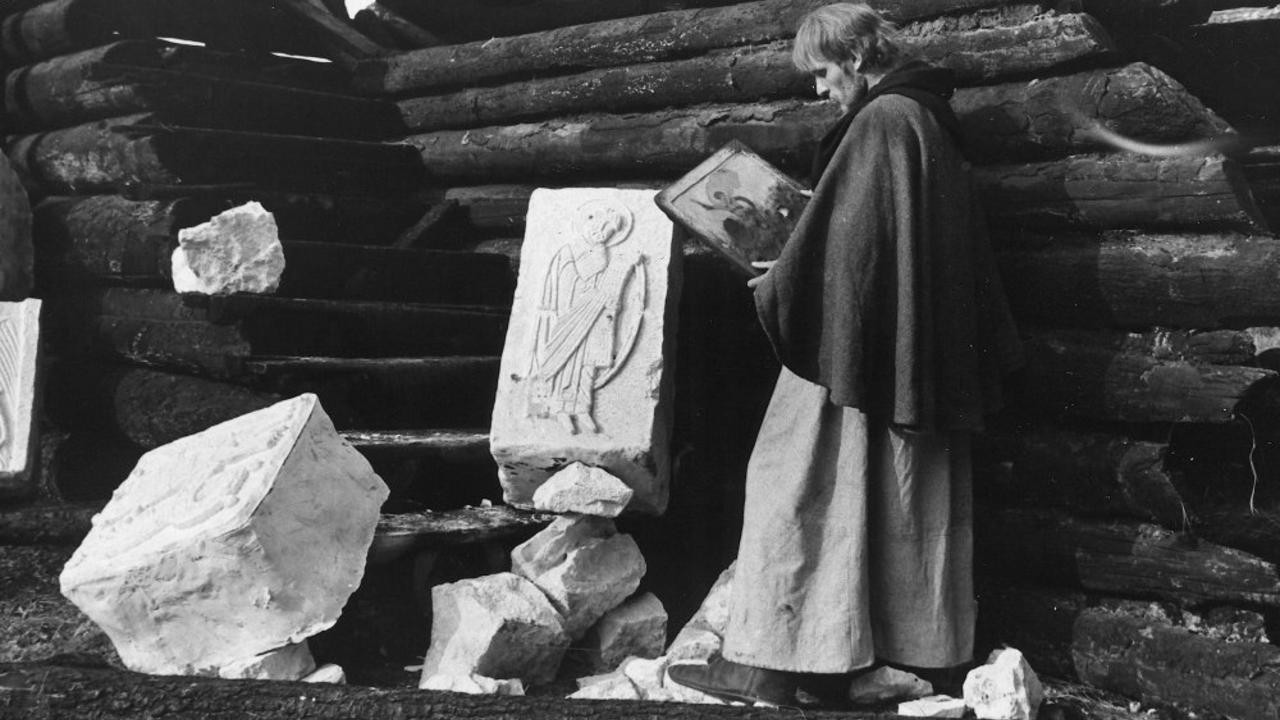
Immediately suppressed by the Soviets in 1966, Andrei Tarkovsky’s epic masterpiece is a sweeping medieval tale of Russia’s greatest icon painter. Too experimental, too frightening, too violent, and too politically complicated to be released officially, Andrei Rublev has existed only in shortened, censored versions until the Criterion Collection created this complete 205-minute director’s cut special edition. —The Criterion Collection
One of the most important artists of the second half of the twentieth century, Tarkovsky was one of the few unqualified masters in the history of film. While he certainly wasn’t the only great director of his generation of Soviet filmmakers, he was, like Eisenstein was to an earlier generation, its most renowned and most influential.
The son of artists- actress Maria Ivanovna and poet Arseni Tarkovski— he studied both Arabic and geology before turning to film. He enrolled at VGIK in 1959, directed the acclaimed short The Steamroller and the Violin in 1960 and won the Golden Lion at the Venice International Film Festival for his first feature, Ivan’s Childhood, in 1962. By the time he completed his second feature, Andrei Rublev, he was regarded by many as “a poet of the cinema” – and by the Soviet censors as dangerously esoteric. Unreleased in the Soviet Union until 1971 (and then only in a truncated version), Andrei Rublev was seen first at international festivals and widely… read more
As always with Tarkovsky, this was philosophically and visually rich (the shot of Andrei in the church directly after the raid is particularly beautiful) but unfortunately I felt like it was overlong in parts with a few scenes that just dragged for too long. Overall not as satisfying as the stuff he went on to make in the 70s (not much is) but flawed Tarkovsky is still easily worth 3 hours of your time.
Pure genius or straight manic, I cannot be too sure. The depths that Tarkovsky goes through to fill in the gaps of the life of an iconographic master is painstaking to even think about. To only have this film banned by the USSR soon after release is tragic, but truly apropos considering the context of the comrade politics it was created under - that oddly services Rublev's motif that life without art is dismal.
The greatest epic ever made (I don't think "epic" would be the most appropriate way of describing Sátántangó). A gorgeous, poetic masterpiece. The animal cruelty is quite distressing however.
A round-up of the most popular posters on the Movie Poster of the Day Tumblr.
On the occasion of what would have been Andrei Tarkovsky’s 80th birthday, Adrian Curry looks back on the best posters for his films.
"In the nearly 30 years I've been writing about movies for LA Weekly," begins FX Feeney, "no moviemaking genius has meant more to me than
Andrei Tarkovsky’s episodic re-imagining of the life of the 15th century icon painter and monk, Andrei Rublev, is both epic in scale and dreamlike. Tarkovsky manages to reflect the serenity and calm… read review
Andrei Tarkovsky’s Andrei Rublev is an epic monument of international cinema. Like Mount Everest it is a sight to behold, and often quite as challenging to conquer all the way through. There is plenty… read review
Andrei Rublev moves at a typical Tarkovsky pace (aka whatever is slower than a snail pace.) But like any other film he’s made, the thought-provocation and breathtaking images make it well worth the… read review
This single film redefined what movies can be. Almost half my DVD collection was nearly dumped after my embrace of a very prolific and longest piece of celluloid to cross my path. My eyes were opened… read review