Watch unlimited films online for $6.99.
Try MUBI for FREE.
 

Synopsis

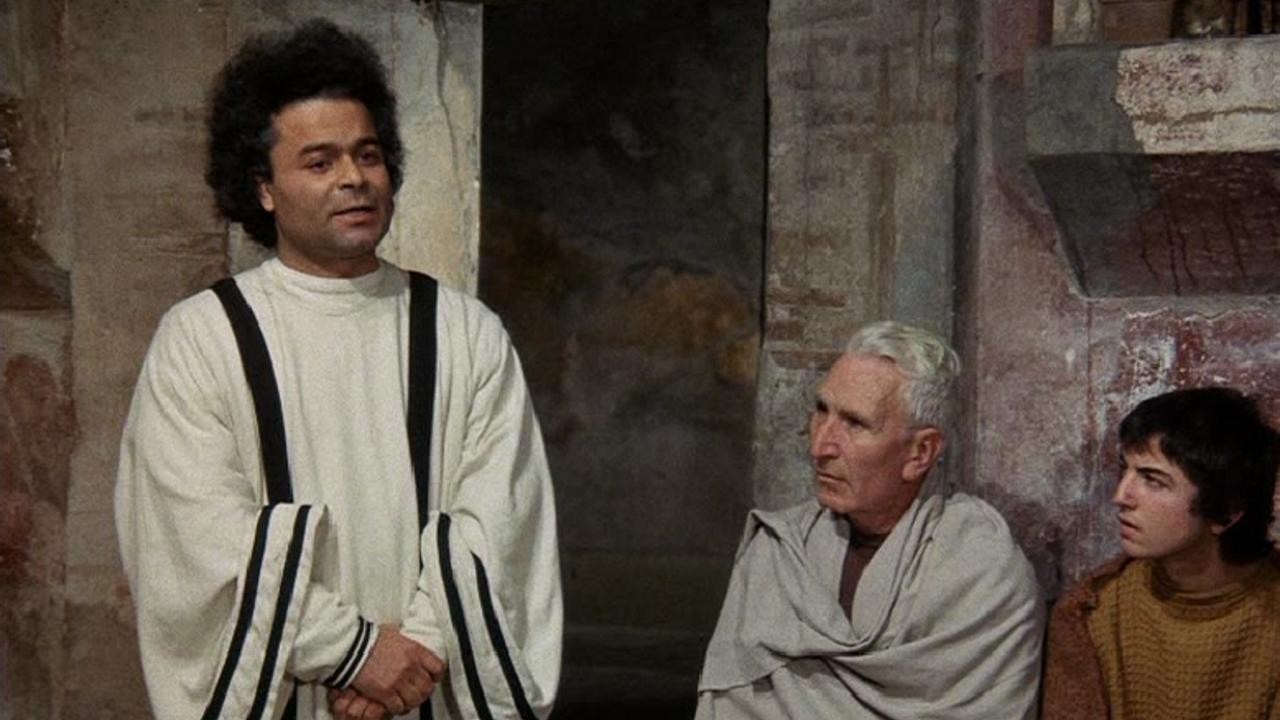
A lovely account of the final years of the Christian theologian and “father of the Church” Augustine, when he returned to North Africa from Italy at the end of the fourth century, the film was conceived by Rossellini to assert the many analogies he saw between the decadent, dying world of Augustine’s time, which was “on the edge of the abyss,” and a contemporary world rife with war (Vietnam), pollution, and global poverty. Rossellini hoped that an audience tired of cynical political leaders and moral drift would respond to Augustine’s message, that charity and caring can heal a failing world and point a way out of its spiritual morass. (Rossellini conveniently leaves out Augustine’s licentious earlier life, detailed in the Confessions, and moralistically disports Fellinian transvestites as signposts of decadence.) With the ruins of Pompeii, Herculaneum, and Paestum standing in for North Africa, a visual design that emulates the mosaics and frescoes of the time, and a Berber filmmaker playing the title character – chosen, Tag Gallagher reports, for his “charitable face” – Augustine of Hippo reaches a pitch of fervency in its final sequence that will leave even unbelievers shaken. Rossellini contrived the best endings for his films, and the conclusion of this extraordinary historical film is one of his most powerful. “Extraordinary… Though Rossellini’s concern for content is as rigorous as it is in his other ‘teaching films’… Augustine of Hippo is unexpectedly cinematic, with lovely sets, costumes, music, sound effects, and, seemingly, more camera movements than in all the other films put together” (Vincent Canby, The New York Times). —Cinematheque Ontario

Director

Original

Roberto Rossellini

Rossellini was one of the directors of the Italian neorealist cinema, contributing films such as Roma città aperta (Rome, Open City 1945) to the movement.

In 1937, Rossellini made his first documentary, Prélude à l’après-midi d’un faune. After this essay, he was called to assist Goffredo Alessandrini in making Luciano Serra pilota, one of the most successful Italian films of the first half of the 20th century. In 1940 he was called to assist Francesco De Robertis on Uomini sul Fondo.His close friendship with Vittorio Mussolini, son of Il Duce, has been interpreted as a possible reason for having been preferred to other apprentices.

Some authors describe the first part of his career as a sequence of trilogies. His first feature film, La nave bianca (1942) was sponsored by the audiovisual propaganda centre of Navy Department and is the first work in Rossellini’s “Fascist Trilogy”, together with Un pilota ritorna (1942) and Uomo dalla Croce (1943). To this period belongs… read more

Wall

Displaying 0 wall posts.

Related Films