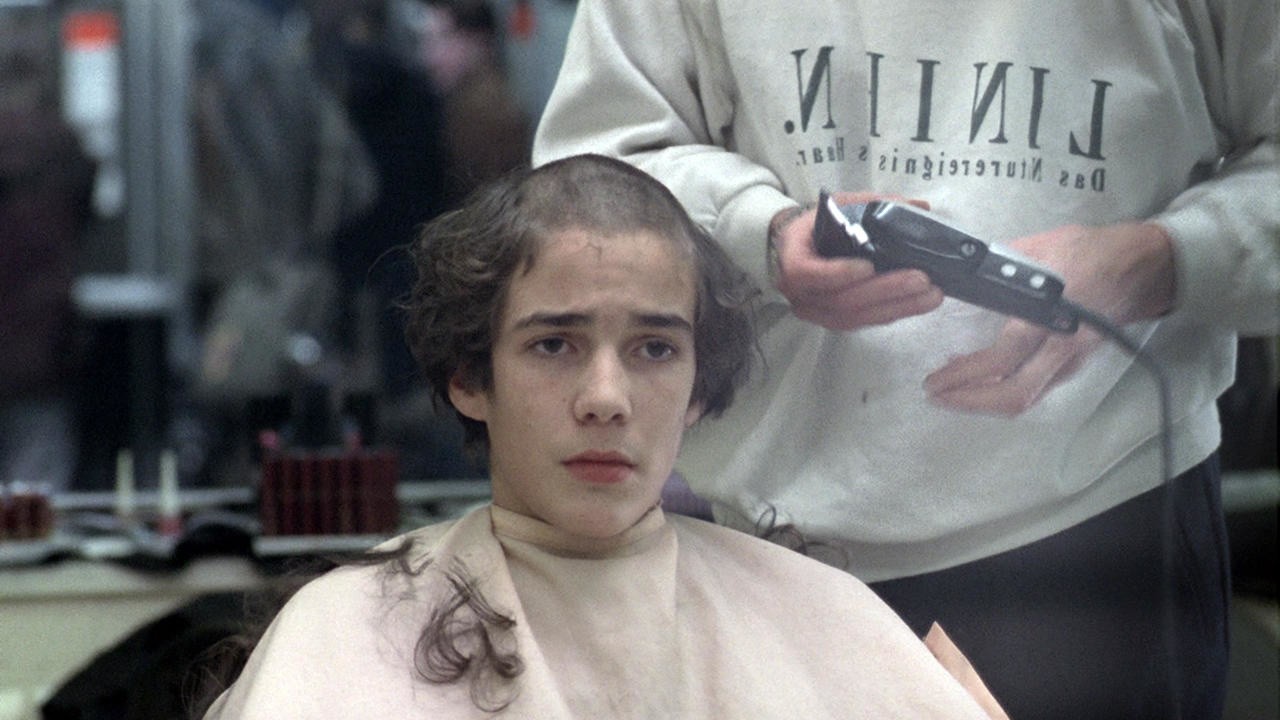
Written and directed by Haneke, this “bone-chilling” (Stephen Holden, The New York Times) feature film opens with the amateur footage of a pig being slaughtered with a butcher gun. This unceremonious recording is owned by 14-year-old Benny (Arno Frisch; Haneke’s Funny Games), a boy whose preferred mediums of experience are video cameras, action movies, and the surveillance monitors placed in his room.
Accustomed to a trite routine of school activities, daily visits to a local video store, and hours in front of his bedroom TV, Benny finds himself enthralled by his tape of a slaughtered swine. Staying alone in his parents’ apartment, Benny eventually brings home an unknown girl, immediately exposing her to the rapturous videotaping. Then, after revealing that he stole the gun that took the pig’s life, Benny coldly shoots his guest and turns his unwrought curiosity into a slaughter video franchise. “I once saw a TV program about the tricks they use in action films,” says Benny. “It’s all ketchup and plastic.”
By colliding the differences between frames and flesh, “Haneke’s chilling look at post-modernity and voyeurism” (Pauline Kael) is deprived of character psychology and the pathologizing justifications of violence. Instead, Haneke’s sophomore theatrical release offers a lucid depiction of human beings deprived of their capacity to empathize with — and be hurt by — others. –KINO
Cheerfully wishing his audience a “disturbing evening” at a London retrospective of his films, director Michael Haneke insists that he is an optimist at heart, despite all of the relentlessly bleak carnage and deeply disturbing imagery so vividly painted and seared into the mind of anyone who has had the uncomfortable experience of viewing his work.
Practically born into show business, to an actress mother and director father, in Munich in March 1942, Haneke spent his early years in a working class suburb of Vienna before an early attempt at fame as an actor and pianist. Failing to achieve early success, Haneke attended the University of Vienna to study philosophy and psychology, and became a film critic and stage director before making his eventual debut as a television director with After Liverpool in 1973. Setting in motion a television career specializing in literary adaptations and small screen films, Haneke would work successfully in that medium until his feature debut… read more
Presents multiple explanations for Benny's behavior without singling one out, which some may find frustrating or lazy but it allows the viewer to consider the subject without the film feeling preachy (Funny Games) which is something I can pretty much always appreciate. Up there with Haneke's best for me, and the themes have only gotten more relevant over time.
Once again it's the family, hold dear subject in Haneke's philosophy, who has to face the nihilism. In this story, a boy perpetrates a series of sterile wickednesses without letting us know the cause. This film it’s surely an example well defined of the dissolution of morality. Nor insanity, nor madness are the protagonists of the events, just the impossibility of a guy to empathize with the others.
Benny's Video exposes a dark exploration about obsession in Haneke's second installment of his "glaciation trilogy" bookended with The Seventh Continent and 71 Fragments of a Chronology of a Chance. The trilogy's thematic focus on social fragmentation and alienation surfaces with a quiet horror recorded and documented in Benny's Video. The reclusive teen's impressions of a pig slaughter inspires un unimaginable act.
Lynne Ramsay’s third feature is a mishmash of soiled diapers, leaden musical cues and underlined soul-sickness,
Here in Germany, where The White Ribbon has been in theaters for a couple of weeks now, Michael Haneke was on television last night. There
Como en casi todas las películas de Michael Haneke, la realidad y la construcción de la realidad en imágenes siempre aparecen en dos polos. El constante cuestionamiento de las imágenes cinematográficas… read review
Haneke debe ser unos de los pocos directores contemporáneos, si no el único, que sabe tratar y mostrar la violencia cotidiana, la del dia a dia, con una mirada tna gélida y pesimista, pero, aún asi… read review