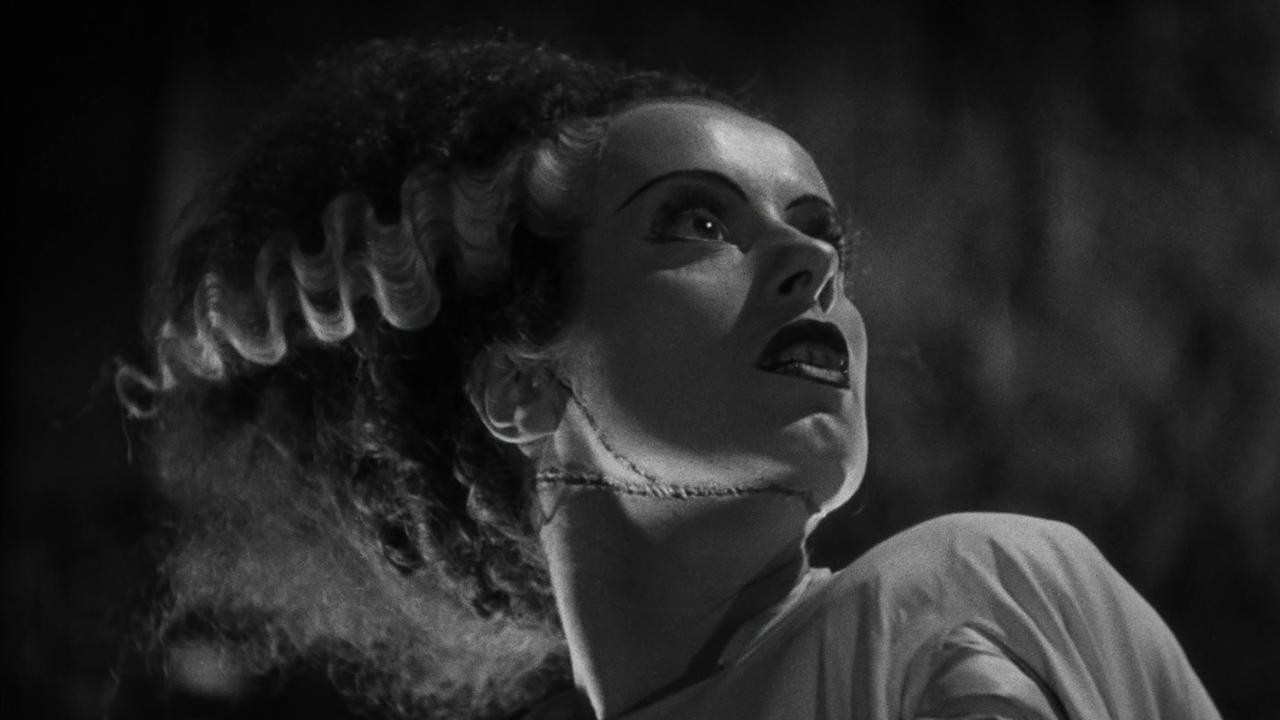
It opens with a brilliant prologue that features a wicked thunder storm, in 1816, hitting the British country residence where the young demure author Mary Shelley is being entreated by her famous poet husband Percy Bysshe Shelley and his counterpart Lord Byron to continue with her nightmarish tale of Dr. Frankenstein and his Monster. And so the sequel begins, set in 19th-century Germany. We learn that the Monster survives the mill fire and is taken in by the eccentric philosopher-scientist Dr Pretorius, who was given the boot by his university. We also learn that Baron Henry Frankenstein, the Monster’s creator, is in bed suffering from mental agony while comforted by his wife Elizabeth. Their quiet is interrupted by the visit of Henry’s former teacher, the demented Dr. Septimus Pretorius, who when the men are alone threatens to tell everyone that Henry created the Monster that killed some of the villagers unless Henry agrees to create a bride for the Monster and thereby begin an artificial race. Henry refuses but humorously responds “A woman, that should be really interesting.” The unscrupulous Pretorius, whose mentor could be the Marquis de Sade, is set upon eliminating the concept of good and evil thinking we would all get a good belly laugh if everyone did what they wanted to. Later on we discover that Pretorius is not such a libertarian, but instead wants everyone to do only what he wants them to do. This is basically the structure of the plot, as the remainder of the film concentrates on the Monster trying to find a place in the world to dwell with humans but can’t find a place to fit in. The Monster tries to rescue a young shepherdess from drowning, meets a kindly blind hermit in the woods who befriends him and teaches him to say a few words and about music and drink, as the lonely man is glad to have company and his kindness brings tears to the Monster. When Pretorius abducts Henry’s wife, he forces him to create the Monster’s female mate or else he threatens to harm Elizabeth. —Ozu’s World of Movie reviews
James Whale (22 July 1889 – 29 May 1957) was a British film director, theatre director and actor. He is best remembered for his work in the horror film genre, having directed Frankenstein (1931), The Old Dark House (1932), The Invisible Man (1933) and Bride of Frankenstein (1935), all recognized as classics of the genre. Whale directed over a dozen films in other genres, including what is considered the definitive film version of the musical Show Boat (1936). He became increasingly disenchanted with his association with horror, but many of his non-horror films have fallen into obscurity.
Born into a large family in Dudley, England, Whale early discovered his artistic talent and studied art. With the outbreak of World War I, Whale enlisted in the British Army and became an officer. He was captured by the Germans and during his time as a prisoner of war he realized he was interested in drama. Following his release at the end of the war… read more
A couple of weeks ago there was a lot of buzz about the fact that this rare teaser poster (the only one known to be in existence) for the 1935
Charles Vidor, no relation to the more celebrated King, made Gilda, ensured himself a place in the film history books with a slick and thematically
Boris Karloff as Gruesome is out-gruesomed by Skelton Knaggs in Dick Tracy Meets Gruesome (1947).
"I don't want to hear! I've changed my mind, I won't do it!" says a puling, nearly hysterical Henry von Frankenstein (Colin Clive) when his one