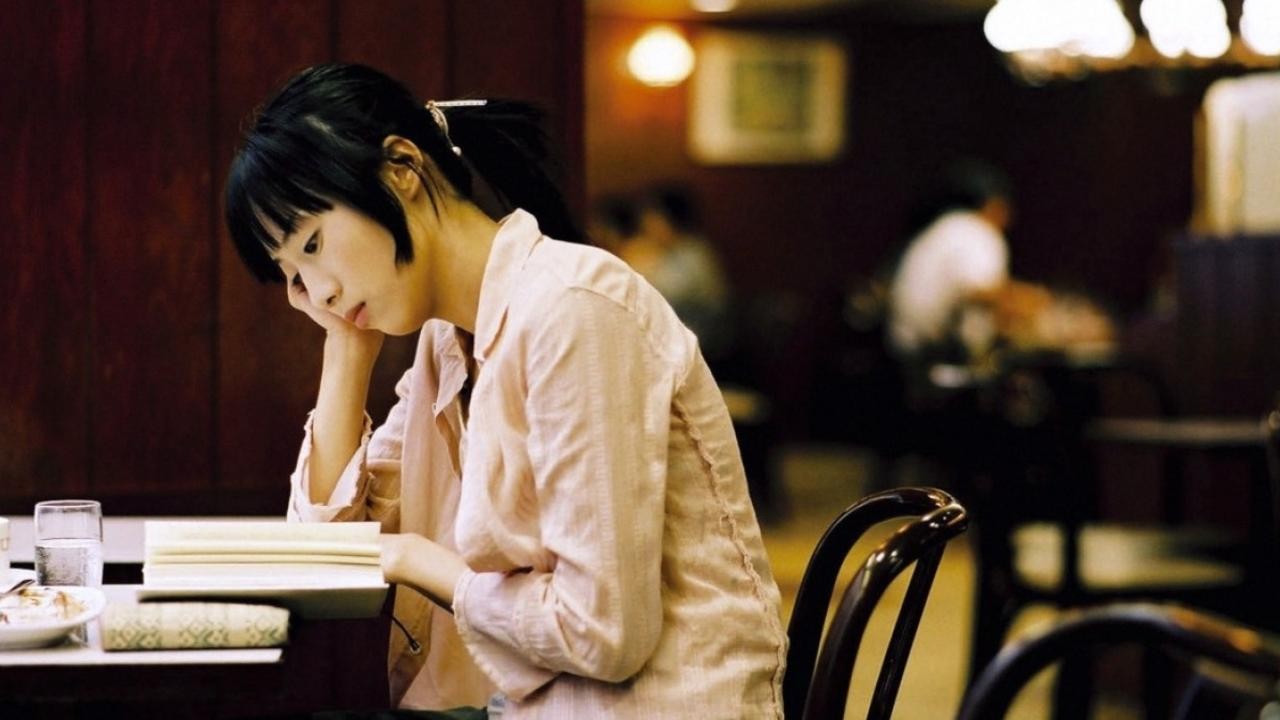
The story revolves around a young Japanese woman (played by Hitoto Yo) doing research on Taiwanese composer Jiang Wen-Ye, whose work is featured on the soundtrack. The late composer’s Japanese wife and daughter also make appearances as themselves. –wikipedia
Director Hou Hsiao Hsien, in a 1988 New York Film Festival World Critics Poll, was voted one of three directors who would most likely shape cinema in the coming decades. He has since become one of the most respected, influential directors working in cinema today. In spite of his international renown, his films have focused exclusively on his native Taiwan, offering finely textured human dramas that deal with the subtleties of family relationships against the backdrop of the island’s turbulent, often bloody history. All of his movies deal in some manner with questions of personal and national identity, particularly, “What does it mean to be Taiwanese?” In a country that has been colonized first by the Japanese and then by Chiang Kai-Shek’s repressive Nationalist Government, this question is pregnant with political connotations.
Hou was born to a member of the Hakka ethnic minority in southern Guangdong province in mainland China, but his parents emigrated to Kaohsiung, Taiwan… read more
This is basically my kind of movie: simple and just about regular lives. I'd expected more from it and now that I've watched it I really wish it had focused more on Hajime's life (partly because I'm a huge Tadanobu Asano fan, but also because something about trains is so attractive to me). Overall a nice, calm film.
Like many great texts, whether cinematic or otherwise, in which one major artist pays homage to another, Café Lumière informs us just as much about the architect of such an endeavor as the individual being acknowledged. Hou —who slyly incorporated a clip of Ozu's Late Spring in his remarkable Good Men, Good Women, also produced by Shochiku, a film that was similarly concerned with how the past does (and doesn't) have bearing on the present—largely deploys his own modernist formal and structural devices to discern a number of Ozu's thematic (the passing of time, the dissolution of the nuclear family) and visual (trains, laundry) motifs. A quiet, gracefully unassuming masterpiece.
Dont try to look for a meaning, there is none (except maybe the train theme).This movie is pure slice of life. Watch only if you are in a really contemplative mood, otherwise you could be bored to death. I kinda see the Ozu homage, but except for the signature camera work, this movie doesn't have the wit, sharpness nor social awareness of Ozu's films.
What is the 21st Century? is the column where Ignatiy Vishnevetsky tries to find an answer to the titular question. *** Above: Alden Ehrenreich
Yoko (Yo Hitoto) is a young Japanese writer working on a biography of a Taiwanese composer, Wen-Ye Jiang, who had his heyday in Japan in the 1930’s. Assisting her in her research is Hajime (Tadanobu… read review
Hou’s tribute to Ozu is flawed and occasionally dull, but I think it’s a success for the most part. Hou has always had a touch of Ozu in him, and if he doesn’t get the specifics right, at least the… read review