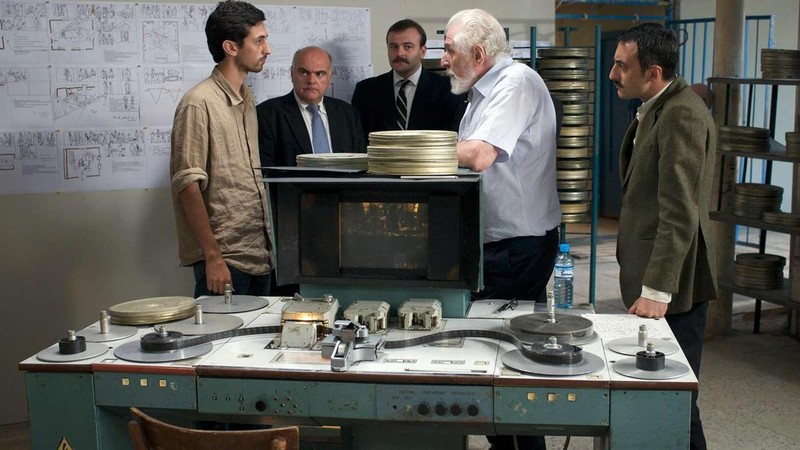
USSR, 1950’s. Nicolas is an idealistic film director who’s struggling against all odds to get his films made: He confronts the Soviet regime, seeks exile in France and ends up working in a zoo… Chantrapas is an ironic look at filmmaking and at the political and economic obstacles one must overcome in order to make films. It’s a tender homage to an era that’s long gone (or is it?) and to the tangible means that make filmmaking possible: editing consoles, 35mm negative film, the script’s pages… This charming satire is loosely based on the director’s own personal experience. Georgian native Otar Iosseliani is already a classic. His films were banned in the USSR and he was forced to emigrate to France in the early 1980’s. In this film, he declares his love of filmmaking above and beyond all the obstacles along the way. In spite of everything, Iosseliani affirms that, “film is a delightful fair.” –Garbiñe Ortega, 4+1 Film Festival
Otar Iosseliani was born in Tbilisi, Republic of Georgia, where he studied at the State Conservatory and graduated in 1952 with a diploma in composition, conducting and piano. In 1953 he went to Moscow to study at the faculty of mathematics, but in two years he quit and entered the State Film Institute (VGIK) where his teachers were Alexander Dovzhenko and Mikhail Chiaureli. While still a student, he began working at the Gruziafilm studios in Tbilisi, first as an assistant director and then as an editor of documentaries. In 1958 he directed his first short film Akvarel. In 1961 he graduated from VGIK with a diploma in film direction. When his medium-length film Aprili (1961) was denied theatrical distribution, Iosseliani abandoned filmmaking and in 1963-1965 worked first as a sailor on a fishing boat and then at the Rustavi metallurgical factory. Aprili was finally released only in 1972. In 1966 he directed his first feature film Giorgobistve that… read more
"Welcome to the private, whimsical world of Otar Iosseliani," begins Dan Fainaru in Screen. "Access permitted only for those who share
Above: Léa Tissier in Young Girls in Black. Of Gods and Men (Xavier Beauvois, France) With Beauvois’ inspired, sober film, one of the growers