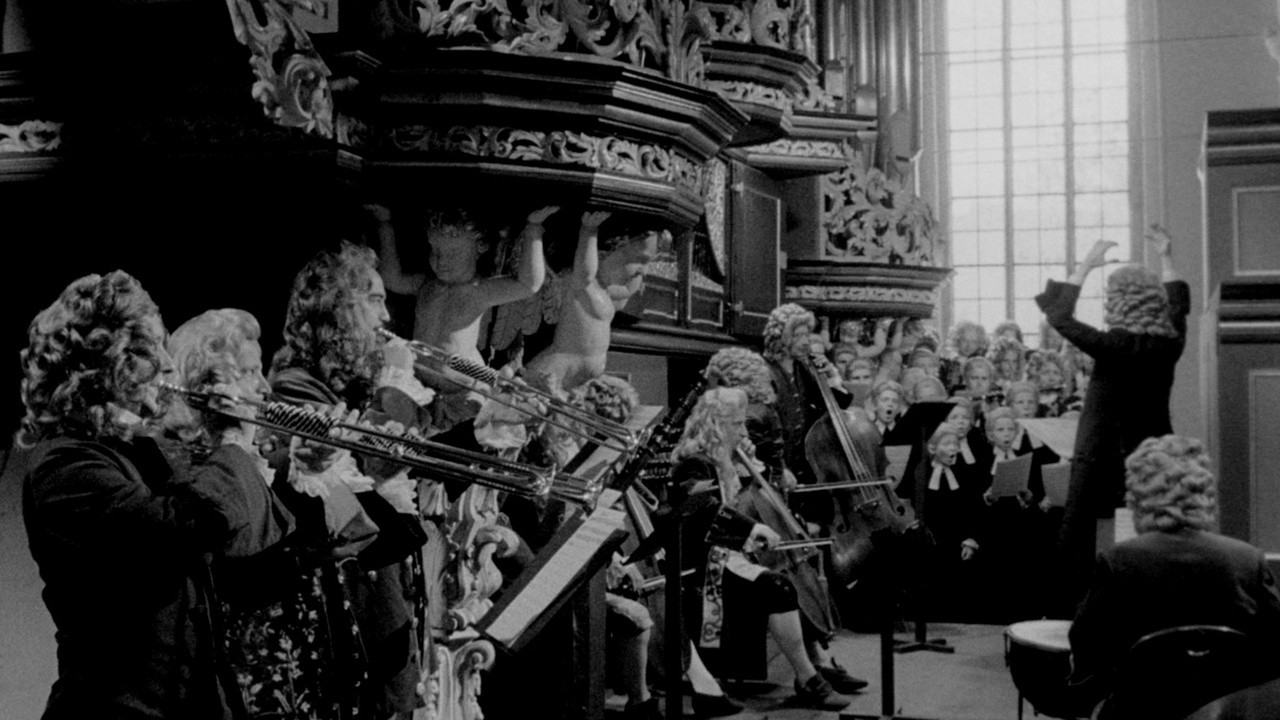
Anna Magdalena, the second wife of Johann Sebastian Bach relates: “He was a conductor, director of the chamber musicians at the court of Anhalt-Cöthen. My father was court and field trumpeter in Weissenfels, and my brother was a trumpeter in Anhalt-Zerbst where I had sung a few times, at the director’s discretion, with the orchestra. And soon I was engaged as a singer at the princely court of Anhalt-Cöthen. His wife had died the year before and, from this marriage, three sons and one daughter were still alive: Catharina Dorothea, Wilhelm Friedemann, Carl Philipp Emanuel and Johann Gottfried Bernhard. Father had began working on a little book for the piano for Friedemann in which, besides other exercises, two special opuses were added for the benefit of studious, musical young people. Soon he started on a small book for piano for me too. He worked under a graceful prince, who loved and was well versed in music, presuming he would be able to spend his lifetime at his court. However, this Serenissimus perchanced to marry a princess from Berenburg and as his inclination for music appeared to be growing lukewarm, especially since the new princess did not seem interested in the arts; God arranged for him to be appointed ‘Directore Musices’ and ‘’Cantor’ at the Thomas School in Leipzig." –Berlinale
Daniele Huillet was a German filmmaker best known for her close collaboration, so close that it is often uncredited, with Modernist director Jean-Marie Straub. According to Huillet, she is mainly in charge of sound and editing while her partner deals with camera work, but she also assists with script-writing and directing. The films of Huillet and Straub are usually based on and offer historical insight into high German literature or music. Films such as Chronik der Anna Magdalena Bach (1968) tend to be so intellectually demanding that they are rarely seen commercially, and are primarily to be found on the international festival circuits. Many of their works also tend to make strong political statements such as their examination of the Israeli-Palestinian conflict Fortini (1976).
(From http://www.allmovie.com/cg/avg.dll?p=avg&sql=2:95128)
Filmmaker Jean-Marie Straub and Daniele Huillet, his wife and co-director, have become leading figures in New German cinema. Their films are not for passive viewers seeking light entertainment; films such as Not Reconciled or Only Violence Helps Where Violence Rules (1965) are intellectually demanding, and yet are among the most haunting films of German cinema. Prior to teaming up with Huillet, the French born Straub worked as an assistant to French directors such as Abel Gance, Jean Renoir, and Robert Bresson. He met and teamed up with Huillet in 1954. To avoid the draft, he fled to Munich, Germany in 1958 where they got involved with radical theater groups. By the early sixties he and his wife had become a prominent directors. They made their debut with the short Machorka-Muff in 1963. In 1968, their long-time friend Fassbinder appeared in The Bridegroom, the Comedienne and the Pimp. Straub and Huillet’s most famous film is Chronicle of Anna Magdalena Bach (1968). By the late ’60s… read more
...life are petty ramifications, impersonal digits to be recorded by anonymous bookkeeping. Seeing this unshattered faith in music, one thinks either of Job or of the musician from Quignard's "Tous les matins du monde". In an effort to redeem life with all its tragic failures, Bach`s music is an arduous plea and a chant of glory, a heretical devotion to form and a recognition of human submissian to divinity. Awesome!
A huge disappointment for those who seek the explanation of major artistic achievement in the socio-political environment of an age, this beautiful film about music situates its vantage point in the epicentre of Bach`s life: music. Wordless majesty is left to speak alone, with occasional interstices of speech. The shift of perspective is uncompromising: music is the grand watercourse of existence, while events of...
This is being released on February 22 by New Wave Film, which I guess is connected to Artificial Eye. It's coming with Sicilia and another film for about 20 U.S. dollars. A big score for those of us who were just about to pluck down 70 or 80 bucks for the out of print New Yorker disc of this single film on Amazon.
Jacques Rancière, Philippe Lafosse and the public in conversation about Straub-Huillet after a screening of their films.
When considering the paucity of works by the filmmaking team of Danièle Huillet and Jean-Marie Straub available in the DVD format, it behooves
Artifice is a kind of death, and also a new form of life, as, of course, art is about life (as much as certain objects are about life’s
In this brilliant quasi-biopic, Huillet-Straub accomplish several feats: providing a structure of Bach’s life and work, displaying how Bach’s music developed over time, commenting on the family and… read review