MUBI brings you a great new film every day.  Start your 7-day free trial today!
Watch a new film every day for $4.99.
Try MUBI for FREE.
 

Citizen Kane

United States

1941

119 Min
Black and White
1.37:1
English
  • Currently 4.4/5 Stars.
  • 1
  • 2
  • 3
  • 4
  • 5

   |   

DIR Orson Welles

EXEC George Schaefer

PROD Orson Welles

SCR Herman J. Mankiewicz, Orson Welles

DP Gregg Toland

CAST Orson Welles, Joseph Cotten, Dorothy Comingore, Agnes Moorehead, Ruth Warrick, Ray Collins, Erskine Sanford, Everett Sloane, George Coulouris, Paul Stewart

ED Robert Wise

PROD DES Van Nest Polglase

MUSIC Bernard Herrmann

Berlinale (Retrospective)

Synopsis

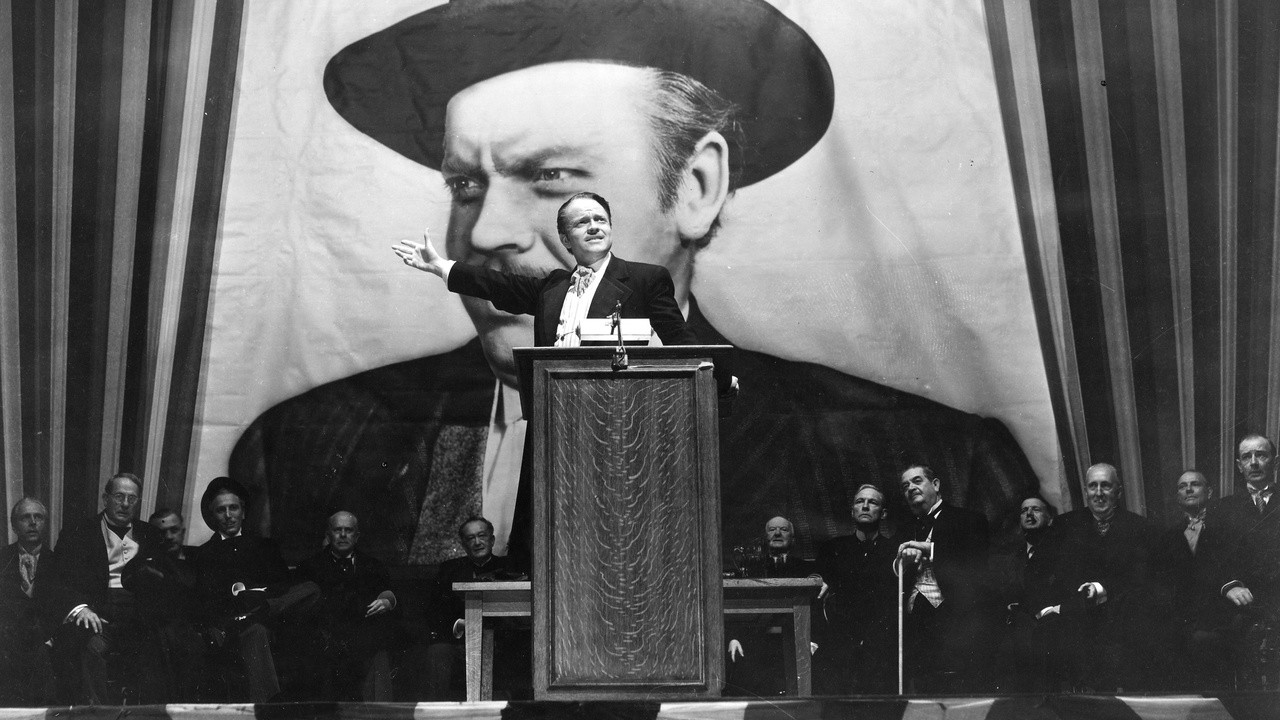
Seventy-year-old newspaper tycoon Charles Foster Kane dies in his palatial Florida home, Xanadu, after uttering the single word “Rosebud.” While watching a newsreel summarizing the years during which Kane built a dying newspaper into a major empire, married and divorced twice, ran unsuccessfully for governor and saw the collapse of his newspaper empire during the Depression, an editor decides they have not captured the essence of the controversial newspaperman and assigns reporter Jerry Thompson to discover the meaning of Kane’s last word.

Thompson first approaches Kane’s second wife, singer Susan Alexander, in the Atlantic City nightclub where she now performs. After the drunken Susan orders Thompson to leave, the accommodating bartender reports her claim that she had never heard of Rosebud. Next, Thompson reads the unpublished memoirs of Wall Street financier Walter Parks Thatcher, Kane’s guardian and trustee of the mining fortune left to Kane by his mother: Thatcher first meets young Kane in 1871 at his mother’s Colorado boardinghouse. Learning that she has become wealthy from mining shares left her by a former boarder, she is determined that her son will be reared and educated in the East. As young Charlie plays outside with his sled, Mrs. Kane hands over management of the mine’s returns to Thatcher, against her husband’s wishes, then grants the financier guardianship over her son. Despite the boy’s protests, he is sent away to live with Thatcher. When Kane turns twenty-five, he assumes control of the world’s sixth largest private fortune, and while professing disinterest in most of his holdings, writes Thatcher that he intends to run The Inquirer, a small, New York newspaper acquired through a foreclosure. He moves into the paper’s offices and with the help of his best friend, Jedidiah Leland, who acts as the drama critic, turns it into a lively, muckraking publication, which attacks slum landlords, swindlers and big business. In 1898, The Inquirer attempts to draw the United States into war with Spain. After the 1929 stock market crash, Kane relinquishes control of his empire to Thatcher’s syndicate. Thompson finishes his reading of Thatcher’s memoir without learning anything about Rosebud.

Thompson next questions Bernstein, formerly Kane’s general editor and now chairman of the board. Bernstein describes the early days of Kane’s tenure at The Inquirer: After Kane and Leland take over the publication in 1892, Kane prints a declaration of principles—that he will report the news honestly and will make the paper a champion of his readers’ rights as citizens and as human beings. Leland senses the document’s importance and keeps the handwritten declaration as a memorial. Six years later, when Kane acquires the top reporters from the rival paper, whose circulation The Inquirer has surpassed, Leland worries that Kane’s approach to the news will also resemble his rival’s. During this period, Kane begins to collect the European statues and furniture that will later crowd the rooms of Xanadu. On one European trip, Kane meets and becomes engaged to Emily Monroe Norton, the President’s niece, whom he marries in 1900. After relating these events, Bernstein suggests that Rosebud was probably something that Kane lost, perhaps a woman.

Taking Bernstein’s advice, Thompson visits Leland, a self-described “disagreeable old man,” in the hospital where he is living out his old age. Leland claims Kane believed in nothing except himself, but suggests that Kane’s story is about how he lost love because he had none to give: As Kane’s empire expands, his marriage to Emily deteriorates. One night in 1915, Kane encounters Susan as she is leaving a pharmacy after purchasing a toothache remedy. Susan innocently offers to let Kane, who has been spattered by mud from a passing carriage, use her apartment to clean up. Kane is at ease with Susan, who has no idea of his importance, and when he learns that her mother wanted her to become an opera singer, requests that she sing for him. In 1916, Kane runs for governor against corrupt political boss Jim Gettys. After a successful campaign speech, Emily sends their son home alone and asks Kane to accompany her to Susan’s boardinghouse, where they find Gettys with Susan. Gettys admits that he forced Susan to contact Emily and tells Kane that he will reveal their relationship unless he withdraws from the campaign. Despite the hurt that scandal will bring to his family and Susan, Kane refuses, convinced that he has the love of the electorate. He is mistaken, however, and loses the race. Leland accuses Kane of treating “the people” as if he owned them and asks to be transferred to The Inquirer‘s Chicago branch. After Emily divorces him, Kane marries Susan and in 1919, builds the Chicago Opera House for her. Susan’s voice is very poor, however, and her debut is met with ridicule, except by The Inquirer critics. When Kane finds Leland slumped over his typewriter in a drunken stupor after beginning an unfavorable review of Susan’s performance, he finishes the notice himself, retaining the negative viewpoint, but then fires his old friend.

Thompson now returns to Atlantic City to question Susan again. She insists that it was Kane’s idea that she have an operatic career and describes their tempestuous life together: During a noisy quarrel with Susan, Kane receives a special delivery from Leland, returning the $25,000 check Kane sent after firing him and including the handwritten copy of the declaration of principles, which Kane burns. When Susan begs to quit, Kane insists that he will be humiliated if she leaves the stage, and forces her to continue singing until she attempts suicide. Later, they retire to Xanadu, where a bored Susan spends her days working jigsaw puzzles. Finally fed up with his overbearing attempts to orchestrate her life, Susan reproaches Kane for trying to buy her affections with jewels and other material things. He slaps her in anger, and she leaves him. Her story finished, Susan sends Thompson to talk to Raymond, the butler at Xanadu. Thompson confesses to Susan that he feels sorry for Kane, and Susan admits that she does, too.

At Xanadu, Raymond agrees to speak with Thompson for a price, then relates the events following Susan’s departure: The furious Kane tears apart Susan’s room, until he comes across a small glass snow globe with a tiny cabin inside. Kane picks it up, murmurs “Rosebud” and leaves the room, seemingly unaware of the servants who surround him. Still as ignorant of the significance of Kane’s dying word as when he started, Thompson prepares to leave Xanadu with the other reporters and photographers. Passing through rooms where Kane’s possessions are being inventoried and crated, Thompson is now convinced that even if he had learned the meaning of Rosebud, it would not have explained the man. Unnoticed among the boxes and crates is an old child’s sled. As a workman throws the sled into a furnace, the word Rosebud, painted across the top, is consumed by the flames. —AFI

Director

Original

Orson Welles

The prodigy son of an inventor and a musician, Welles was well-versed in literature at an early age, particularly Shakespeare, and, through the unusual circumstances of his life (both of his parents died by the time he was 12, leaving him with an inheritance and not many family obligations), he found himself free to indulge his numerous interests, which included the theater. He was educated in private schools and traveled the world. He found it tougher to get onto the Broadway stage, and get a job with Katharine Cornell. He later became associated with John Houseman, and, together, the two of them set the New York theater afire during the 1930s with their work for the Federal Theatre Project, which led to the founding of the Mercury Theater. The Mercury Players later graduated to radio, and their 1938 “War of the Worlds” broadcast made history when thousands of listeners mistakenly believed aliens had landed on Earth. In 1940, Hollywood beckoned, and Welles and company went west to… read more

Wall

Displaying 4 of 153 wall posts.
Picture of Malik

Malik

6May13

http://idlermag.com/2011/08/02/kanes-gifts/

  • Picture of Malik

    Malik

    6May13

    “Orson Welles was always embarrassed by Rosebud. “It’s a gimmick, really,” he told interviewers, “and rather dollar book Freud.” The mystery of “the great man’s last words” was, like the reporter Thompson charged with solving it, “a piece of machinery” designed to lead the audience through the fragmented plot. The solution to the mystery is supposed to be that we, like Kane’s friends, lovers, and confidantes, discover that “the great man” is actually hollow inside. There is nothing there — no lost love, no moral truths, no imparted wisdom. “Rosebud” is just a missing piece in the jigsaw puzzle. It has no special value other than that it is missing. Kane the man, like Kane the film, is what Borges called it: a labyrinth without a center.”

Picture of Enquan Gu

Enquan Gu

28Apr13

Voltaire said Self love is a like a balloon inflated with wind.

Picture of Steve Pulaski

Steve Pulaski

15Apr13

If you haven't seen this film with the Roger Ebert commentary, you have a new priority. He knows more about one movie than I'll ever know about all of cinema.

Whyte Nite likes this

Picture of Aguaespejo

Aguaespejo

23Feb13

Though it isnt one of my favourite films, it *is* a 'poem unlimited' open to unending interpretation. After all there are 2 things one must judge: does a movie do what *it wants to do* well? (the aesthetic question) & do I like what it wants to do? (the ideological). Its useful to separate the two sometimes. I realize that this isnt about the film but after all the ink that has been spilled about it what more to say?

Related Films

Fans

Displaying 5 of 11251 fans.

Articles

Our roundup of essays and articles on this film.
W184

The Noteworthy: Scorsese on "The Searchers", Film Criticism: The Next Generation, Orson Welles’ Sketch Book

By Adam Cook on March 13, 2013

A couple of crowd-funding projects to check out, new trailers from Baumbach, Coppola, Malick and Whedon, Orson Welles’ Sketch Book & more.

read article
W184

Sight & Sound's "Greatest Films of All Time"

By Notebook on August 3, 2012

The British magazine unveils the results of their 2012 poll of the greatest films of all time.

read article
W184

Daily Briefing. TSPDT updates its top 1000

By David Hudson on January 8, 2012

Also: Malick, Ozu, Robert Kramer and more lists and awards.

read article
W184

Image of the day. Orson Welles in "The Adventures of Tintin"

By Daniel Kasman on December 23, 2011

A joshing jab at the great auteur in the English adaptation of Red Rackham’s Treasure.

read article
W184

The Complete "Vertigo Variations"

By Daniel Kasman on December 16, 2011

One of 2011’s best films: a feature length, hugely ambitious video essay on the mysteries of Alfred Hitchcock’s Vertigo.

read article
W184

Obsessions: Nine Notes Regarding the Music of Bernard Herrmann

By Paul Clipson on October 30, 2011

A selection of the great composer’s most interesting music cues, in honor of his centennial.

read article
W184

Bernard Herrmann @ Film Forum

By David Hudson on October 21, 2011

The Bernard Herrmann centennial is the occasion for a two-week, 22-film retrospective.

read article
W184

Daily Briefing. Chris Fujiwara is Edinburgh's New Artistic Director

By David Hudson on September 14, 2011

Also: Michael Sragow semi-retires, ohn Calley dies and Slate binges on Welles and Soderbergh.

read article
W184

The Forgotten: Hitler, Dead or Alive

By David Cairns on June 15, 2011

You know about in-betweeners? They're the people who, in classical studio animation, draw the characters in between the key poses. The key

read article
W184

"Citizen Kane" @ 70

By David Hudson on May 4, 2011

Updated through 5/5. "It storms after us down the corridors of history like its own hero. Bloated, grotesque, tremendous; destroying as it

read article
W184

Senses of Cinema 57, Lists, More

By David Hudson on December 19, 2010

Editor Ronald Caputo notes that many of the articles appearing in the new issue of Senses of Cinema were first presented as papers at the Cinema

read article
W184

Obsessive / Compulsive: "The Social Network" (David Fincher, USA)

By Ignatiy Vishnevetsky on September 20, 2010

An immaculate realization of clichés, a multi-billion-dollar lawsuit transmuted into a low-stakes male weepie, a bunch of college-movie

read article
W184

Frantisek Vlácil, B Kite on Welles, "My Dog Tulip," More

By David Hudson on August 31, 2010

Frantisek Vlácil, B Kite on Welles, “My Dog Tulip,” More

read article
W184

Topics/Questions/Exercises Of The Week—30 April 2010 (Special Blu-ray Preservation/Restoration Edition)

By Glenn Kenny on April 29, 2010

The Warner Home Video restoration of David Lean's 1965 epic Doctor Zhivago is a thrill to behold in the high-definition Blu-ray format. So

read article
W184

Topics/Questions/Exercises Of The Week—20 November 2009

By Glenn Kenny on November 19, 2009

Lot of Awards: Okay, now I'm getting confused. Who was it that said "Who gives a f**k about a goddamned Grammy"? Of course it was Public

read article
W184

Exhibits from the C.F. Kane Museum

By Notebook on May 31, 2009

Directed by B. Kite  The Auteurs is proud to present for a limited time the first two installments of American: Exhibits from the C.F

read article
W184

Film Canons

By Pacze Moj on November 2, 2008

In the September 2006 issue of Film Comment, writer-director-critic Paul Schrader wrote a 16-page history/defense of film canons that ended

read article

Lists

Displaying 5 of 1136 lists.

Reviews

Displaying 4 of 14

O filme que não queriam que fosse.

By João Pedro Tomás on December 28, 2012

O filme que não queriam que fosse.

Para começar, gostava de introduzir esta pequena formalidade que é a classificação deste filme. O MUNDO A SEUS PÉS não é para mim um dos melhores…  read review

The mark of Kane

By Musycks on September 29, 2012

Orson Welles had built such a reputation as the master of the entertainment mediums of stage and radio in the late 1930’s, that when he turned his ambitions to film RKO gave him the keys to the lolly…  read review

Great Technique, Sad Story

By Byron Brubake​r on August 31, 2012

I’ve been reading quite a bit about this movie in excerpts collected in Roger Ebert’s Book of Film. When I first saw this just out of high school, the story didn’t capture me and I had barely seen…  read review

Citizen Kane

By Adam Suraf on September 17, 2011
Like ‘Sgt. Pepper’s’, “The Great Gatsby”, “The Simpsons”, and the 1927 New York Yankees, there’s “Citizen Kane”, and there’s everything else. 25-year-old Orson Welles stormed Hollywood from Broadway…

Forum

Displaying 8 of 13 discussion topics.

Something I believe you Mubians will appreciate

97 posts by 31 people 4 months ago

Citizen Kane blu-ray...

8 posts by 6 people over 1 year ago

Orson Welles's unmade film on the life of Christ

6 posts by 5 people almost 2 years ago

Greatest Film Ever Made

42 posts by 22 people about 2 years ago

CITIZEN KANE AT 70

2 posts by 2 people about 2 years ago

Sincere Q: What makes Citizen Kane great?

46 posts by 30 people about 2 years ago