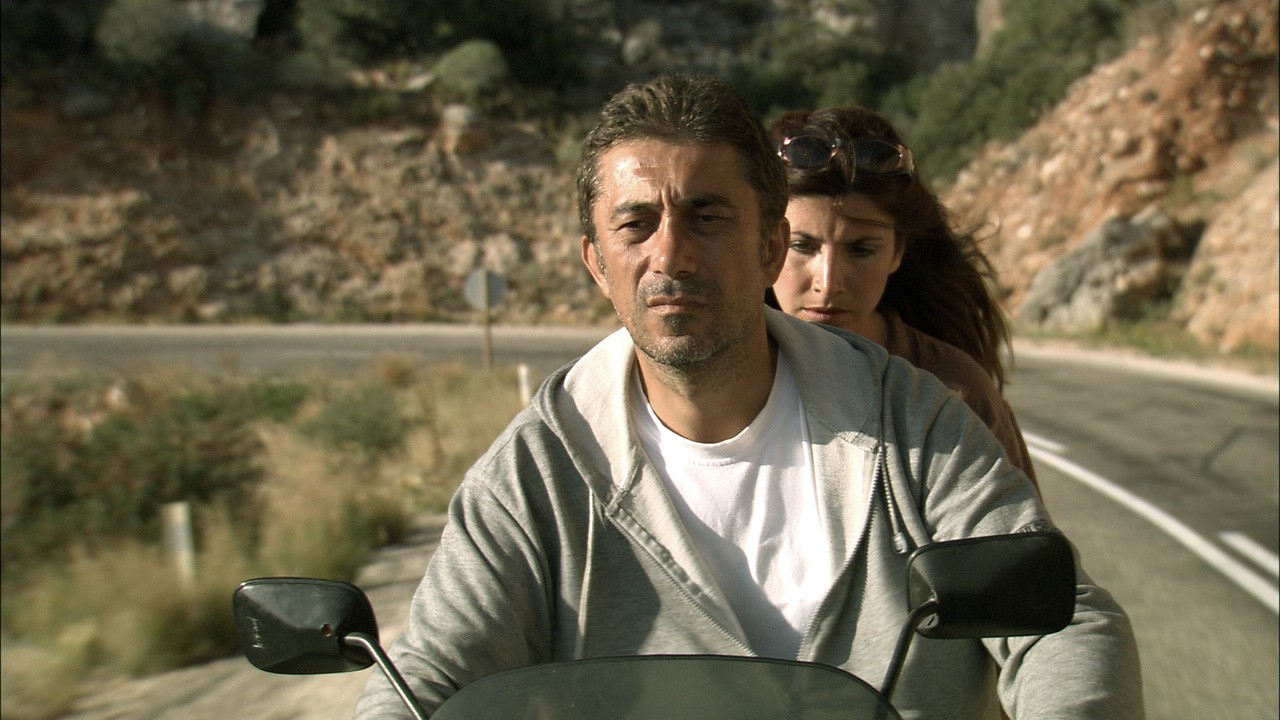
Climates (Ikimler) is internationally acclaimed writer-director Nuri Bilge Ceylan’s sublime follow-up to his Cannes multi-award winner Distant. Beautifully drawn and meticulously observed, the film vividly recalls the cinema of Italian master Michelangelo Antonioni with its poetic use of landscape and the incisive, exquisitely visual rendering of loneliness, loss and the often-elusive nature of happiness. During a sweltering summer vacation on the Aegean coast, the relationship between middle-aged professor Isa (played by Ceylan himself) and his younger, television producer girlfriend Bahar (the luminous Ebru Ceylan, Ceylan’s real-life wife) brutally implodes. Back in Istanbul that fall, Isa rekindles a torrid affair with a previous lover. But when he learns that Bahar has left the city for a job in the snowy East, he follows her there to win her back. Boasting subtly powerful performances, heart-stoppingly stunning cinematography (Ceylan’s first work in high definition) and densely textured sound design, Climates is the Turkish filmmaker’s most gorgeous rumination yet on the fragility and complexity of human relationships.
Nuri Bilge Ceylan (born 26 January 1959 in Istanbul) is a Turkish photographer and film director. He is married to the filmmaker, photographer, and actress Ebru Ceylan, his co-star in İklimler.
Ceylan learned photography at age 15, and developed an interest in film at 22. After graduating from Boğaziçi University with a BSc degree in Electrical and Electronics Engineering, he went on with his studies on cinema for two years at Mimar Sinan University.
Ceylan’s first short film Koza (Cocoon) was screened in the Cannes Film Festival in 1995. He received many awards with his debut feature Kasaba (Small Town). His third feature Uzak (Distant) received many awards including the Grand Jury Prize and the Best Actor Prize at Cannes, and was praised internationally. His 2006 film Iklimler (Climates) won the FIPRESCI Movie Critics’ Award at the 2006 Cannes Film Festival and received international praise by critics and experts. The film won 5 awards at the 2006 Antalya Golden Orange… read more
Ceylan’s talent with visuals is clear, but I’ve yet to see a film of his that is great. This reveals that, paradoxically, trying to make a work as realistic as possible can lead to it become artificial. The moments that stand are the odd ones - Ceylan's habit of using bedside cabinet drawers as headrests, the sight of a peanut (?) on a floor – that are strange enough to feel far more real than the story.
Coloristically, these climates move from greys that shimmer and veil to blizzards of white-out that erase, or revive the glamour of, nebulous connections between fragile selves uncertain of what but not that they desire. Typical touchstones for the hushed, charged relations between Ceylan's characters, his meticulous mise-en-scene, and his penchant for artful gloom are Tarkovsky and Antonioni. I see Tarr's Damnation.
The word “masterpiece” is dropped pretty often this time around — but not lightly.
For a filmmaker of such particular aesthetic sensibilities, Nuri Bilge Ceylan has been compared to a surprising range of directors over the
J’aime énormément les films où le silence est quasi total. J’aime aussi quand les plans s’attardent sur les personnages pour tenter de retranscrire au mieux les émotions. J’aime encore plus quand l’esthétisme… read review
Climates isn’t really a movie in the normal sense. There’s less a plot arc than a succession of incidences, and we’re given next to nothing to go by for the characters. With few specifics, what we… read review
Here’s a tip: if you want to make an interesting, absorbing movie, make sure you have more than five minutes of story stretched out to a tedious hour and a half. Ceylan’s film, while a gorgeous collection… read review
Ceylan won me over with his amazing landscape shots — his photography has an amazing affect on this, his first HD film. The shots in the east, when he is standing at a railing with a winter landscape… read review