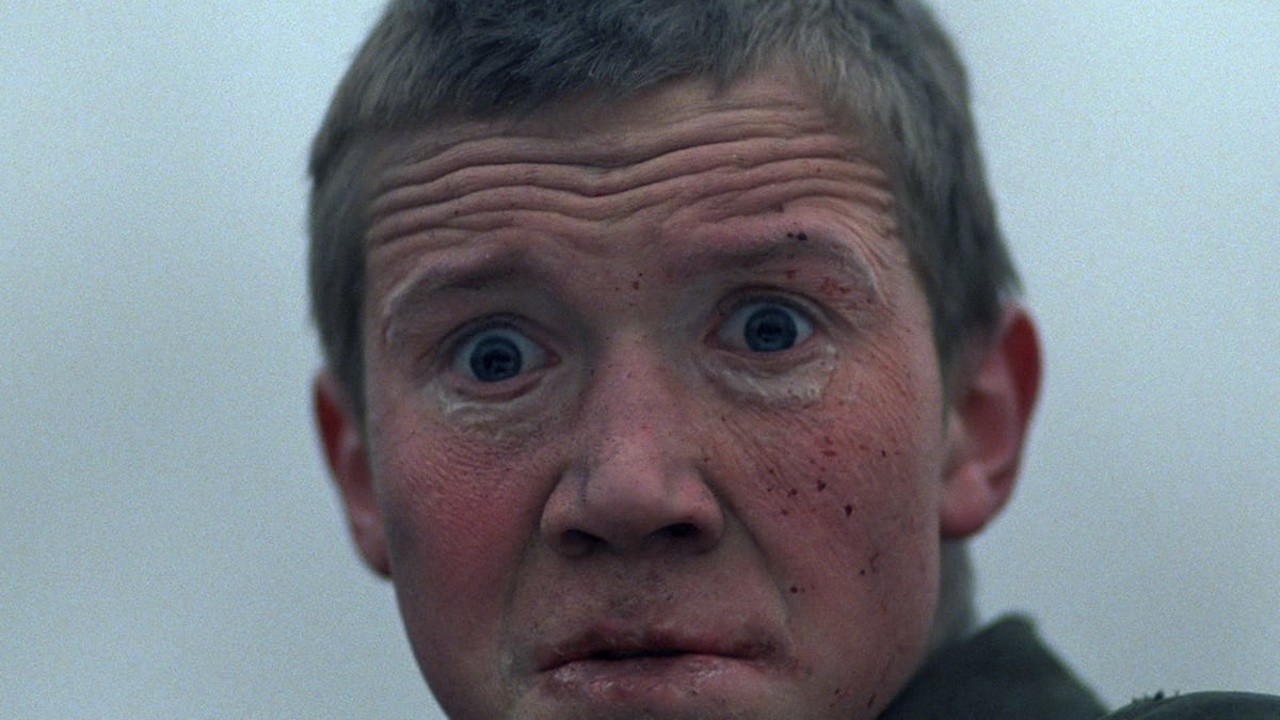
A crowning achievement of 1980’s Soviet cinema, Elem Klimov’s Come And See is perhaps the ultimate WW II film. This savage and lyrical fever dream of death, rage and terror experienced through young eyes is a virtual primer for the subsequent, similarly psychedelic intensity of Terrence Malick’s The Thin Red Line and Spielberg’s Saving Private Ryan. Klimov’s elegant, harrowing union of unflinching ferocity and dreamlike clarity moved Empire Of The Sun author J. G. Ballard to declare Come And See the greatest war film ever made. Time Out New York agreed, saying “Come And See’s nimble balance of the sordid with the elegiac makes Peckinpah’s Cross Of Iron seem like Newsies.”
When young Florya willingly joins a group of Partisans fighting the Nazis in Byelorussia, U.S.S.R., he little suspects that he is plunging through the looking glass. Separated from his comrades during a paratroop attack and struck deaf by German artillery, Florya – in the company of Glascha, a beguiling peasant girl – wanders a battle-scorched Russian purgatory of prehistoric forests and man-made slaughter. Florya’s journey takes him and us through a gallery of exquisitely poetic imagery and brutal human atrocity.
Unlike traditional war films, Come And See never stoops to convenient heroic catharsis or genre movie narrative symmetry. Images of a beautiful girl’s impromptu dance in the rain and an SS unit’s spontaneous, self-congratulatory applause at their own butchery haunt with equal power. More than any other war film, Come And See unites the powerful truths and inescapable dilemmas that lurk behind both the raptures of youth and the horrors of war. —KINO
Former first secretary of the Soviet Filmmakers’ Union Elem Klimov was a graduate of the All-Russian State Institute of Cinematography, where he studied under Efim Dzigan. Over the course of his long career he made just five films, the most famous being the classic World War II film Come and See. Come and See was in many ways informed by Klimov’s childhood experiences; during the battle of Stalingrad Klimov’s family was evacuated by raft on the Volga. At the 1985 Moscow Film Festival, Come and See won Klimov both the FIPRESCI Prize and the Golden Prize. In his personal life, Klimov was married to the film director Larissa Shepitko, who tragically died in a car crash in 1979. At the time of the crash, Shepitko was working on her film Farewell, which Klimov subsequently completed. Klimov’s films ranged from black comedies to historical epics. Later on in life, Klimov had plans to adapt Dostoevsky’s Demons, Bulgakov’s Master and Margarita and to make a film on Stalin. However, none of… read more
This film blew my mind - it's harrowing without being preachy, poetic without being flowery, pummeling without relying on cheap shock tactics. Can't recommend highly enough
Everybody has stolen images, scenes and framing from this movie, the most unmediated of films 'about' War, Nazism and childhood.
The First Part Andrzej Zulawski swings his camera like a steel fist. Indeed, right at the start of his first feature, The Third Part of the
When I finally got round to watching this film, was it worth the wait? YES! YES! YES! I could happily (in retrospect) have waited another few years before seeing it. I stayed awake to operate the fast… read review
I think Elem Klimov reached the full climax of cinematic revolution in making this film. Come and See stands with authority with the ability in hypnotizing me with its magical pendulum, it’s really… read review
http://travissaves.blogspot.com/2011/06/come-and-see-probably-one-of-most.html?spref=fb
I’ve never done drugs before in my life (outside of the legal drugs that keep my uncle’s kidney from rejecting… read review
Stunning.
One of those “war movies” that’s not really a war movie so much as a punch to the gut. No scenes of the tough sarge gathering his troops for one last heroic assault here. Instead… read review