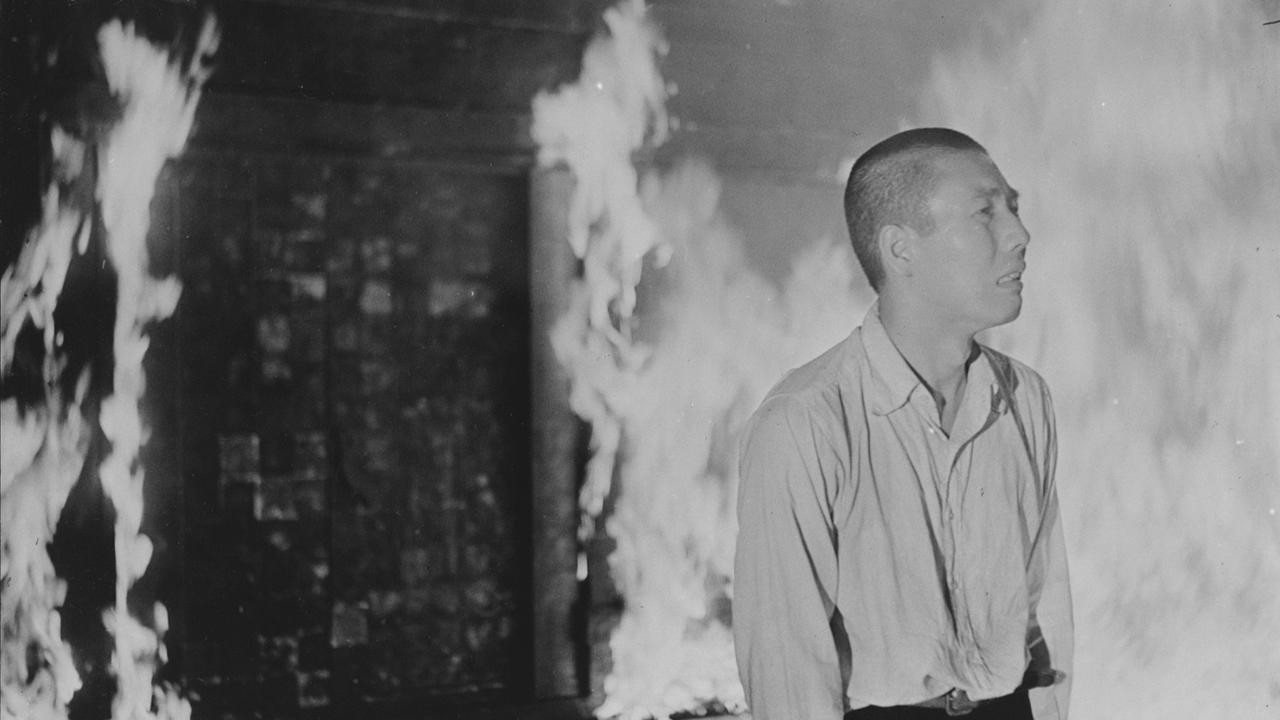
One of the most beautiful of all Japanese films, Conflagration is based on a best-selling novel by Yukio Mishima. “Ichikawa was Mishima’s favorite director,” James Quandt notes, “and from this adaptation, it is easy to see why.” Mishima based his story on an actual incident, the burning of Kyoto’s celebrated Golden Pavilion. A young man, Mizoguchi (Raizo Ichikawa), disgusted by his mother’s promiscuity and disenchanted with his weak father, becomes a Buddhist acolyte. But the obsessive, stuttering youth finds his temple school to be sullied by sexual hypocrisy. In despair, he deliberately sets fire to the temple, symbol of pure beauty, and a national treasure, causing a conflagration that for him is a holocaust. Ichikawa’s interpretation of Mishima’s already highly conceptual novel was profoundly original, using Toshiro Mayuzumi’s avant-garde music and Kazuo Miyagawa’s “architectonic” widescreen cinematography to chilling effect. Donald Richie noted, “The textures captured in black and white were-even for Japan-beyond comparison.” —BAM/PFA
Born on November 20, 1915, in Ujiyamada, Mie Prefecture, Ichikawa first gained western recognition during the 1950s and 60s with several bleak films, particularly two acclaimed antiwar films, The Burmese Harp and Fires on the Plain.
Ichikawa began his career as a cartoonist, and collaborated with his wife, screenwriter Natto WADA, until 1965. His films are generally regarded as dark and bleak, interspersed with sparks of humanity, and he often intertwines comedy and tragedy within the same story. He also has a flair for technical expertise, irony, detachment, and a drive for realism across all genres. After Akira KUROSAWA’s departure, no other Japanese director has come close to Ichikawa’s level of recognition, the power of his films, and commercial success.
Ichikawa passed away on February 13, 2008. At age 91 (2006), he was still active as a director, completing a feature-length film, The Inugamis, and directing one segment of the Japanese fantasy, Ten Nights of Dream… read more
I recently re-read Mishima's The Temple of the Golden Pavilion and figured it would also make a good oppurtunity to revisit the movie. Ichikawa has taken Mishima's dense, philosophical novel and streamlined it. While I'm not big into comparing the book to the movie, I will say the movie is more enjoyable. It may not be as psychologically complex as the novel, and I found myself missing the bizarre psychosexual sequences, but it's constructed in a far more theatrical manner. Ichikawa as always had a flair for the cinematic, and there are some brilliant sequences; the actual burning of the temple ranking as one of my favorite set pieces in the cinema. And the scene where Kashiwagi is introduced, with the camera following his awkward dance of a walk, you can feel the heaviness pressing down on you. On a side note, I'm perplexed why the movie starts out declaring it not to be based off a true story, when everyone knew that it was.
A gallery of human obsession and pain, the story is very typical of Mishima's yearning for perfection and the disilluionment with impossible ideals that leads -either directly or indirectly- to catastrophe. Beautifully made by Ichikawa, utilising Toshiro Mayazumi's music and grandmaster Kazuo Miyagawa's cinematography to great effect.
A troubled young man training to be a Buddhist priest becomes disillusioned and sets fire to a sacred temple... Based on a novel by Yukio Mishima who later committed seppuku and was the subject of a biographical film by Paul Schrader, Ichikawa's drama also possesses some typically majestic cinematography from Master Director of Photography Kazuo Miyagawa and features soon-to-be superstar Tatsuya Nakadai in support...