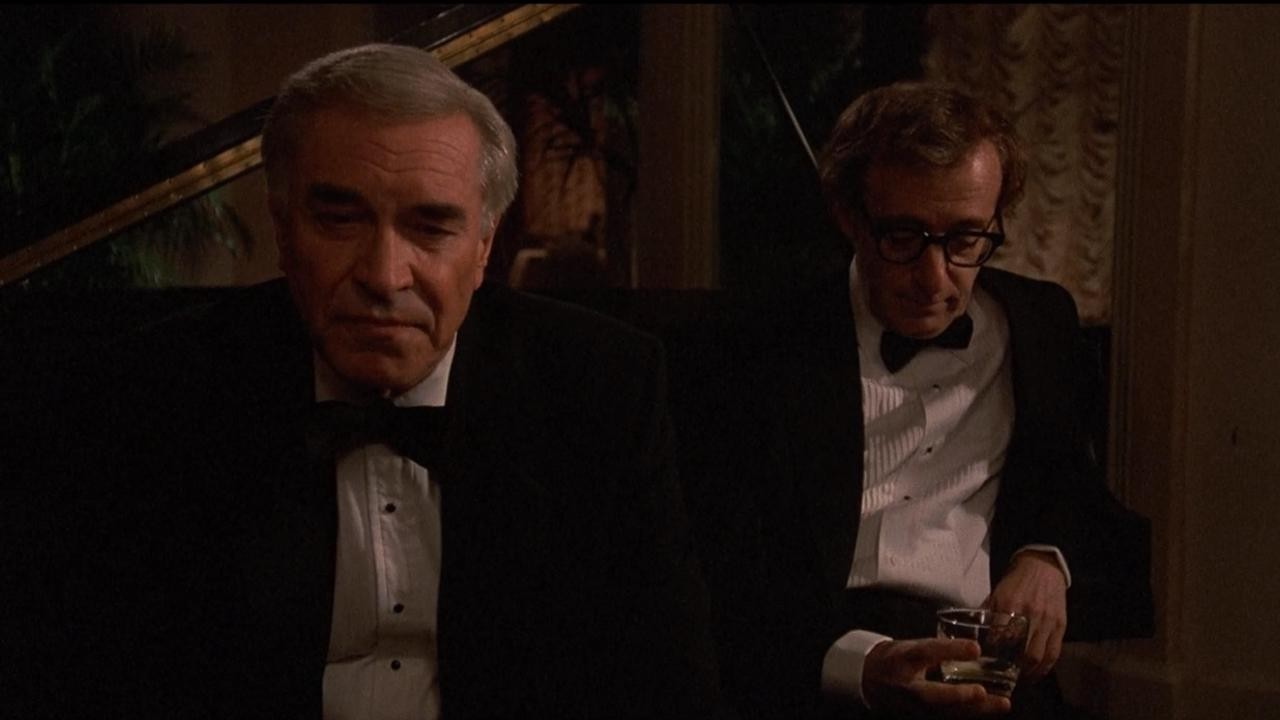
Opthalmologist Judah Rosenthal has had an affair with Dolores for several years, and now she threatens to ruin his life if he doesn’t marry her. When his brother Jack suggests to have Dolores murdered, Judah is faced with a big moral dilemma: destruction of his life or murder. Meanwhile, documentary filmmaker Clifford Stern is trying to make a film of a philosophy professor, but instead he’s commissioned to make a portrait of succesful TV producer and brother-in-law Lester, who to Clifford represents everything that he despises. –IMDb
Actor, director, screenwriter, and playwright Woody Allen redefined film comedy during the 1970s, bringing a new measure of sophistication and personal complexity to the form. Born Allen Stewart Konigsberg in Brooklyn, NY, on December 1, 1935, he adopted his stage name at the age of 17, and in 1953 enrolled in NYU’s film program, and soon dropping out of school to begin writing for comedian David Alber. Two years later, Allen graduated to writing for television; during his five-year in television, his efforts won him an Emmy nomination. He eventually decided to try his hand as a stand-up performer. After slowly gaining a reputation on the New York-club circuit, he became a frequent talk show guest and in 1964 issued his self-titled debut comedy LP. With 1966’s What’s Up, Tiger Lily?, a puckish re-tooling of a Japanese spy thriller complete with his own story line and dubbed English dialogue, he made his directorial debut. In 1969 Allen directed two short films for a CBS television special… read more
One of the best movies I've ever seen, best of the 80's, best of all time, and one of the best of whatever else. A movie about how unfair life is, how dark it is, how absurd it is, how evil it is, and how God sometimes turns his back on it and lets it all happen. Obviously taking inspiration from Bergman here (as always), Woody Allen makes it his own; giving us a thought provoking, funny, and dramatic masterpiece.
O ser humano define-se pelas decisões que toma, pelas escolhas que faz, ao longo da sua vida - as consequências são, na maior parte das vezes, irremediáveis. Mas são nossas.
The most Dostoevskian of Allen's films. Brilliant & darkly written, with a comedically bleak outlook on the way this world turns and how we decide for ourselves how to realize and rationalize our actions. Blended in with the script are Allen's typical mainstay characters and cinematic references in the form of movie theater screens. Also, his constant homage to Bergman becomes a reality by having Sven Nykvist as DOP.
Foi em uma entrevista concedida à Revista Time, em 2008, que Woody Allen não só desconstruiu sua persona neurótica frente ao entrevistador, que lhe disparou 10 perguntas diretas, mas, quando perguntado… read review
A relatividade de valores morais é a principal questão sobre a qual Allen se debruça enquanto cobre, com absoluto controle, duas vertentes da trama – uma cômica e outra trágica, temperadas com pitadas… read review
I loved the juxtaposition between the separate stories, each with its moral dilemma. A murder in one, infidelity in the other. I noticed how Woody Allen used his camera to draw the audience into… read review
I must say that despite the fact that I’ve been very fond of Woody Allen’s work for a long time I hadn’t watched this exceptional movie until a couple weeks ago when I found it while buying other movies… read review