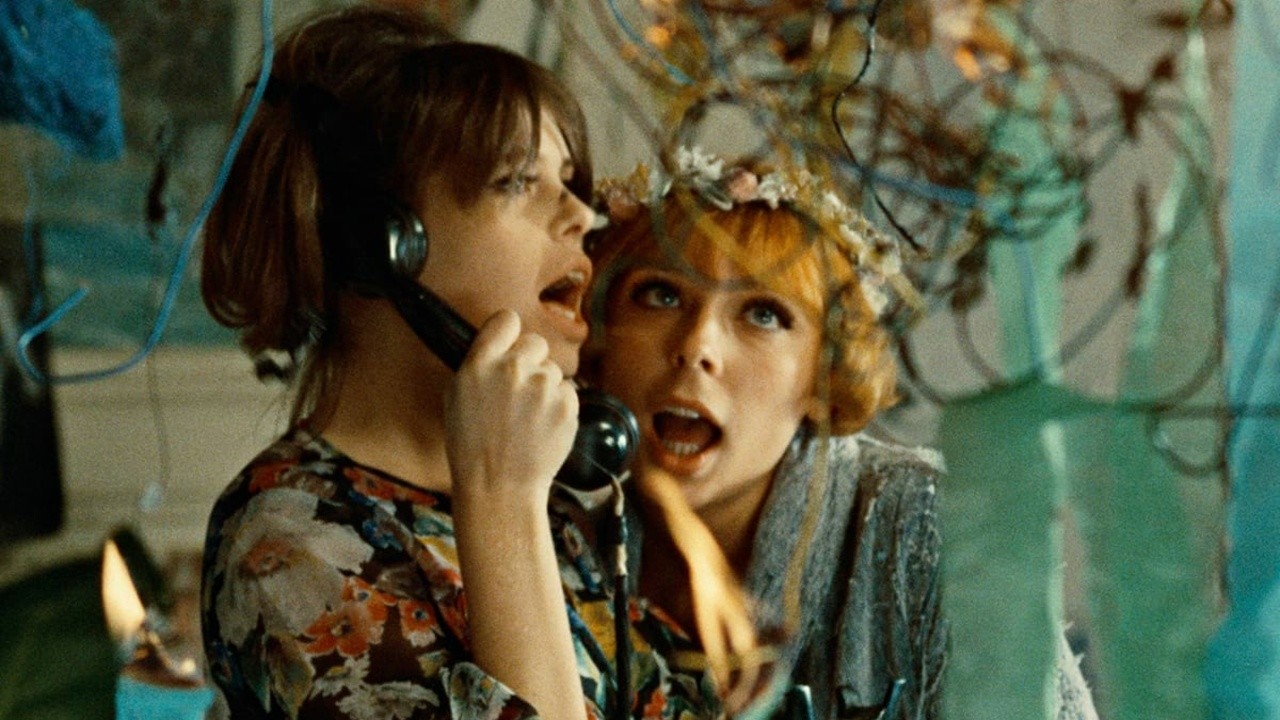
Perhaps the New Wave’s most anarchic entry, Věra Chytilová’s absurdist farce follows the slapstick misadventures of two brash young women, known only as Marie I and Marie II. Believing the world to be “spoiled,” they decide to spoil themselves as well, and embark on a series of disorderly, prankish escapades in which nothing—food, clothes, men, war—is sacred. Daisies is an aesthetically and politically adventurous film that’s widely considered one of the great works of feminist cinema. –The Criterion Collection
Vera Chytilová was born on February 2, 1929, in Ostrava, Czechoslovakia (now Czech Republic). She studied philosophy and architecture in Brno for two years, then worked as a technical draftsman, a designer, a fashion model, a photo re-toucher, then worked as a clapper girl for Barrandov Film Studios in Prague. There she continued as a writer, actress, and assistant director.
She was denied a scholarship, or even a recommendation from Barrandov, but she took the admissions tests at FAMU and was accepted. From 1957-1962 she studied film directing under Otakar Vávra, who also taught Jirí Menzel, Milos Forman, Jan Nemec, and Ivan Passer. In 1962 she graduated as director from Film Academy (FAMU) in Prague. Her graduation film Strop (Ceiling 1962) and the following film Pytel blech (A Bagful of Fleas 1963) were “staged” improvisations with non-actors. In 1966 Chytilova and her husband, Jaroslav Kucera, made a witty surrealist comedy Sedmikrásky… read more
What, you've never seen Vera Chytilova's 1966 Daisies, a touchstone of the Czech New Wave that could perhaps best be described as a feminist
Before I talk about the film itself, I should probably talk briefly about the Czech New Wave since the mood of this era provides the feeling and energy for this production.
For almost the entire… read review