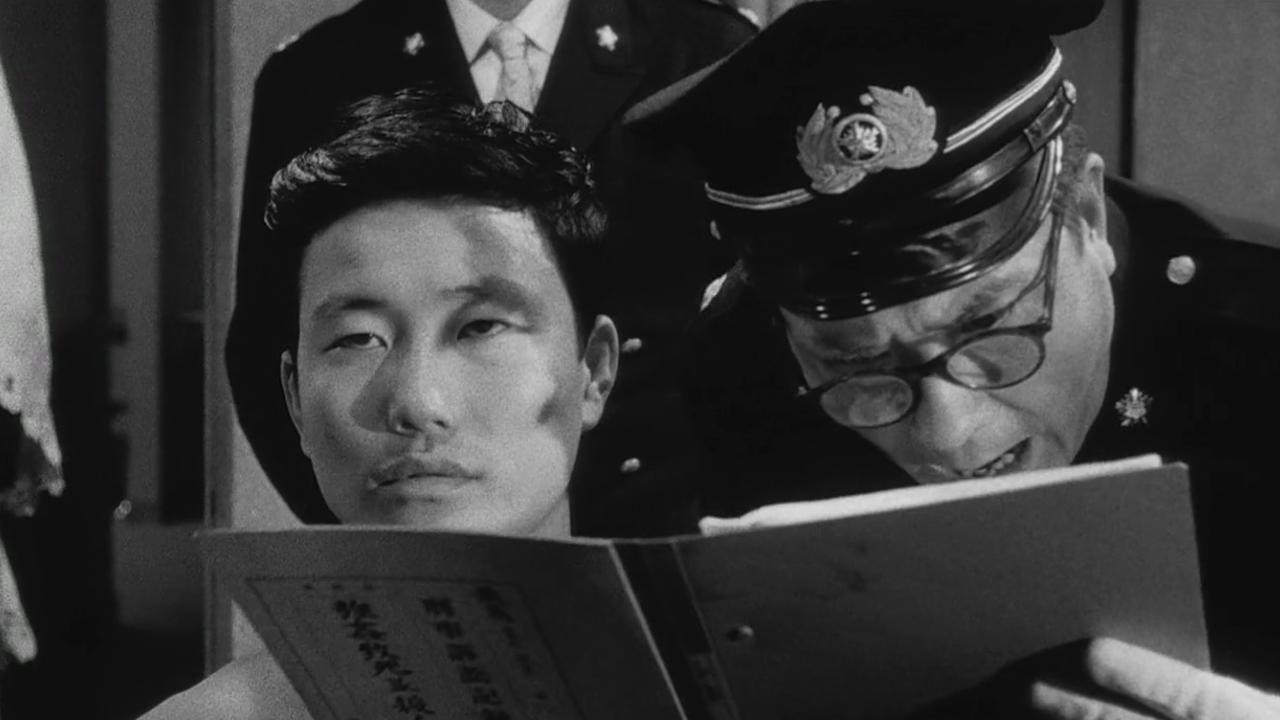
A clinically presented series of stark white, unembellished placards illustrates the sobering statistical data for the overwhelming public sentiment against the abolition of the death penalty as an off-screen narrator (Nagisa Oshima) provides a snide, but impassioned rebuttal to popular opinion by presenting a objective documentary of the austere and impersonal milieu associated with the methodical process of carrying out a state execution through the specific example of the appointed hanging of a convicted rapist and murderer known only as ‘R’ (Do-yun Yu): an empty, minimalist sitting room that provides an illusive, parting glimpse of a semblance of home for the condemned prisoner as he makes his way into the execution room, an assembly of unnamed official guests waiting in a segregated viewing room to witness the macabre ceremony, a procedural rehearsal of the chamber’s fail-safe sequence as the prisoner is blindfold and fitted with a noose, the actuation of trap door, the median measured time of 18 minutes before the heart completely stops and a staff physician (Rokko Toura) is able to record the official time of death. However, the seemingly predictable execution script fails to correlate as expected, as the doctor continues to detect R’s breathing for several minutes beyond the expected point of expiration. The unexpected development shifts the film’s tone from observant polemic to wry, dark comedy as the guards – eager to disavow any culpability that may have led to the malfunction – are thrown into helpless confusion on how to proceed with the seemingly half-dead hanged man in order to complete their assigned task. Imploring the doctor to promptly resuscitate R as an ironic humane gesture so that he can regain consciousness before being put to death again (and therefore, have an awareness of his guilt), the guards soon realize that the trauma of the failed execution has resulted in the prisoner’s amnesia. Acting on the advice of the education officer (Fumio Watanabe), the officials begin to re-enact episodes from the trial transcripts before an impassive and oblivious R in order to trigger his memory, revealing a more insidious and pervasive cultural malaise that cannot be set right by the empty gestures of inequitable justice. —Filmref.com
Nagisa Oshima’s career extends from the initiation of the “Nuberu bagu” (New Wave) movement in Japanese cinema in the late 1950s and early 1960s, to the contemporary use of cinema and television to express paradoxes in modern society. After an early involvement with the student protest movement in Kyoto, Oshima rose rapidly in the Shochiku company from the status of apprentice in 1954 to that of director. By 1960, he had grown disillusioned with the traditional studio production policies and broke away from Shochiku to form his own independent production company, Sozosha, in 1965. With other Japanese New Wave filmmakers like Masahiro Shinoda, Shohei Imamura and Yoshishige Yoshida, Oshima reacted against the humanistic style and subject matter of directors like Yasujiro Ozu, Kenji Mizoguchi and Akira Kurosawa, as well as against established left-wing political movements. Oshima has been primarily concerned with depicting the contradictions and tensions of postwar Japanese society. His… read more
Rewatch: The first hour is a masterpiece. The second half started to meander, and that's when it lost the caustic, stinging satire of the institute it set out to ridicule. Verdict: Still 3/5.
Beautiful. Death penalty leads you to the abstraction, the abstraction leads you to the death penalty.
A very taut, satirical first half gives way to something more ambiguous and well... something I can't quite put my finger on.
Stark and thought provoking, this film offers a different kind of procedural insight into a killer's mind. It also offers cultural criticism and dark comedy of the highest aesthetic order. "I do not want to be killed by an abstraction".