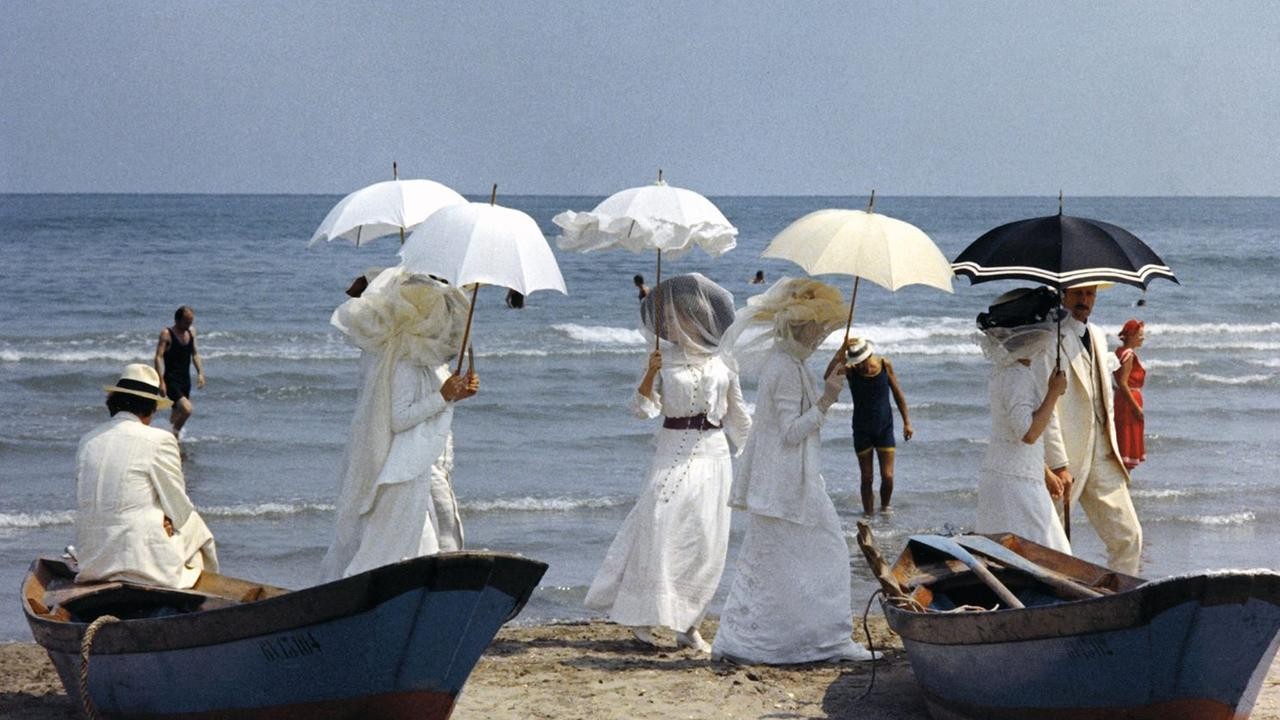
In this adaptation of the Thomas Mann novel, avant-garde composer Gustave Aschenbach (loosely based on Gustav Mahler) travels to a Venetian seaside resort in search of repose after a period of artistic and personal stress. But he finds no peace there, for he soon develops a troubling attraction to an adolescent boy, Tadzio, on vacation with his family. The boy embodies an ideal of beauty that Aschenbach has long sought and he becomes infatuated. However, the onset of a deadly pestilence threatens them both physically and represents the corruption that compromises and threatens all ideals. —IMDb
Luchino Visconti di Modrone, Count of Lonate Pozzolo (2 November 1906 – 17 March 1976) was an Italian theatre, opera, and cinema director, as well as a screenwriter. He is best known for his films The Leopard (1963) and Death in Venice (1971). There is a museum dedicated to the director’s work in Ischia.
One of seven children, Visconti was born in Milan into a noble and wealthy family, one of the region’s richest. His father Giuseppe Visconti di Modrone was the Duke of Grazzano. In his early years he was exposed to art, music and theatre, and met the composer Giacomo Puccini, the conductor Arturo Toscanini, and the writer Gabriele d’Annunzio. During World War II Visconti joined the Italian Communist Party.
Visconti made no secret of his homosexuality. His last partner was the Austrian actor Helmut Berger, who played Martin in Visconti’s film The Damned. Berger also appeared in Visconti’s Ludwig in 1972 and Conversation Piece read more
The performance by Dirk Bogarde is so staggering it's a shame the movie isn't better. It's one thing to move at a deliberate pace, another to be remarkably boring
I agree with the commenter below that I prefer this movie to the Mann novella, as well written as it is. The grey area of this story between an artistic person's appreciation of beauty and just being creepy makes me prefer not to know every thought going through Aschenbach's head. Also: why did they change Aschenbach's occupation from a writer to a composer? Doesn't matter much but seems pointless to change that.
A lyric film about an artist struggle for purity. It's interesting to note that there are elements of Thomas Mann's Doctor Faustus in Visconti's film as well, which adds another darker tone to the film.
A woman arrives in an unnamed southern European city, intent on making a rendezvous with a mysterious friend… whom she’s never met.
When I watched this as a kid the movie was a beautiful mistery. Along with the time I’ve been discovering about what it tells in full extent, maybe I’m still in the mid of the way.
Of course this… read review
Easy on the eye, if not the ear (note the ghastly English dubbed version) this is an arch and mannered filming of Mann’s novella – stretched to snapping point by repeatedly drowning in soporific longeurs… read review