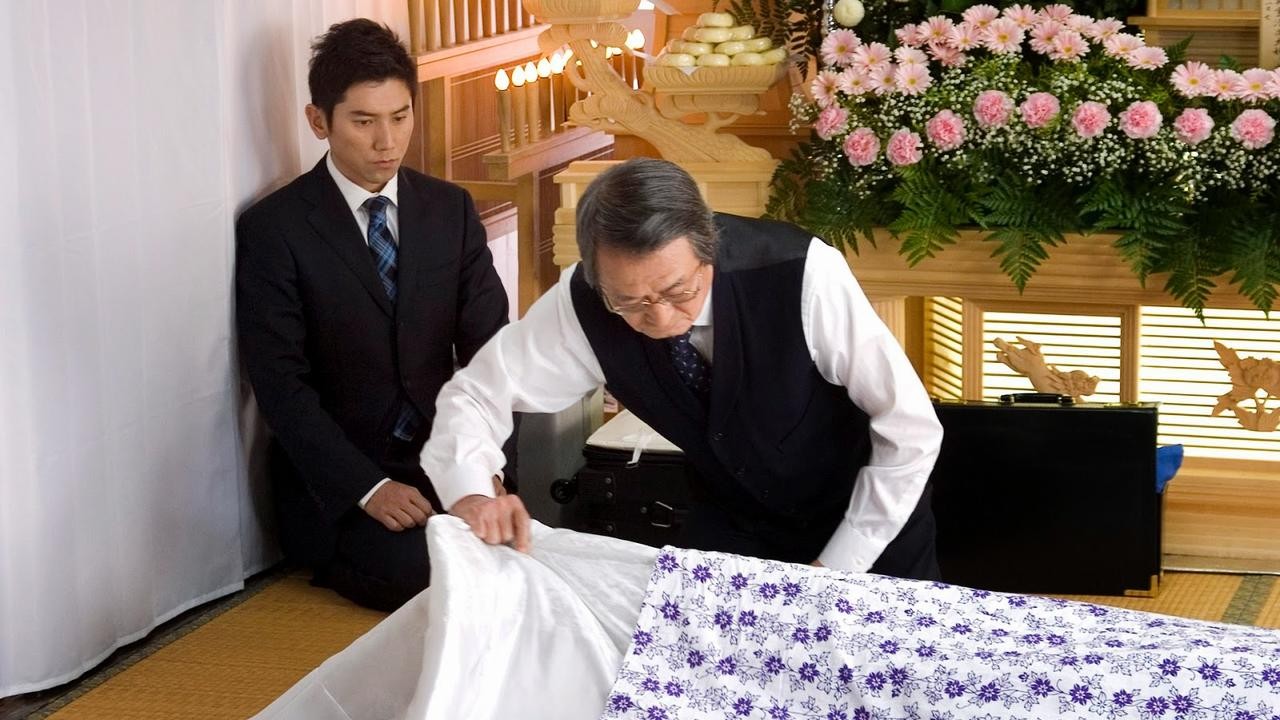
With the breakup of his Tokyo orchestra, Daigo, a young cellist, decides to return with his adoring wife Mika to his hometown in Japan’s far north. Searching for work, he responds to a cryptic classified ad for work in “Departures” only to find out that the position is in the field of “encoffining,” the ritual preparation of a corpse before it is placed in a casket for cremation. Daigo gradually takes to the work and finds he has a real talent, but he is too ashamed to tell Mika, leaving him torn between his true calling and his marriage.
Winner of the Academy Award® for best foreign language film this year, Departures achieves a pleasingly droll blend of screwball-like humor with a moving story about reconciliation, acceptance, and finding one’s place in the world, enhanced by a richly orchestrated score. By taking us into the uniquely Japanese tradition of the “Nokanshi”-who washes, dresses, and grooms the dead body in front of the deceased’s family, helping the living to bid farewell and the dead to move on to the next world-director Yojiro Takita also offers a refreshingly light and life-affirming vision of how we can reconcile ourselves with death and dying. —Tribeca Film Festival, http://www.tribecafilm.com/filmguide/Departures.html
Yōjirō Takita (滝田 洋二郎 Takita Yōjirō, born December 4, 1955 in Takaoka, Toyama, Japan), is a Japanese filmmaker. Yōjirō Takita entered the film industry through Mukai Productions, where he served as an assistant director. Takita first came to prominence with the long-running, popular light-comic pink film Molester’s Train (痴漢電車 Chikan densha) series, started by Shin’ya Yamamoto in 1975, and which Takita began directing in 1982 at Shintōhō. Later, for the Nikkatsu studio, Takita filmed similar Molester’s films as part of that studio’s Roman Porno line. Molester’s School Infirmary (1984), Molester’s Tour Bus (1985) and Molester’s Delivery Service (1986) are some of these titles.Takita’s 1986 mainstream comedy, No More Comic Magazines! received critical praise, and he has produced several popular films since then. Yomiuri Shimbun writes that Takita’s films usually have, “a warm tenderness, reflecting his bright and upbeat personality.”
His 2008 film Departures (おくりびと Okuribito… read more
Subtle, but with a lot of emotion. This was very touching, but I can proudly say that it didn't make me cry... more than two or three times.
It ventured into sentimentalism more than I liked. It's interesting, however, to see such a light take when the subject is dead. A film that could have been more serious than Winter Light! Being Mexican, we see death as happy, and we even humanize death, but I hadn't seen a film that did something similar. It's enjoyable, but to be honest, I liked Waltz with Bashir much better.
There are some scenes where the appeal of the story is erased by the fake, the film almost pushes itself to be exaggeratedly touching. The storyline regardless of other aspects is interesting and unique. I admired the Japanese culture's understanding of respect once again.
Fui ver “A Partida”, do diretor japonês Yojiro Takita , por curiosidade e sem grandes expectativas. Afinal, levou o Oscar de Melhor Filme Estrangeiro de 2009! Não vale aqui entrar na polêmica sobre… read review
Searching the Japanese word 納棺 in Google Images would surely produce images pertaining to the said ritual; searching its English counterpart, however, would mostly provide images of the film being… read review
Barring the last 15 minutes, The Departures walks a tightrope – between the darkest comedy, the macabre and a strong humanist core. It does it with immaculate skill, deftly balancing scenes of visceral… read review
This is a film about death but it is not morose, depressing or macabre. The send-off for the departed is a respectful and contemplative ritual, captured in every tender, glowing frame. It reminded… read review