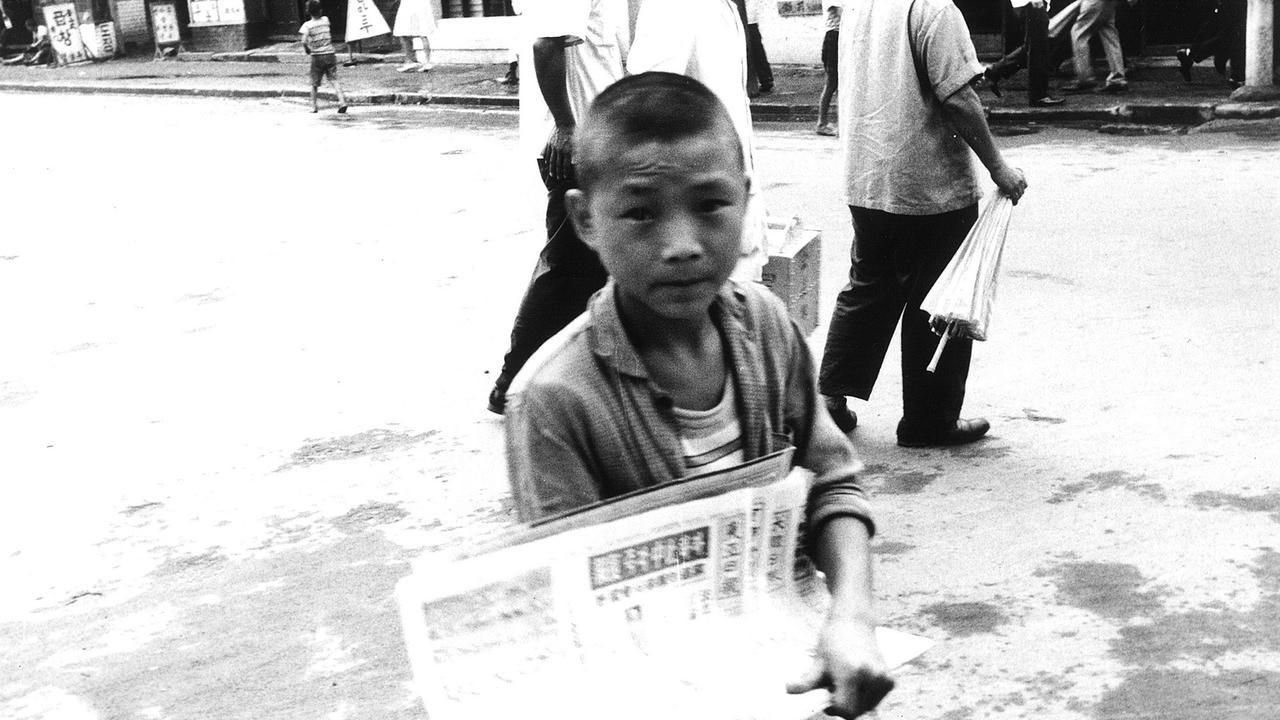
Consisting of a series of diary entries narrated by a boy over photographs made by Oshima himself during a 1964 trip to Korea, Yunbogi’s Diary is a highly political tale chastising Japan’s involvement in Korea. Oshima confronts his country with the mess it made during the occupation, particularly the resulting chaos and poverty that would continue beyond the Korean War. Throughout the film, he draws parallels with the situation in Japan right after World War II. However, at regular intervals the boy’s narration is halted and Oshima’s own voice is heard, reading verse that emphasises the fact that this is Korea in the 60s rather than Japan in the 40s, and that children are suffering most of all. And when children suffer, the future suffers. The technique of using sound effects and narration over still images would be employed again by Oshima for an altogether different project: the manga adaptation Ninja Bugeicho (1967). —MidnightEye
Nagisa Oshima’s career extends from the initiation of the “Nuberu bagu” (New Wave) movement in Japanese cinema in the late 1950s and early 1960s, to the contemporary use of cinema and television to express paradoxes in modern society. After an early involvement with the student protest movement in Kyoto, Oshima rose rapidly in the Shochiku company from the status of apprentice in 1954 to that of director. By 1960, he had grown disillusioned with the traditional studio production policies and broke away from Shochiku to form his own independent production company, Sozosha, in 1965. With other Japanese New Wave filmmakers like Masahiro Shinoda, Shohei Imamura and Yoshishige Yoshida, Oshima reacted against the humanistic style and subject matter of directors like Yasujiro Ozu, Kenji Mizoguchi and Akira Kurosawa, as well as against established left-wing political movements. Oshima has been primarily concerned with depicting the contradictions and tensions of postwar Japanese society. His… read more