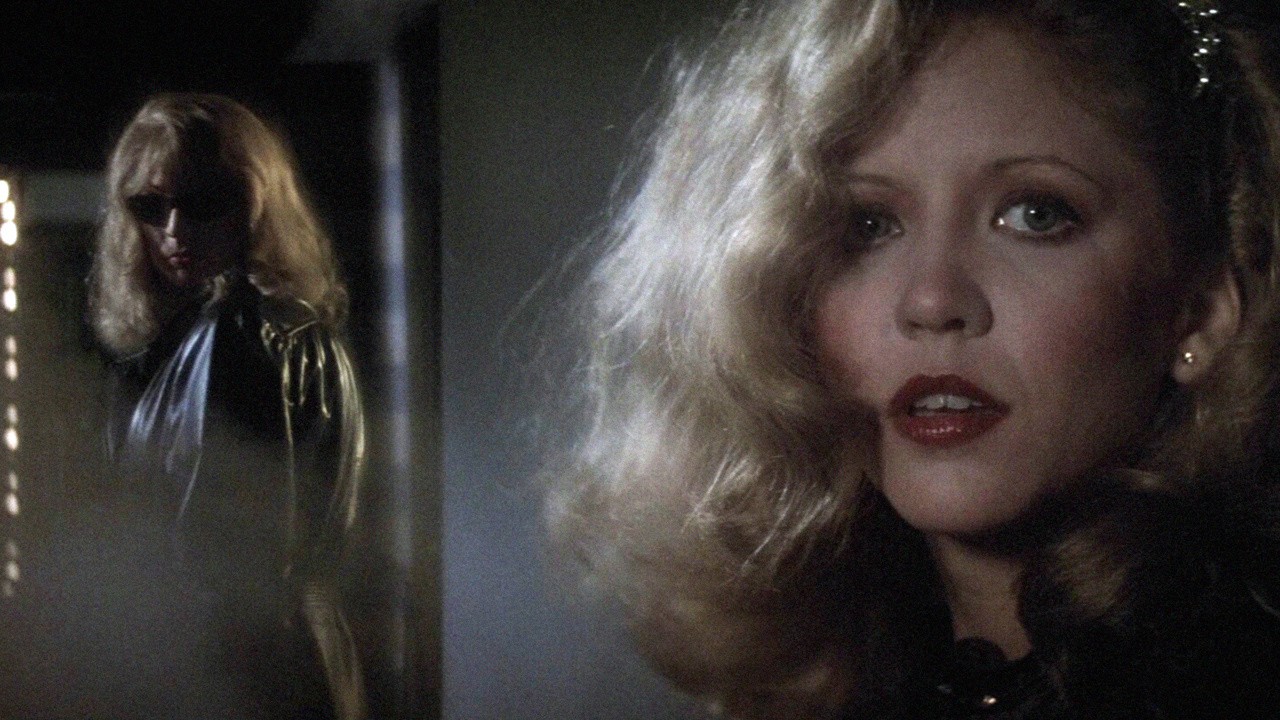
While taking a shower, Kate Miller, a middle-aged, sexually frustrated New York housewife, has a rape fantasy while her husband stands at the sink shaving. Later that day, after complaining to her psychiatrist Dr. Robert Elliott about her husband’s pathetic performance in bed, she meets a strange man at a museum and returns to his apartment where they continue an adulterous encounter that began in the taxicab. Before she leaves his apartment, she finds papers which certify that the man has a venereal disease. Panicked, Kate rushes into the elevator, but has to return to his apartment when she realizes she’s forgotten her wedding ring. When the elevator doors open, she’s brutally slashed to death by a tall blonde woman wearing dark glasses. Liz Blake, a high-priced call girl, is the only witness to the murder and she becomes the prime suspect and the murderess’s next target. Liz is rescued from being killed by Kate’s son Peter… —IMDb
Brian De Palma is one of the well-known directors who spear-headed the new movement in Hollywood during the 1970s. He is known for his many films that go from violent pictures, to Hitchcock-like thrillers.
Born on the 11th of September in 1940, De Palma was born in New Jersey in an American-Italian family. Originally entering university as a physics student, de Palma became attracted to films after seeing such classics as Citizen Kane (1941). Enrolling in Sarah Lawrence College, he found lasting influences from such varied teachers as Alfred Hitchcock and Andy Warhol.
At first, his films comprised of such black-and-white films as Bridge That Gap (1965). He then discovered a young actor whose fame would influence Hollywood forever. In 1968, de Palma made the comedic film Greetings (1968) starring Robert de Niro in his first ever credited film role. The two followed up immediately with the film The Wedding Party (1969) and Hi, Mom… read more
Another great lurid and bombastic thriller from cinema's greatest and most shameless plagiarist Brian DePalma. His kinetic camerawork is thrilling as usual, and his sense of the Hitchcockian top notch as always. But what struck me the most was the quality of the performances. Michael Caine is sublimely creepy, and Nancy Allen both cute and sexy. DePalma is at his best with this type of film.
If De Palma had simply made gripping, cheeky trash art, it would have been enough. But "Dressed to Kill" is more, an extension and deconstruction of "Psycho." It delves deeper into the psychosexual subtext of Hitchcock's masterpiece and even pokes fun at (or pays homage to) the infamous scene explaining Norman's condition. And with Pete, we get a hint of the detective-as-voyeur as explored in "Blow Out."
The co-director of Jafar Panahi’s This Is Not a Film is banned from traveling outside Iran. Plus: Senses of Cinema needs help.
La imagen hipersexualizada del castigo superyoico y la represion. Hitchcock mas perverso. La fascinación por las perversiones sexuales y la explicación psicológica de los mismos. El inolvidable score… read review