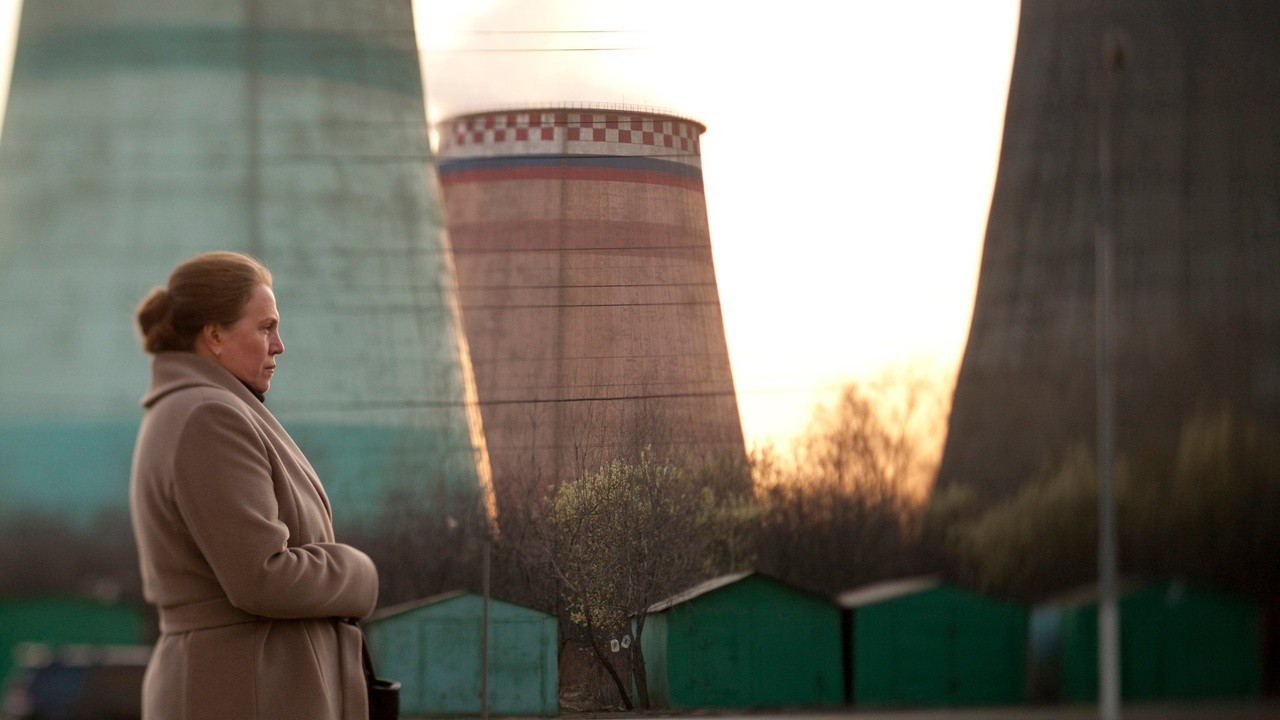
Elena and Vladimir are an older couple, they come from different backgrounds. Vladimir is a wealthy and cold man, Elena comes from a modest milieu and is a docile wife. They have met late in life and each one has children from previous marriages. Elena’s son is unemployed, unable to support his own family and he is constantly asking Elena for money. Vladimir’s daughter is a careless young woman who has a distant relationship with her father.
A heart attack puts Vladimir in hospital, where he realizes that his remaining time is limited. A brief but somehow tender reunion with his daughter leads him to make an important decision: she will be the only heiress of his wealth. Back home he announces it to Elena. Her hopes to financially help her son suddenly vanish. The shy and submissive housewife then comes up with a plan to give her son and grandchildren a real chance in life. –Cannes Film Festival
Andrey Petrovich Zvyagintsev (Russian: Андре́й Петро́вич Звя́гинцев) (born February 6, 1964) is a Russian film director and actor. He is mostly known for his 2003 film The Return, which won him a Golden Lion at the Venice Film Festival.
Zvyagintsev was born in Novosibirsk, Siberia. At the age of 20 in 1984 he graduated from the drama school in Novosibirsk as an actor. Since 1986 he has lived in Moscow where he continued his studies at the Russian Academy of Theatre Arts until 1990. From 1992 to 2000 he worked as an actor for film and theater. In 2000 he began to work for the TV station REN TV and directed three episodes of the television series The Black Room.
In 2003, he directed his first feature film The Return, which received several awards, including a Golden Lion at the Venice Film Festival. His second feature film The Banishment premiered at the 2007 Cannes Film Festival and was nominated for a Palme d’Or. n 2008, he directed a short segment for the film New York… read more
Near perfect, complete experience. True cinema. Zvyagintsev had already proven himself capable with THE RETURN, yet with ELENA, he exceeded expectations. What a cinéaste.
It begins the way many traditional japanese dramas of the 40's and 50's began, but the class conflicts and family preocupations of yore are given a post-modern perspective where the moral standpoint of the main character becomes increasingly faded and volatile, to the point where her decisions are not so easily justified or reprehensible. Shot with skill and a startling sense of atmosphere, this film stays with you.
A modest, beautiful social realism drama from the finest Russian filmmaker in a generation. Read my full review here: http://366movies.com/2012/12/03/330elena/
Adrian Curry’s annual round-up of his favorite film posters of the year.
A look at the process that led to the poster for the new Zvyagintsev and its designer’s selection of his favorite movie posters of all-time.
Overviews of the Museum of the Moving Image series: 13 features and seven shorts, nearly all of them New York premieres.
High time to round up the films at this year's Cannes Film Festival that never saw entries of their own and send them on their way. Today
Um grito objectivo e puramente cinematográfico.
Para mim, esta é a verdadeira definição de verdadeiro cinema, de um filme completo. E digo completo pois, no fundo, tem tudo… read review
Empty lives in search for something to fill their vacuous souls in a world where there’s nothing to be found ! ‘Modernity’ is a facade in a world where primal instincts still reign supreme and blood… read review
This review is part of my coverage of the 2012 Milwaukee Film Festival… read review
The long introductory shot introducing the apartment Elena shares with her second husband (and former employer) begins looking just like any ordinary apartment then slowly reveals evidence of wealth… read review