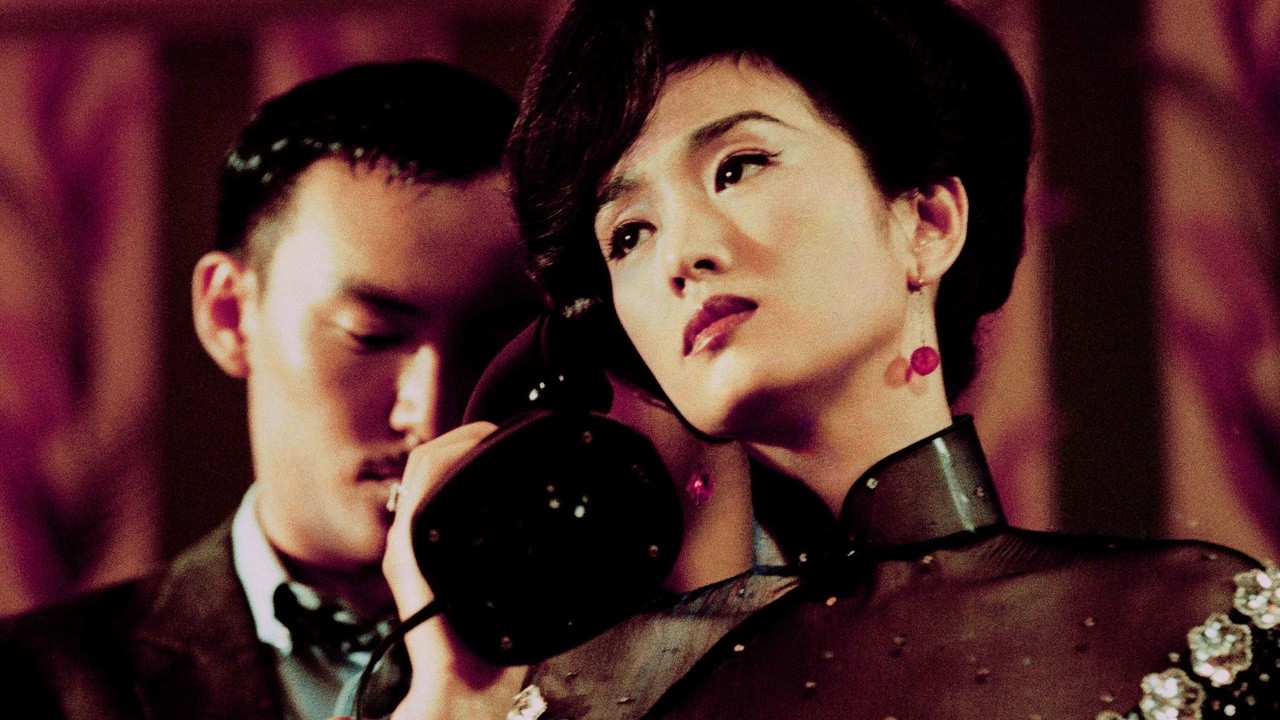
A three-part anthology film about love and sexuality: a menage-a-trois between a couple and a young woman on the coast of Tuscany; an advertising executive under enormous pressure at work, who, during visits to his psychiatrist, is pulled to delve into the possible reasons why his stress seems to manifest itself in a recurring erotic dream; and a story of unrequited love about a beautiful, 1960s high-end call girl in an impossible affair with her young tailor. –IMDb
Born in Shanghai, he moved to Hong Kong with his parents at the age of five. Coming from the Mainland and speaking only Mandarin and Shanghainese, he had a difficult period of adjustment to Cantonese speaking Hong Kong, spending hours in movie theatres with his mother. He made his directing debut in 1988 with As Tears Go By, produced by Alan Tang. It was a crime melodrama of the kind then hugely popular, and with heavy borrowings from Martin Scorsese’s Mean Streets (1974), but already displayed one of his principal trademarks in its atmospheric and sometimes expressionistic color palette. It is his only box office hit to date. Wong went on to direct several more feature films in the 1990s, among these were Chungking Express (1994), Fallen Angels (1995), Ashes of Time (1994). His first major international recognition was at the 1997 Cannes Film Festival where he won the Best Director prize for Happy Together (1997). The filming of In the Mood for Love (2000) had to be shifted from Beijing… read more
At the age of 26, Steven Soderbergh permanently altered the face of independent cinema when he became the youngest-ever winner of the Palme d’Or at the 1989 Cannes Film Festival for sex, lies and videotape, his feature-film directorial debut. A simmering exploration of the nature of modern relationships and the links between sexuality and voyeurism, the film was an international sensation that established its director as one of the golden boys of world cinema. Born in Georgia on January 14, 1963, Soderbergh grew up in Baton Rouge, LA, where his father was the Dean of Louisiana State University’s College of Education. While still in high school, Soderbergh enrolled in the university’s film animation class and began making short 16 mm films with second-hand equipment. After he graduated from high school, he went to Hollywood, where he worked as a freelance editor. Soderbergh’s time in Hollywood was brief, and he soon returned home, where he continued making short films and writing scripts… read more
Michelangelo Antonioni once described his work as “archeological research” which sifted through “the arid remains of our times”. If Fellini claimed to treat the past as science fiction, Antonioni gazed deeply into the future already visible in the present (L’Eclisse) or a past which uneasily hung onto a present that had outlived it (L’Avventura). Born in an upper-middle class family in Ferrara in 1912; Antonioni studied economics at the University of Bologna, where he staged works by Luigi Pirandello as well as original work written by himself. Antonioni’s time as a film critic for the Roman Cinema magazine brought him in contact with Cesare Zavattini, Federico Fellini, Roberto Rossellini, Luchino Visconti and others. For Rossellini, he would co-write Un pilota ritorna and with Fellini, he collaborated on the screenplay of his first feature The White Shiek.
Antonioni, however, yearned to begin his own career in film. To this end, he enrolled at the Centro Sperimentale di Cinemografia… read more
Wong Kar-Wais short "Hand" is what really lifts up this three movie set of films about sex and love. The Steven Soderbergh movie about the stressed out ad executive is good, but not great, and the Antonioni menage-a-trois bored me.
I only care about Wong Kar-Wai's film _Hand_ which was gorgeous and filled with yearning, irrevocable romantic tragedy, silent yet believable emotions, helped of course by Christopher Doyle's camera work--as precise as a master Chinese tailor in days gone by.
Couldn't stop feeling like I was watching soft porn during Atonioni's story. Disappointing.
Critic-filmmaker Luc Moullet pens a provocative, previously unpublished take on the difference between the B&W and color work of Antonioni.