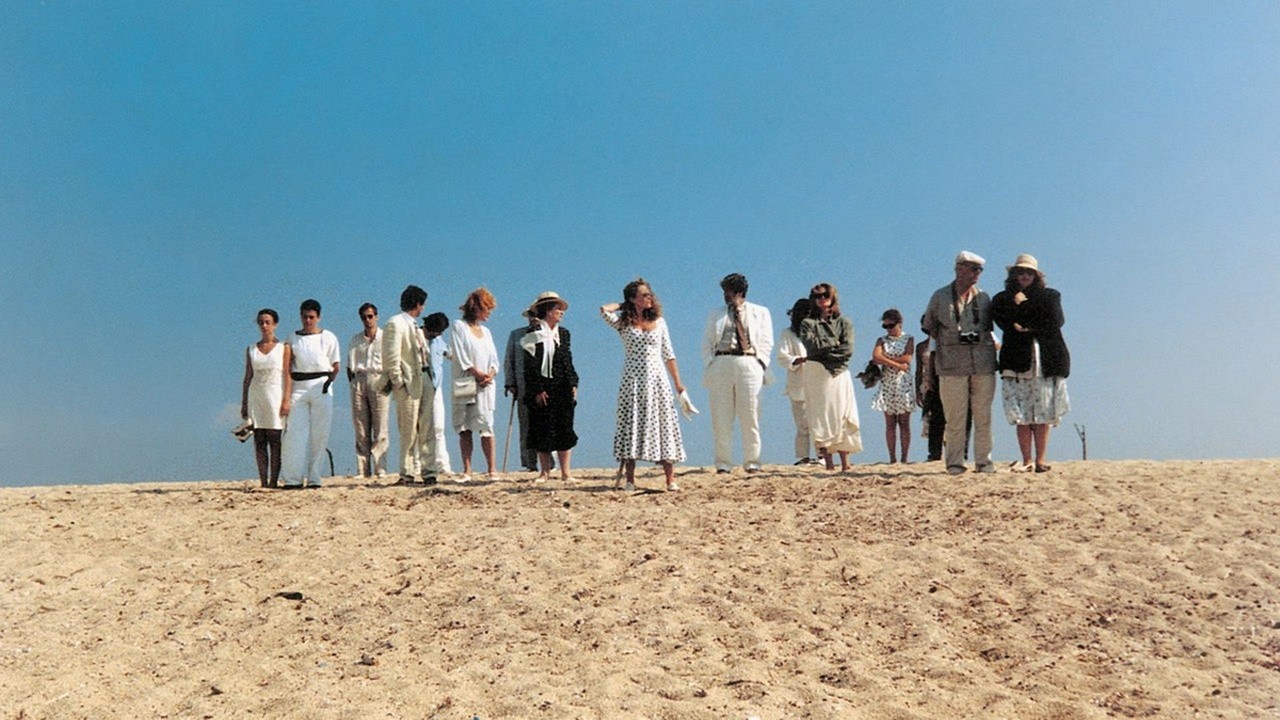
Winner of the Cannes Film Festival Grand Prize, Theo Angelopoulos’s deeply moving odyssey centers on Alexander (portrayed by Bruno Ganz), a celebrated Greek writer who, while terminally ill, focuses on one special last idyllic day. A poetic, haunting, and abundantly beautiful film, Eternity and a Day weaves an emotionally charged tale of love and life, where the past and the present come together to create a forceful yet eloquent message of hope for the future. Embarking on a dreamy and transcending voyage to relive an idealized time with his long lost wife at their beloved seaside retreat, his day is interrupted as he happens upon a lost and troubled eight year old boy whose future plight brings new meaning to Alexander’s own journey into the past. Crossing paths at a special moment in time, the two strangers, man and boy, share a poignant life experience as one journey ends and a new one begins. —Amazon
Theo Angelopoulos began to study law in Athens but broke up his studies to go to the Sorbonne in Paris in order to study literature. When he had finished his studies, he wanted to attend the School of Cinema at Paris but decided instead to go back to Greece. There he worked as a journalist and critic for the newspaper “Demokratiki Allaghi” until it was banned by the military after a coup d’état. Now unemployed, he decided to make his first movie, Anaparastasi (1970). Internationally successful was his trilogy about the history of Greece from 1930 to 1970 consisting of Meres tou ’36 (1972), O thiasos (1975), and Oi kynigoi (1977). After the end of the dictatorship in Greece, Angelopoulos went to Italy, where he worked with RAI (and more money). His movies then became less political. —IMDb
this is how I discovered the great work of Angelopoulos. Nostalgia, exile, sorrow, loneliness and silence: my go to issues in cinema, and of course, a remarkable cinematography...
" I have asked you one day: How long will tomorrow last? And you answered to me: Eternity and a day. "
Theo Angelopoulos' avoidance of editing is mesmerizing at its best. At worst, it makes my mind wander away from the story - not unlike the distracted old poet played by Ganz in this film. "Ah, those were the times" - I can read similar sentiments between many of the long takes, and unfortunately a lack of faith in tomorrow. Up close, I enjoyed the presence of the Albanian boy. He is not allowed much, but brings hope.
His career spanned four decades and, in 1998, he won the Palme d’Or for Eternity and a Day.
Amazing scene after amazing scene! This movie moves around in circles, almost like a dog looking for a spot to pee, but instead, we have an old man looking backwards and through his life, thinking… read review