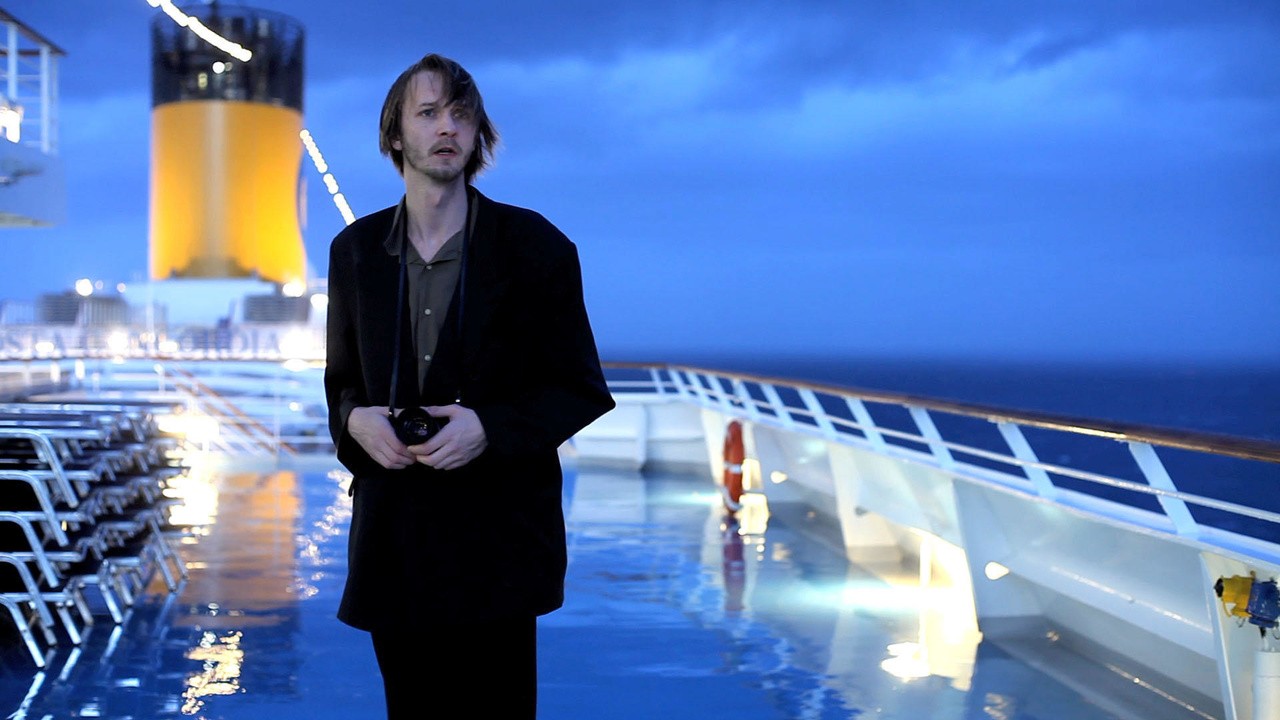
A symphony in three movements. Things such as: The Mediterranean, a cruise ship. Numerous conversations, in numerous languages, between the passengers, almost all of whom are on holiday… An old man, a war criminal (German, French, American we don’t know) accompanied by his granddaughter. A famous French philosopher (Alain Badiou). A representative of the Moscow police, detective branch.
An American singer (Patti Smith). An old French policeman. A fired female United Nations officer. A former double agent. A Palestinian ambassador.
It’s a matter of gold, as it was before with the Argonauts, but what is seen (the image) is very different from what is heard (the word).
Our humanities. Visits to six sites of true or false myths: Egypt, Palestine, Odessa, Hellas, Naples and Barcelona.
Our Europe. At night, a sister and her younger brother have summoned their parents to appear before the court of their childhood. One of the parents in fact has to appear on television to stand as a candidate in the local elections. The children demand serious explications of the themes of Liberty, Equality and Fraternity.
The lynchpin of the French New Wave, Jean-Luc Godard was arguably the most influential filmmaker of the postwar era. Beginning with his groundbreaking 1959 feature debut A Bout de Souffle, Godard revolutionized the motion picture form, freeing the medium from the shackles of its long-accepted cinematic language by rewriting the rules of narrative, continuity, sound, and camera work. Later in his career, he also challenged the common means of feature production, distribution, and exhibition, all in an effort to subvert the conventions of the Hollywood formula to create a new kind of film.
Godard was born in Paris on December 3, 1930, the second of four children. After receiving his primary education in Nyon, Switzerland – during World War II, he became a naturalized Swiss citizen – he studied ethnology at the Sorbonne, but spent the vast majority of his days at the Cine-Club du Quartier Latin, where he first met fellow film fanatics Francois Truffaut and Jacques Rivette. In May… read more
Outstanding, disturbing, flawlessly captured, overflowed with melancholy disguised by Socialism. Avé Godard.
The cinematographer of Film socialisme and Godard’s forthcoming Adieu au langage, discusses their work together.
Vertigo returns with a special issue on Jean-Luc Godard.
Also: Adam Curtis on Dead of Night, life, the universe and everything. And more.
Also: Theo Angelopoulos, Alberto Lattuada and Jean-Pierre Gorin on DVD.
Also: It’s Tuesday Weld Day at DC’s. And of course there’ll be a Steve Jobs biopic.
Godard talks about his next film, Benning mentions one he slipped in between Ruhr and Twenty Cigarettes — and more.
"No Comment," reads the final title card of Film Socialisme. Despite being on screen for only a few seconds, it's become—in the
Updated through 6/12. Let's begin this quick run through goings on in New York and with J Hoberman in the Voice: "Dennis Hopper changed the
“Nor is there any ‘figurative’ and ‘nonfigurative’ art… A person, an object, a circle are all ‘figures
"At 11 minutes long, Tacita Dean's film Prisoner Pair (showing at the Common Guild gallery in Glasgow [through February 5]) is a svelte précis
"It would be a fool who thought they had all the necessary competences to comment fully on this extraordinarily rich oeuvre which is constitutively
"As psychology is the cheap tool of Hollywood plot and the bourgeois axis of identification" — so begins David Phelps's piece for the BOMBLOG
Put on your best costume jewelry: this evening, as every New York cinephile knows, the 48th New York Film Festival kicks off at Lincoln Center
Just five titles in today's entry in a series of roundups wrapping Toronto (as opposed to the 30+ in yesterday's Contemporary World Cinema
Jean Luc-Godard's "late period has repeatedly demonstrated an interest in a critical cinema, an art that interrogates itself by giving form
Jean-Luc Godard’s ideal form of film distribution for Film Socialisme.
I have admit it up front: I only speak English (which is something of an embarrassment in Cannes, where just about every non-American speaks
Above: Frammartino's Le quattro volte. Le quattro volte (Michelangelo Frammartino, Italy) There are too many great moments to mention in
Craig Keller has been doing outstanding work in the run-up to the passionately anticipated new film from Jean-Luc Godard, Film Socialism
The lineup for the 63rd Cannes Film Festival is evidently still a work-in-progress, with an additional three or four titles to be added
Many, many big thanks to Kurt Walker for the tremendous find!
As pretty much every review has noted, Jean-Luc Godard’s latest film essay ends with a title card that says “No Comment”—a convenient/appropriate authorial absence that leaves the whole sprawl open… read review
As media democratizes, actual democracy is in decline. Cheap technologies proliferate to the point that anyone can distribute what they create, but does this lead to a grassroots, vox populi like… read review
Jean Luc-Godard is considered a poet that creates poems in images. ‘Film Socialisme’ tries to give its way by his broken story. Actually, it fails. The film tries to construct many thoughts about certain… read review
Jean-Luc Godard’s newest film feels like an exercise — a bit strenuous and very familiar. Though it is interesting, if only for Godard’s attempt to navigate through the modern media and visual means… read review