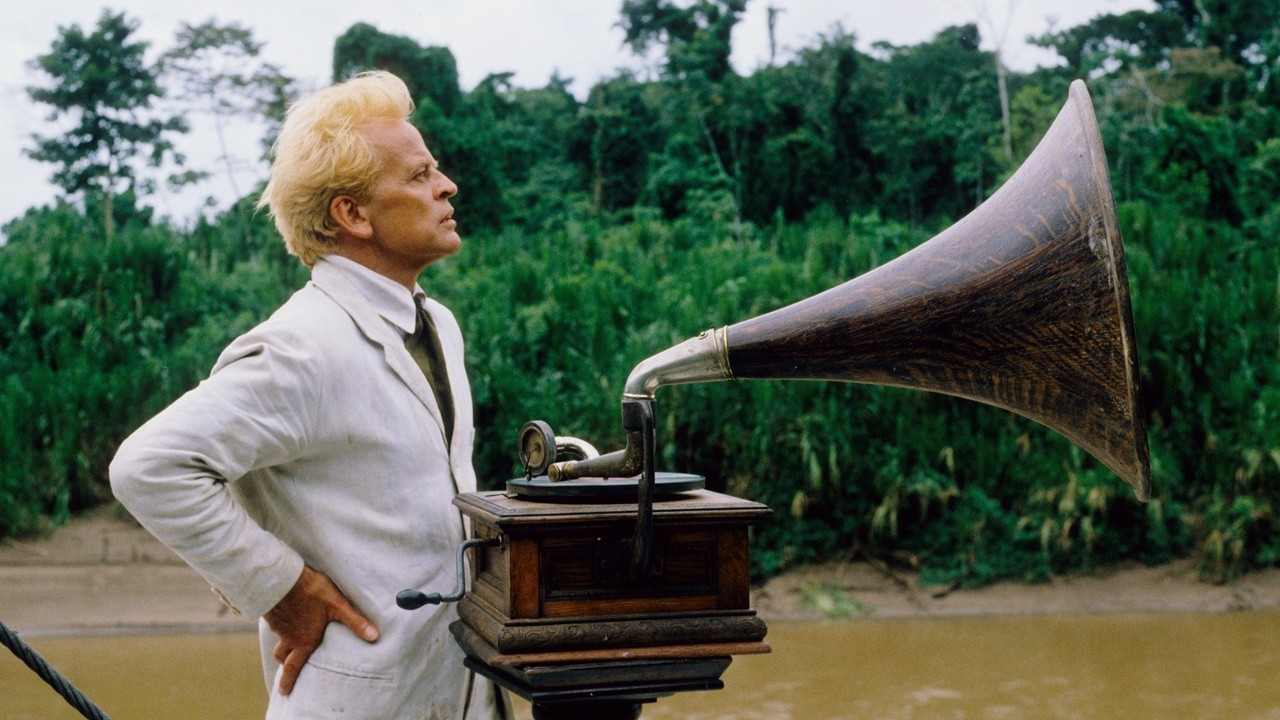
Brian Sweeney Fitzgerald, better known as Fitzcarraldo, wants to build the largest opera house that ever existed, in Iquitos, in the middle of Amazonia. To inaugurate the theater, he plans to invite Caruso, a tenor he heard perform in a production of Ernani in Manaus. With the help of his wife Molly, he seeks sources of funding. Along the way, he realizes that the only way to earn enough money would be to exploit the rubber trees. However, Fitzcarraldo devises a plan: to navigate the unexplored Pachitea River, which runs parallel to the Ucayali. According to the maps he has consulted, the two rivers nearly touch at a certain point, separated by a single mountain. He has a boat restored and calls it the “Molly Aida”, sets off on his journey and manages to intrigue the locals. Indeed, the locals help him climb over the mountain with his boat, to avoid the rapids and then navigate downstream towards the rubber trees. In the end, though, Fitzcarraldo does not succeed in building his opera house; instead, he converts his boat into a stage, brings in many singers and musicians, and puts on a show that is finer than any the Amazon rainforest had ever seen before. —Thessaloniki International Film Festival
One of the most influential filmmakers in New German Cinema and one of the most extreme personalities in film, Werner Herzog quickly gained recognition not only for creating some of the most fantastic narratives in the Film history, but for pushing himself and his crew to absurd and unprecedented lengths, again and again, in order to achieve the effects he demanded. Born Werner Stipetic in Munich on September 5, 1942, Herzog came of age in Sachrang, Bavaria, amid extreme poverty and destitution. After Herzog turned seventeen, a German film producer optioned one of his screenplays, then promptly destroyed the contract when he discovered the author’s age. Circa 1962, 20-year-old Herzog enrolled in the University of Munich as a history and literature student, and produced his first motion picture, the twelve minute Herakles, his second short Game in the Sand, and his third, the pacifist tract The Unprecedented Defense of Fortress Deutschkreuz.In 1963, he established his own production… read more
Yes, it meanders forever and we don't know much about its main character save his Caruso obsession. But no matter. The film is really the story of Herzog's own obsession and it's a masterpiece. As we watch the hero's welcome after literally moving a ship over a mountain and through unconquered rapids, it is Herzog's victory we're watching - a complete artistic success and fulfillment of an all-encompassing obsession.
Also: The NYT Magazine Hollywood Issue. Lists and interviews.
A manic no-budget special effects comedy that achieves a certain cockeyed charm.
Kinski died at the age of 65 on November 23, 1991. Heart attack in California. His ashes were scattered into the Pacific Ocean.
Ramin Bahrani speaks clearly and assertively. He knows what he wants; even more admirably, he seems to know exactly why he wants it. He can
As screened @ Cinemuse
Dare to dream the impossible… but at what cost?
In order to fund his dream of bringing the opera into the… read review
I just saw ‘Fitzcarraldo’ this week for the first time, and was absolutely captivated by it. I think it’s most reedemable quality is the fact that it’s very subtle and authentic, yet more epic than… read review
Epic in scope and undoubtedly slow (it didn’t bother me one bit, but I can see where people come from saying this), Fitzcarraldo explores man’s foolish attempts at heroic feats. The sheer simplistic… read review
Seeing as how Fitscarraldo is by far one of his best, I wonder if maybe the appeal of Herzog’s films is that of an incredible spectacle that more or less really happened, that he decided to film… read review