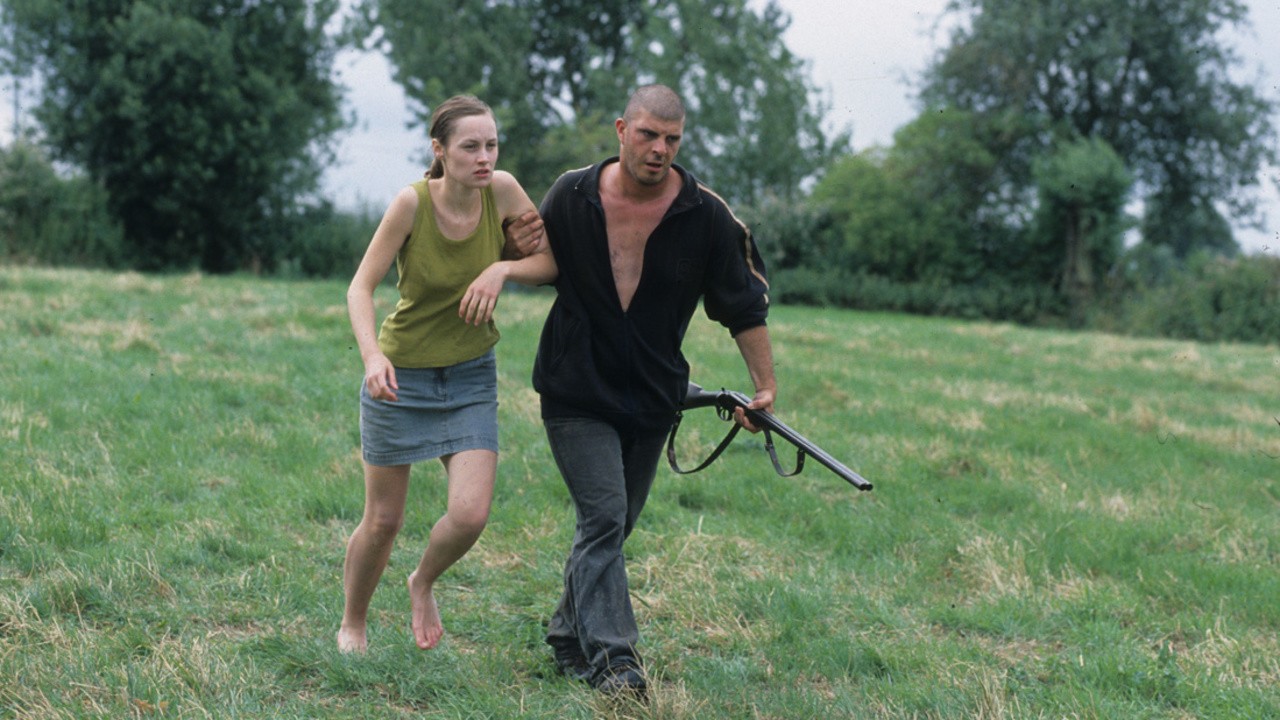
Flanders. Demester divides his time between his farm and walks with Barbe, his childhood friend. He loves her, secretly and painfully, accepting from her the little that she can give him. Along with others his age, Demester leaves to be a soldier in a war in a far off land. Barbarity, camaraderie and fear turn Demester into a warrior. As the seasons go by, Barbe, alone and wasting away, waits for the soldiers to return. Will Demester’s intense love for Barbe save him?
Bruno Dumont is a filmmaker whose use of celluloid is a direct result of his intense desire to understand and make sense of the world around him. His downbeat dramas may not appeal to those who see only the negative in a cinematic world of stark reality, but viewers with the ability to see a glimmer of light in the darkness will surely connect with his sometimes bleak cinematic endeavors. A former philosophy professor who has turned his mind toward crafting confrontational films in which no aspect of modern society is out of bounds, Dumont has claimed that his films are the result of a noted effort to bring film back to the body in hopes of stirring the viewer’s emotions. His 1997 debut, The Life of Jesus, was not a literal retelling of the events of the life of the biblical Jesus, but a socially critical look at life in Northern France. Acclaimed worldwide for its affecting portrayal of bored street youth, the film opened many doors for the director, and it wasn’t long before… read more
In Flandres reveals a climatician alongside Zvyagintsev, Ceylan, Tarr; his murky pastoral textures the working class ghettos, whose minimal connections reflect the consigned routines. The subsequent shift to the warzone - in another likeness to the geosocially isolated fraternity of Beau travail; here topically Middle Eastern - only exacerbates the condition, from apathy to numbness, in both veiled polemic and dual study of geographic cause-and-effect, to which Dumont’s muted yet graphic milieu ultimately reinforces.
If this movie were a shape it would be the letter "c", because....what's the point of drawing a complete circle? Seriously, we're all just too apathetic for that.
Dalle fredde campagne delle fiandre (Hors Satan) al polveroso deserto del medio oriente (Hadewijch). Dumont traccia il terreno per le opere successive! From the cold plains of Flanders (Hors Satan) to dusty desert of Middle East (Hadewijch). Dumont track the ground for the following works!
There was once a great director named Bruno Dumont...the first 30 minutes or so are about the best thing Dumont has ever done: incommunicable fucking in farm country...and then he slides off into territory he knows nothing about and films it badly: in L'Humante, it was the police procedural; in Twenty-nine Palms, it was the USA; and this time the war genre.
"Following in the grand tradition of austere European filmmakers, Bruno Dumont gives religious faith quite a workout in his new film, Hadewijch
Andre Demester (Samuel Boidin, already seen in La Vie de Jesus) is a young farmer working on his farm, situated in the cold countryside of northern France. Its unique leisure moments are made of the… read review
I guess the message is, life is bleak, war is horrid and pointless, sex with a cold partner is unfulfilling. I do, pretty much agree with all of this, but that’s all I could take away from the film… read review