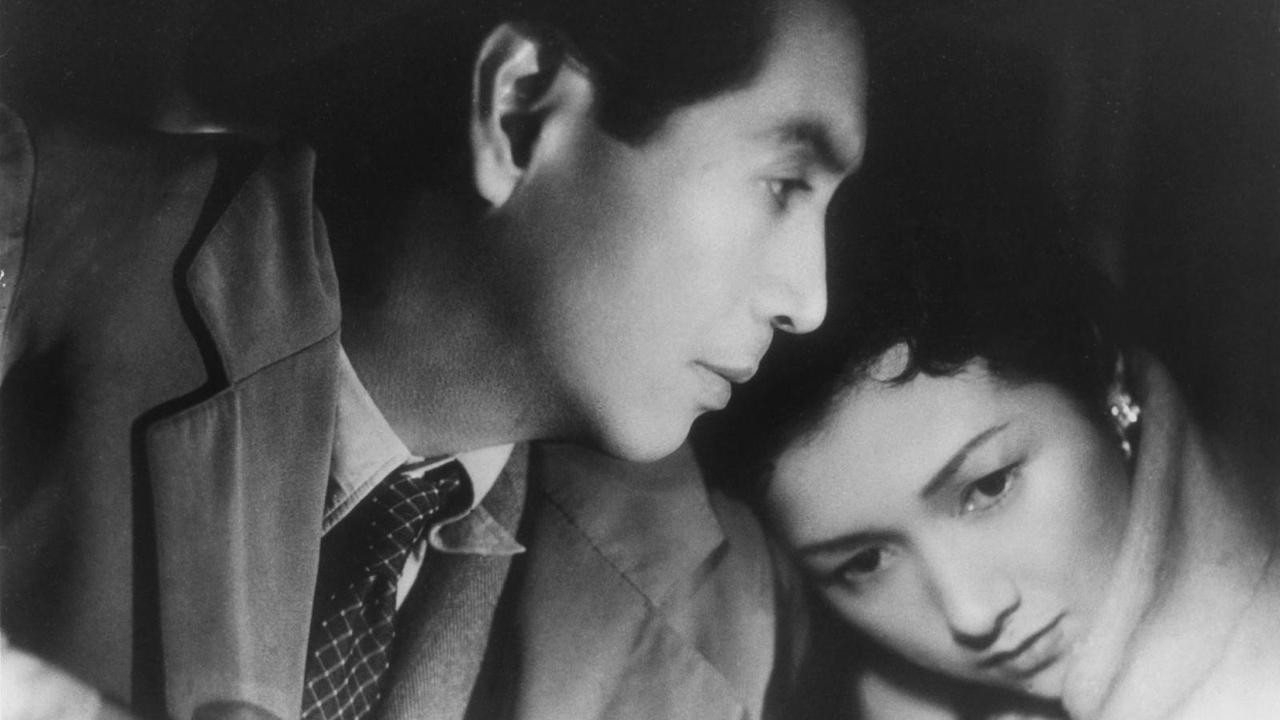
On a bleak and cold morning in November 1946, a group of weary and destitute repatriates from Indochina, insufficiently dressed for the brisk northern weather, disembarks from a Japanese port with their meager belongings for an ill-planned and unassisted government resettlement after the war. Among the returning nationals is Yukiko (Hideko Takamine), a young woman who had traveled abroad to work as a typist for an expedition team stationed in Indochina by the Forest Ministry. Having initially left the country in order to escape the inappropriate conduct and violation of a morally reprehensible and opportunistic relative named Iba (Isao Yamagata), Yukiko is reluctant to return home and instead, visits the residence of an agricultural surveyor named Kengo Tomioka (Masayuki Mori), a former colleague from Indochina with whom she had a love affair. However, Yukiko’s longed for reunion with her lover is marked by disillusionment as the emotionally inscrutable Kengo is reluctant to rekindle their romantic relationship, explaining that his wife is ill and cannot leave her. Once ambitious and idealistic, Kengo now seems resigned and embittered, working in a string of odd jobs and a marginal enterprise on the sale of firewood. Nevertheless, Yukiko continues to persevere in the relationship despite Kengo’s half-hearted commitment, settling in a modest residence near the red-light district where she scrapes a meager existence as a euphemistic “hostess” for American servicemen, one of the few proliferating commerces under occupied Japan. But as Yukiko continues her pattern of self-sacrifice for her fickle and ungrateful lover, the prospect for rebuilding a life together in postwar Japan proves ever-increasingly untenable. —Filmref.com
Mikio Naruse is one of the least known of Japan’s early master directors, both in the West and in Japan, yet he created some of the most moving, darkly beautiful works in Japanese cinema. Like Kenji Mizoguchi, Naruse showed an uncanny understanding for the psychology of women. Like Yasujiro Ozu, he preferred subtle shifts of character over broad strokes of plot. Unlike either of these early greats, however, Naruse’s vision of humanity was much darker and more clinical. He stripped all vestiges of hope or acceptance from his films, what remains is only a willful struggle to endure. His relentlessly negative view of human existence has resulted in Naruse’s often being labeled a nihilist.
Born in Tokyo, in 1905, Naruse was the youngest of three sons of a desperately poor embroiderer. Although he excelled in elementary school, his family could not afford to further his education. He was instead enrolled in a two-year technical school. There, he spent virtually all of his free time… read more
UKIGUMO (浮雲) is the bleakest and most depressing Naruse Mikio film that I have seen thus far. Takamine Hideko's performance was amazing. I am blessed to have seen this on the big screen for the first time.
The first half was truly evocative in its post-war detail and does a great work introducing its characters, but as the film goes along you can tell its pessimistic agenda is played on a single, monotonous note throughout the entire film, rendering the inspired use of ellipsis and ever-changing characters helplessly predictable before its ponderous melodramatic intentions.
In honor of Hideko Takamine's appearance in Film Forum's 5 Japanese Divas retrospective, a frowny-melancholy-dour revision of our
The great Japanese actress Hideko Takamine, who passed away on December 28 at the age of 86, has been eulogized beautifully on MUBI already
2010 began and ended with the deaths of great octogenarian film artists. Eric Rohmer died on January 11, a few months shy of his 90th birthday;
Word is just now beginning to get around that actress Hideko Takamine died on Tuesday at the age of 86. "From her first screen appearance
un buen melodrama que pinta algunas de las principales preocupaciones japonesas de la postguerra. hastiado de su pasado, japón se inclina por cualquier cosa que le recuerde lo menos posible su propia… read review