MUBI brings you a great new film every day.  Start your 7-day free trial today!
Watch a new film every day for $4.99.
Try MUBI for FREE.
 

Gate of Flesh

Nikutai no mon

Japan

1964

90 Min
Color
2.35:1
Japanese
  • Currently 3.9/5 Stars.
  • 1
  • 2
  • 3
  • 4
  • 5

   |   

DIR Seijun Suzuki

PROD Kaneo Iwai

SCR Goro Tanada, Taijiro Tamura

DP Shigeyoshi Mine

CAST Jô Shishido, Yumiko Nogawa, Satoko Kasai, Koji Wada, Tomiko Ishii, Kayo Matsuo, Misako Tominaga, Keisuke Noro, Chico Roland

ED Akira Suzuki

PROD DES Takeo Kimura

MUSIC Naozumi Yamamoto

New York (Masterworks)

Synopsis

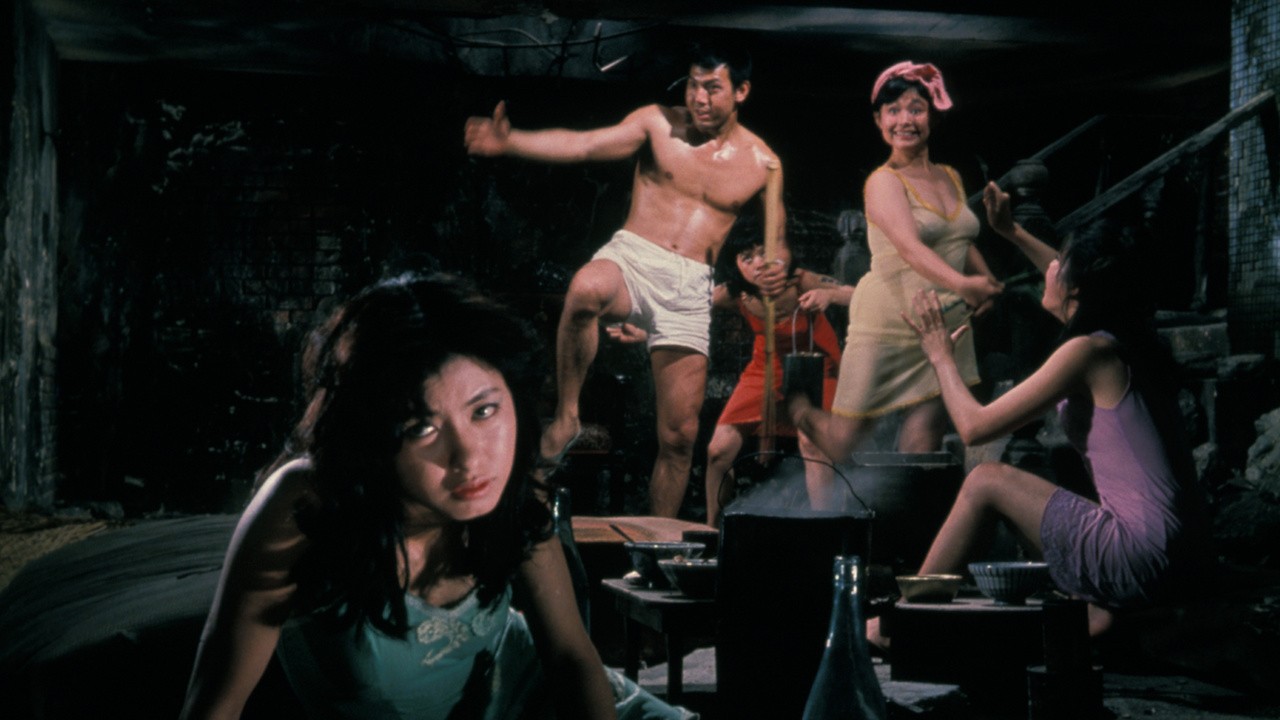
In the shady black markets and bombed-out hovels of post-World War II Tokyo, a tough band of prostitutes eke out a dog-eat-dog existence, maintaining tenuous friendships and a semblance of order in a world of chaos. But when a renegade ex-soldier stumbles into their midst, lusts and loyalties clash, with tragic results. With Gate of Flesh, visionary director Seijun Suzuki delivers a whirlwind of social critique and pulp drama, shot through with brilliant colors and raw emotions. —The Criterion Collection

Director

Original

Seijun Suzuki

Seijun Suzuki (鈴木 清順, Suzuki Seijun?), born Seitaro Suzuki (鈴木 清太郎 Suzuki Seitarō) on May 24, 1923, is a Japanese filmmaker, actor, and screenwriter. His films are renowned by film enthusiasts worldwide for their jarring visual style, irreverent humour, nihilistic cool and entertainment-over-logic sensibility. He made 40 predominately B-movies for the Nikkatsu Company between 1956 and 1967, working most prolifically in the yakuza genre. His increasingly surreal style began to draw the ire of the studio in 1963 and culminated in his ultimate dismissal for what is now regarded his magnum opus, Branded to Kill (1967), starring notable collaborator Joe Shishido. Suzuki successfully sued the studio for wrongful dismissal but was blacklisted for 10 years. As an independent filmmaker he won critical acclaim and a Japanese Academy Award for his Taishō Trilogy, Zigeunerweisen (1980), Kagero-za (1981) and Yumeji (1991).

His films remained widely unknown outside of Japan until a series… read more

Wall

Displaying 4 of 12 wall posts.
Picture of Greg S.

Greg S.

1May13

There is such a distinct sense of environment and place but no real sense of home. Suzuki brings the violence of this lifestyle to the forefront by depicting violence and sexuality being almost inseparable for these women. The code that they live by actually makes anything resembling real passion the girls' enemy. The girls affections for the soldier brilliantly signifies the damaged state Japan was in.

Picture of Arsaib

Arsaib

27Mar13

"Driven by migraine pulse beats hammered out on lonely tom-toms, and fluttering with backward close-ups of Old Glory waving vainly over a land of rising slums, Gate of Flesh—later joined by Story of a Prostitute (1965) and Carmen from Kawachi (1966)—doesn’t just inaugurate Suzuki’s so-called 'flesh trilogy'; it completes a sixties triumvirate of dystopian, Japan-as-junkyard panoramas, bookended by Oshima’s The Sun’s Burial (1960) and Kurosawa’s Dodes’ka-den (1970). Fittingly, when asked to comment on the playful nihilism that characterizes so much of his work, Suzuki once told critic Satō Tadao: 'I think that what remains in our memory is not ‘construction’ but ‘destruction.’ Making things is not what counts. The power that destroys them is.'"—Chuck Stephens

Mr. Arkadin likes this

  • Picture of Greg S.

    Greg S.

    3Apr13

    One of the few major Suzuki works I still need to see. Would you say its his best?

  • Picture of Arsaib

    Arsaib

    3Apr13

    Based on what I've seen so far, yes. Would love to take a look at the aforementioned 'Carmen from Kawachi'.

Picture of Trolley Freak

Trolley Freak

21Feb13

Cult director Suzuki's gritty account of a band of prostitutes working the rubble-strewn streets of post-war Tokyo is achieved using bright primary colours, expressionistic camerawork and bold production design. Sexual conflict arises among the group when an ex-soldier on the run from the military police hides out with them. Knowingly melodramatic and intentionally garish, this is thrilling and trashy entertainment..

Picture of Kijma

Kijma

19Aug12

The cinematography was incredible, the film was wild, angry and passionate. I Loved it.

Related Films

Fans

Displaying 5 of 164 fans.

Lists

Displaying 5 of 67 lists.

Reviews

Displaying 3 of 3

Carne

By Lucas Granero on February 1, 2011

Todavia trabajando para el estudio Nikkatsu, en el que realizó sus aventuras mas desquicidas hasta que lo echaron cuando la cosa se puso un poquito mas intolerante con la inmesa “Branded to Kill”…  read review

Untitled

By timotay​o on September 6, 2009

Seijun Suzuki is a mad genius.

Really. He is quite marvellous in spinning these visually phantasmagorias filled with neon colors and cinemascope compositions so eclectic your head with stretch…  read review

Untitled

By Christo​pher Smith on August 21, 2009

Really strange film from director Seijun Suzuki tells a dark, intense story centered around a serious subject matter – the desperate lives of prostitutes in post-War Tokyo – with surprisingly bright…  read review

Forum

Displaying 0 discussion topics.

DVD

Buy the DVD from The Criterion Collection.