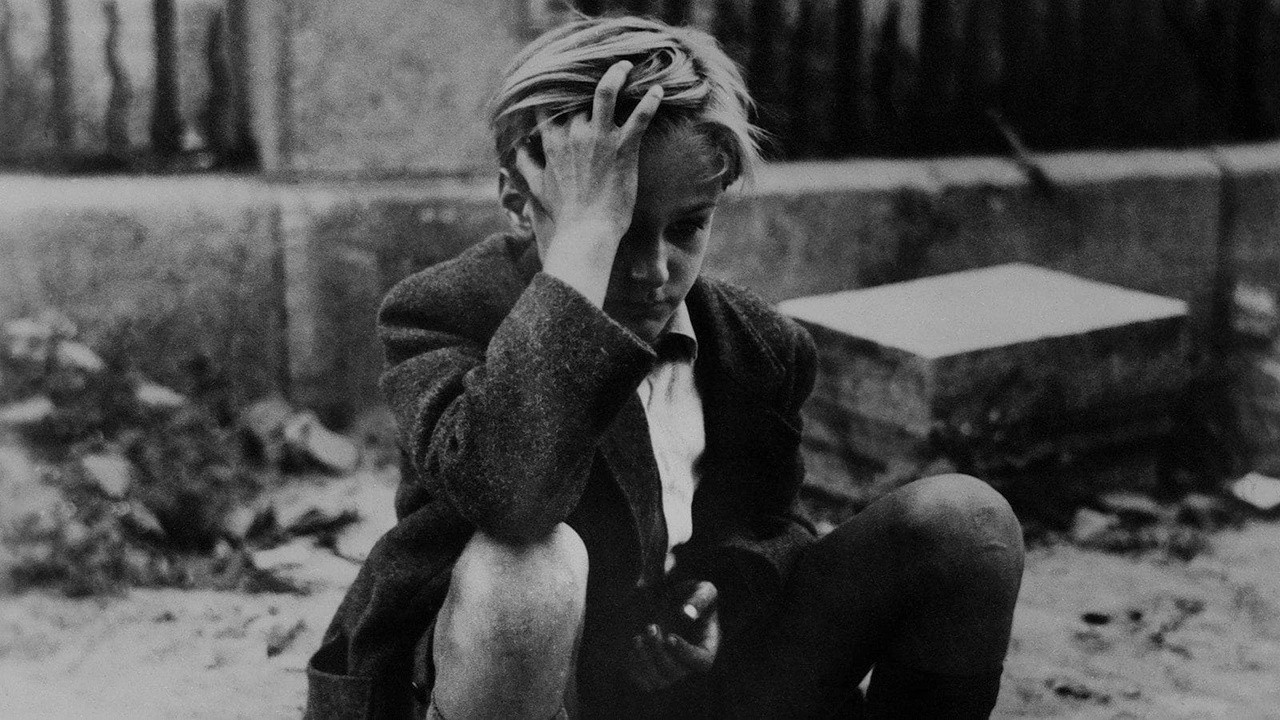
The concluding chapter of Roberto Rossellini’s War Trilogy is the most devastating, a portrait of an obliterated Berlin shown through the eyes of a twelve-year-old boy. Living in a bombed-out apartment building with a sick father and two older siblings, young Edmund is mostly left to wander unsupervised, getting ensnared in the black-market schemes of a group of teenagers and coming under the nefarious influence of a Nazi-sympathizing ex-teacher. Germany Year Zero (Deutschland im Jahre Null) is a daring, gut-wrenching look at the consequences of fascism, for society and the individual. —The Criterion Collection
Rossellini was one of the directors of the Italian neorealist cinema, contributing films such as Roma città aperta (Rome, Open City 1945) to the movement.
In 1937, Rossellini made his first documentary, Prélude à l’après-midi d’un faune. After this essay, he was called to assist Goffredo Alessandrini in making Luciano Serra pilota, one of the most successful Italian films of the first half of the 20th century. In 1940 he was called to assist Francesco De Robertis on Uomini sul Fondo.His close friendship with Vittorio Mussolini, son of Il Duce, has been interpreted as a possible reason for having been preferred to other apprentices.
Some authors describe the first part of his career as a sequence of trilogies. His first feature film, La nave bianca (1942) was sponsored by the audiovisual propaganda centre of Navy Department and is the first work in Rossellini’s “Fascist Trilogy”, together with Un pilota ritorna (1942) and Uomo dalla Croce (1943). To this period belongs… read more
Now I see. Now I see what Andre Bazin was talking about. I do not just understand. I feel it in my guts. How fresh images for the thought. How can this film speak to me as from yesterday? What has happened to a world where the sight of a handle instantly give a boy associations to a weapon, a gun? These are questions I can't answer. But I can keep them like a flame, as a living image, in my thought.
Not a very good ideea to watch it after intense 2.5 hours la terra trema. Although they say Rossellini is the most neorealist of them all, Viscontis film lets this one here seem like classical Hollywood.
u shouldn't watch a rossellini movie , right after a visconti movie. films must be ' digested' slowly
Not a huge Rossellini fan, but this was my favorite of his so far. It's incredibly bleak. A dark turn towards the end really brings the humanity of an isolation of a child to this post-war film. Makes me want to contrast the main character with Tarkovsky's wartime Ivan, as they are polar opposites in character but in similar situations. I loved the last 15 minutes.
Above: Germany Year Zero. Courtesy of the Criterion Collection. Many of the extras (interviews, visual essays) included in this Criterion
"In the immediate aftermath of World War II, Roberto Rossellini made three films that helped to lay the foundations of modern cinema: Rome
Reputations resurrected, re-contextualized, and revitalized: even as the future of home video, at least in the form of the DVD medium, is starting
After focusing on the effects of the war on the Italian people in “Rome Open City” and “Paisan”, Roberto Rossellini went to Berlin to tell the story of the enemy, and what he found was a great city… read review
If there is a more depressing film I have yet to find it. Young Edmund and his family live in the bombed out ruins of post-war Germany. Cramped into one house with four other families, without electricity… read review
Set in the post-war Germany, Rossellini’s final film of his war trilogy (of which I’ve only seen this) completely shocked me. I’d not seen devastation of war and the aftermath. Images formed with words… read review