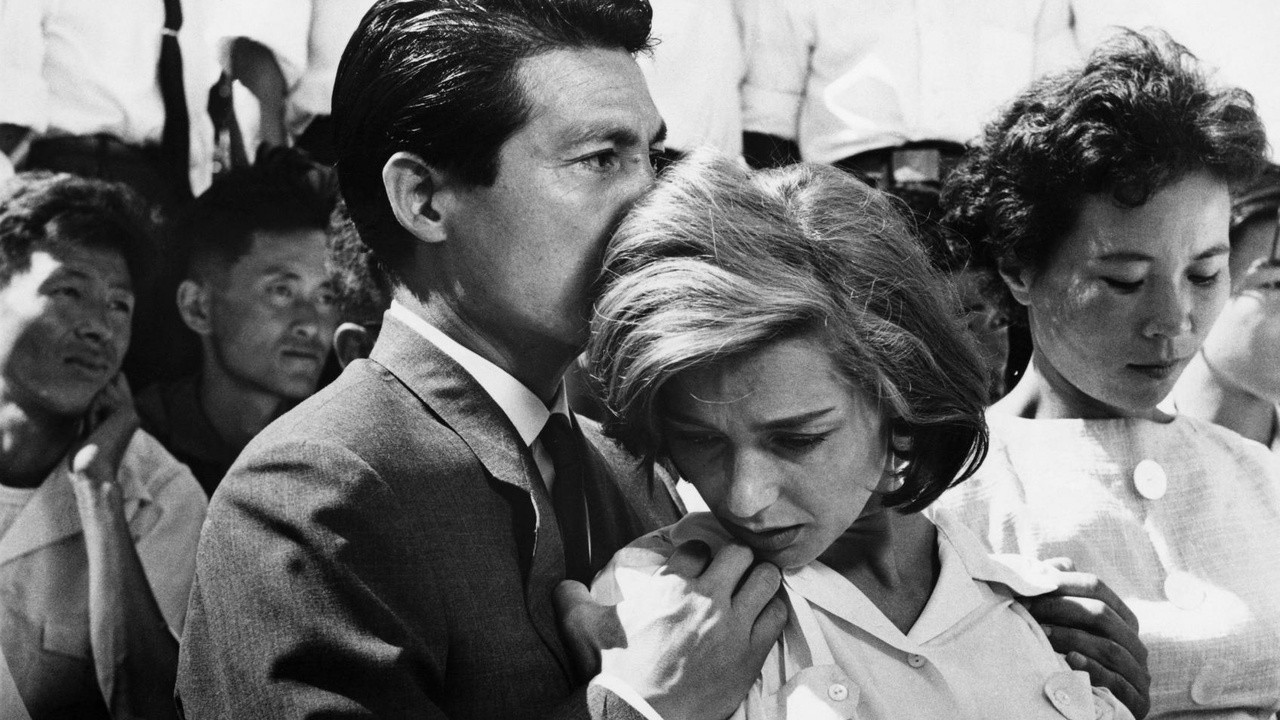
A cornerstone film of the French New Wave, Alain Resnais’s first feature is one of the most influential films of all time. A French actress (Emmanuelle Riva) and a Japanese architect (Eiji Okada) engage in a brief, intense affair in postwar Hiroshima, their consuming fascination impelling them to exorcise their own scarred memories of love and suffering. Utilizing an innovative flashback structure based on a screenplay by Marguerite Duras, Resnais delicately weaves past and present, personal pain and public anguish, in this moody masterwork. —The Criterion Collection
While a seminal figure of the French New Wave, Alain Resnais was not, like so many of his contemporaries, an alumnus of the film journal Cahiers du Cinema. In fact, he existed well outside of the sphere of filmmakers like Jean-Luc Godard, Francois Truffaut, and Jacques Rivette, with a dedication to formalism, modernist concerns, and social and political issues not found in the work of his fellow innovators. Focusing repeatedly on themes of time and memory, Resnais drew from the well of serious literature to offer a singular philosophical and artistic vantage point, employing enigmatic narrative structures, lush cinematography, and lyrical editing patterns to create some of the most provocative and controversial work of the period. Born June 3, 1922, in Vannes, France, Resnais began making his first 8 mm films at the age of 14. In 1943 he enrolled at the newly formed Institut des Hautes Etudes Cinematographie, leaving the following year after declaring his studies too theoretical. He… read more
“Hiroshima, mon amour” by Alain Resnais is a film about the possibility and actuality of the impossible love – IL (intimate love between two persons which cannot be realized in numerous forms of conventional relationships). Taking love affair between a French actress and a Japanese architect in Hiroshima ten years after the nuclear bomb, Resnais examines the necessity for those who live after the nuclear holocaust to become new human beings in order to find new ways of living incompatible with the destructive ways of being in the world (with high-tech weaponry, destruction of the environment, and shock therapies and austerity for wide populations). According to the film, the main protagonists are capable of creating together a new kind of love (which viewers are privileged to see) that can be stronger than human traditional ways of feeling and thinking. By virtuoso montage and sophisticated semiotic devices Resnais stimulates the viewers to clear for themselves the definition of IL. Closer to the end of the film it becomes clear that IL is not the one that is impossible to realize, but it’s the one in which competent perception of the world meets Eros, spirituality meets human body on equal grounds, and human soul meets the destiny of the humankind. IL is an ordeal that lovers inspired by the challenge, can go through to be on the level of demands and predicaments of a post-nuclear holocaust life. . “Hiroshima…” is not a political film, but the one where political aspect of today’s life is inseparable from our existential concerns, intimate life and cultural interests. The bodily love of the hero and the heroine is shown as, as if, having an alchemical power over life and death. The film shows personal love as a psychotherapeutic process and as a healing of human unconscious. Love for another person becomes love for the body of earth, for earth’s earthly and human flesh and soul. The heroine of the film (Emmanuelle Riva in a monumentally unique performance) impersonates the frustrated condition of Western psyche in relation to the very function of love, and simultaneously the vital potential for overcoming the amorous trauma. She is one of the first female characters in the world cinema who is liberated from the pop-cinematic “femininity” and a sugary appeal to male perception. In her personality humanness and womanhood are indissoluble. “Hiroshima, mon amour” is a film of planetary significance, film of human species, film whose relevance for human life grows with each year. by Victor Enyutin Please, visit www.actingoutpolitics.com to read an essay on the film (with analysis of shots) – “A Film about A New Type of Love that Must Be Stronger Than Human Destructiveness (Psychology of the Impossible Love - Without Symbiosis, Sentimentality, Philistinism, Vanity, Rivalry)”
I'm suddenly reminded, following this immensely devastating film, why I bother with films in the first place.
The 20 most popular posters to date from our related Tumblr, Movie Poster of the Day.
Time is regained in Alain Resnais’ new masterpiece, which premiered at Cannes.
A year or so ago, while writing about the brilliant poster for Alain Resnais’s most recent film, Wild Grass, I was a little disparaging of
Today only: Alain Resnais’ collaboration with famed novelist Marguerite Duras, Hiroshima, mon amour, is playing for free in the UK and Ireland
From December 15 through 22, The Auteurs and Stella Artois will be presenting to viewers over 18 in the UK a daily series of French
Above: Emmanuelle Riva and Jean-Paul Belmondo in Jean-Pierre Melville's Léon Morin, Priest. Image courtesy Rialto Pictures. Father the French
Hiroshima, mon amour (1959)
Director:Alain Resnais
Writer:Marguerite Duras
Second viewing after a number of years and after having become more informed about Duras… read review
Of the three films from 1959 generally accepted as the markers for the start of a collectively known era called Nouvelle Vague it might be said that Truffaut’s ‘400 Blows’ was raw and humanist, Godard’s… read review
Hiroshima Mon Amour by Alain Resnais is a breathtaking experience. The opening sequence did something few films achieve…. It gave me chills to the spine. I was devoured by the beauty of the music with… read review
Very interesting but also pretty pretentious French romance touches on some interesting ideas and has some memorable imagery of the aftermath of Hiroshima. Clever and innovative filmmaking techniques… read review