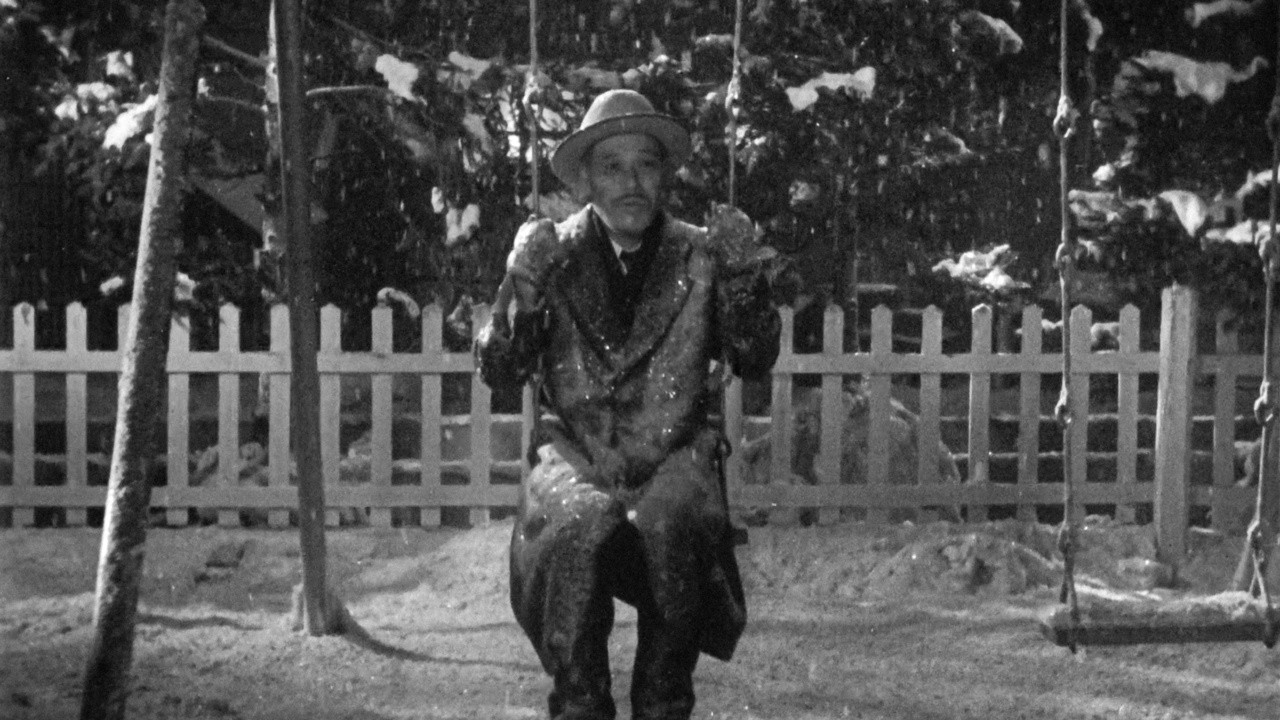
Considered by some to be Akira Kurosawa’s greatest achievement, Ikiru presents the director at his most compassionate—affirming life through an exploration of a man’s death. Takashi Shimura portrays Kanji Watanabe, an aging bureaucrat with stomach cancer forced to strip the veneer off his existence and find meaning in his final days. Told in two parts, Ikiru offers Watanabe’s quest in the present, and then through a series of flashbacks. The result is a multifaceted look at a life through a prism of perspectives, resulting in a full portrait of a man who lacked understanding from others in life. —The Criterion Collection
The son of an army officer, Kurosawa studied art before gravitating to film as a means of supporting himself. He served seven years as an assistant to director Kajiro Yamamoto before he began his own directorial career with Sanshiro Sugata (1943), a film about the 19th century struggle for supremacy between adherents of judo and jujitsu that so impressed the military government, he was prevailed upon to make a sequel (Sanshiro Sugata Part Two). Following the end of World War II, Kurosawa’s career gathered speed with a series of films that cut across all genres, from crime thrillers to period dramas. Among the latter, his Rashomon (1951) became the first postwar Japanese film to find wide favor with Western audiences. It was Kurosawa’s The Seven Samurai (1954), however, that made the largest impact of any of his movies outside of Japan. Although heavily cut for its original release, this three-hour-plus medieval action drama, shot with painstaking… read more
Not many movies can claim to be the subject of peer-reviewed scientific papers in reputed journals. Akira Kurosawa's "Ikiru" (To Live) (1952) is one such masterpiece that regales us 60 years after it was made and contributes to science as well. "Ikiru" is a film that exhibits the strengths of good direction, screenplay and acting. A detailed review of the Berlin Film Festival winner is at http://moviessansfrontiers.blogspot.in/2013/05/145-japanese-maestro-akira-kurosawas.html
I’m not even sure where to begin to review this deeply moving piece of art. I can’t describe to you the story without revealing parts that you really should discover for yourself. You take this journey… read review
Winner of the 1953 Kinema Junpo award for Best Picture, Akira Kurosawa’s beloved post-war masterpiece examines the social conditions of a Japan still reeling from the war, near the end of the American… read review