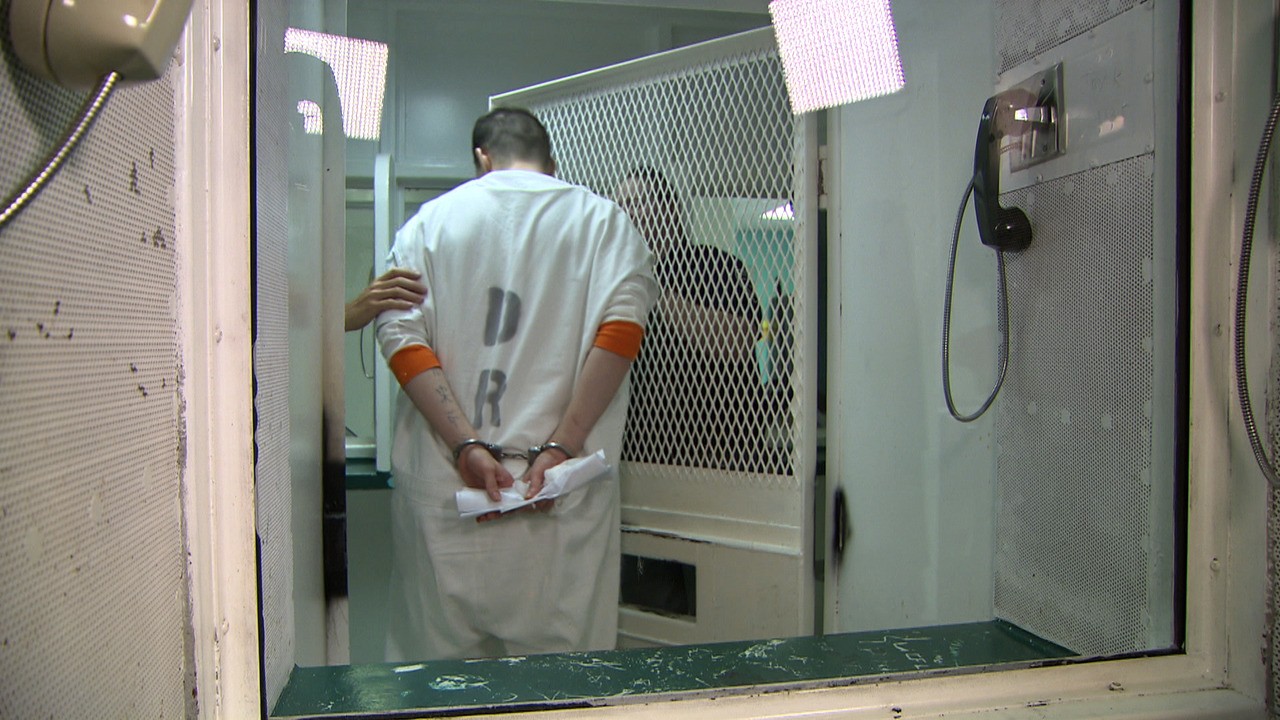
Crime stories can often fall into a predictable pattern of whodunit, but trust Werner Herzog to bring his own unique approach to the genre. He focuses on a triple homicide case in Conroe, Texas, that occurred ten years ago. Epitomizing the word “senseless,” the apparent motive behind the murders was to steal a car for a joyride. The convicted killers were two teenagers, Michael Perry and Jason Burkett, who had a history of substance abuse and violent bravado. They deny their guilt (each blaming the other), but the verdict was based on strong evidence that Herzog doesn’t challenge. Instead, he probes the legacy of the crime and the psyches of the people involved, unveiling layers of humanity, both cold and compassionate.
Herzog, who strongly opposes capital punishment, came to this story after interviewing several people on death row. Among them was 28-year-old Perry, scheduled to die eight days after talking to Herzog. “When I talk to you, it does not necessarily mean that I have to like you,” Herzog says to Perry, “but… I think human beings should not be executed as simply as that.” Burkett, in contrast, was given a comparatively lenient sentence of life imprisonment, prompted by an emotional plea from his father (who is also incarcerated). After delving deeper, Herzog chose to concentrate on this particular case.
In a departure from films like Cave of Forgotten Dreams or Grizzly Man, Herzog refrains from his distinctive and familiar voice-over commentary, but his presence is felt through his questions. In addition to interviewing Perry and Burkett, he talks to their relatives, the victims’ families, law enforcement officials and others. Exploring an American gothic landscape, he takes us from luxury homes to impoverished trailers to prison cells. Herzog’s inquiries yield surprising moments that speak to a variety of human tendencies, including regret, redemption and irrational behaviour. As he’s done so often before, Herzog turns ominous territory into an enlightening trip. –TIFF
One of the most influential filmmakers in New German Cinema and one of the most extreme personalities in film, Werner Herzog quickly gained recognition not only for creating some of the most fantastic narratives in the Film history, but for pushing himself and his crew to absurd and unprecedented lengths, again and again, in order to achieve the effects he demanded. Born Werner Stipetic in Munich on September 5, 1942, Herzog came of age in Sachrang, Bavaria, amid extreme poverty and destitution. After Herzog turned seventeen, a German film producer optioned one of his screenplays, then promptly destroyed the contract when he discovered the author’s age. Circa 1962, 20-year-old Herzog enrolled in the University of Munich as a history and literature student, and produced his first motion picture, the twelve minute Herakles, his second short Game in the Sand, and his third, the pacifist tract The Unprecedented Defense of Fortress Deutschkreuz.In 1963, he established his own production… read more
Un documentario contro la pena di morte che ti piglia volentieri a cazzotti nello stomaco, ti ci lascia un livido grosso così. Potentissimo sia per quanto riguarda il lato visivo (il campo sterminato di tombe col solo numero impresso sopra) sia per l'abisso senza speranza che dipinge, quello di un mondo dove i figli pagano le colpe dei padri e nessuno riesce a chiamarsi fuori dal vortice. Tostissimo. 4*
Clean documentary filmmaking, with little fat or useless material. A very humane (although sorrowful) look at two inmates' lives and (some of) their feelings on their actions. What is truly frustrating is all the critics hailing this as an agenda-free or unbiased picture, where in the first interview Herzog expresses his a) agenda and b) bias.
This was not objectively looking at the issues, this was quite explicitly pursuing an opinion about an issue (that capital punishment is wrong, amoral, inexcusable, et cetera). Quite frankly, capital punishment can be a very powerful and useless tool that is sadly being misused and mishandled. Herzog's allowed to have his opinions, and I can have mine - so can the victims (and criminals) have theirs. But how in the world have critics confused this film with an unbiased and unopinionated documentary? Despite this inaccurate and inexplicable buzz, the film is quite powerful and well executed (pun not intended).
A tremendous amount of magical thinking is engaged by the interviewees (sometimes spurred by interviewer Herzog) to assuage pain, absolve guilt, and justify beliefs. A fascinating look into the minds of the America that provides so much of our prison population.
More world premieres from Antonio Chavarrías, Edwin, Werner Herzog and Kevin Macdonald.
Werner Herzog turns to a small town in Texas and a death penalty case to find alien expressions of violence and grief.
Opening today and running through November 10, DOC NYC features new work by Herzog, Kopple and Demme and a tribute to Richard Leacock.
“Less a piece of political advocacy than a somber inquiry into familiar Herzogian themes of death, violence and time.”
i have an enormous respect for werner herzog and what hes trying to do all the time.
i found this film to be quite good at the beginning with the police video, and departing from the priest saying… read review
With an output rate that would make Woody Allen envious and a string of classics ranging across four decades, the prolific German filmmaker Werner Herzog has built up a devoted international following… read review
Interest in death row is nothing new. I would wager that most people would confess a morbid interest in the inmates and crimes. Only recently documentarian Louis Theroux visited various different high… read review