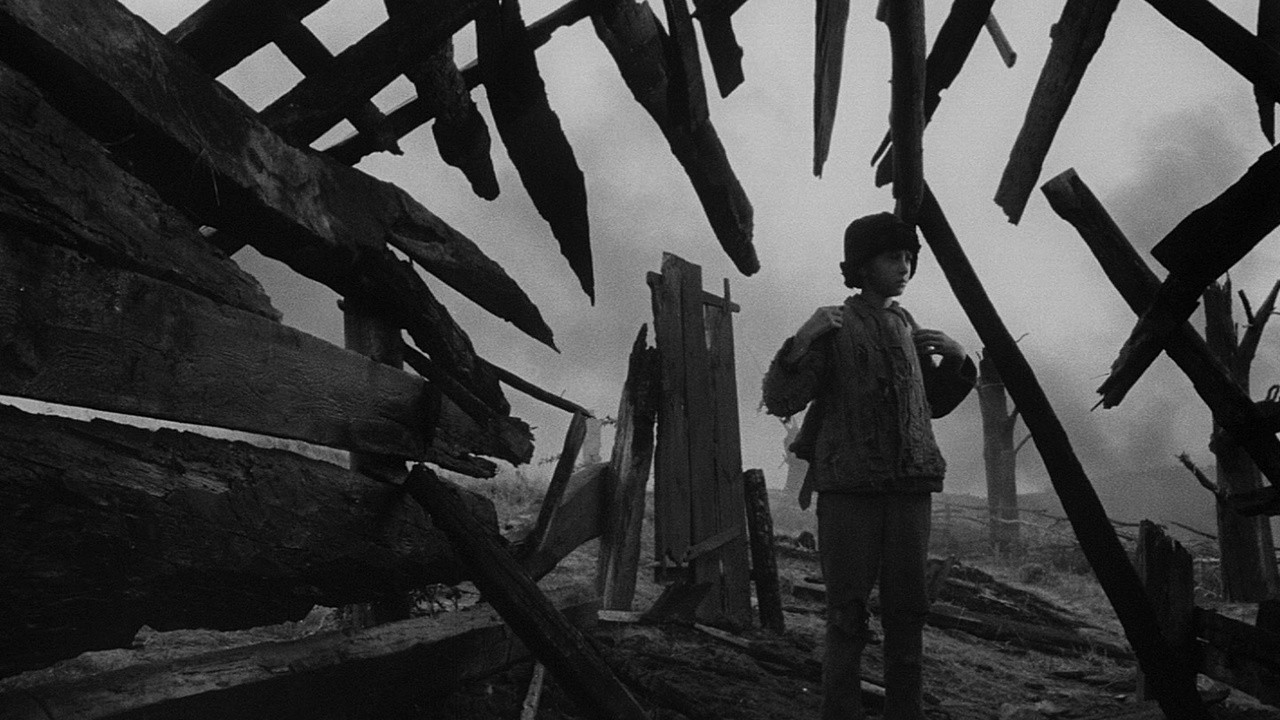
The debut feature from the great Andrei Tarkovsky, Ivan’s Childhood is an evocative, poetic journey through the shadows and shards of one boy’s war-torn youth. Moving back and forth between the traumatic realities of WWII and the serene moments of family life before the conflict began, Tarkovsky’s film remains one of the most jarring and unforgettable depictions of the impact of violence on children in wartime. —The Criterion Collection
Considered one of Russia’s most distinguished contemporary directors, the late Andrei Tarkovsky is known for highly personalized and poetic films. The son of poet Arseni Tarkovsky, he studied Arabic and first worked as a geologist before attending the State Film School in Moscow under Mikhail Romm. While there he made a pair of short films, “There Will Be No Leave Today” (1959) and the acclaimed Katok i Skripka/The Steamroller and the Violin (his diploma film). Following graduation in 1960, Tarkovsky went to work for Mosfilm and made his feature-film directorial debut in 1962 with Ivanovo Detstvo/Ivan’s Childhood. The film earned him top honors at that year’s Venice Film Festival. His sophomore film, Andrei Rublev, is Tarkovsky’s most renowned work. Ostensibly a portrait of a 15th century Russian painter, the film is actually a metaphorical drama mirroring the plight of Russian artists. Some have expanded the film’s parable to reflect the dramatic effects of war and chaos upon humanity… read more
Very beautiful. Felt like a haunting meditation. The cinematography is unreal. It being my second Tarkovsky film, its inspired me to try and watch more of his movies.
Coming after but outdoing Milestone’s All Quiet on the Western Front in depicting war’s usurping of innocence, and preceding but also beating Klimov’s Come and See for visceral wartime atmospherics. The film achieves a sense of lyricism that some veteran filmmakers never capture, let alone first-timers. And while there are some moments here and there that could’ve perhaps been honed a little further - Tarkovsky himself felt the final product could’ve done with some such tweaking yet - on the whole it’s a fine, often beautiful film, and one for the ages.
Reminds me of a lesson from a teacher, who said that the astonishing images of great films have 'layers of meaning'. This piece is a wonderful demonstration of that poetic storytelling.
On the occasion of what would have been Andrei Tarkovsky’s 80th birthday, Adrian Curry looks back on the best posters for his films.
Suddenly this weekend, generous samplings from a slew of new issues from some of the best film magazines around have appeared online. In
First off let me say I love Tarkovsky. Phew, now that I’ve said that I can say, I was extremely disappointed with this film. As the first feature film from the auteur, you can tell he was still finding… read review
Tarkovsky´s first feature film (of a small length, just 93 minutes) feels like a mystical continuation of the first short: The Steamroller and the Violin (in reality it felt more like a prequel, ivan´s… read review
(Friday / March 19, 2010 / 3:45pm)
I’m glad that “Ivan’s Childhood” was my first Tarkovsky experience. I was so touched by this film that I compassionately sympathized for the protagonist. The… read review
For singular first films by any director this project sets high standards Tarkovsky would build on in his later works. The continuity is almost unprecedented and inspired Ingmar Bergman to say he was… read review