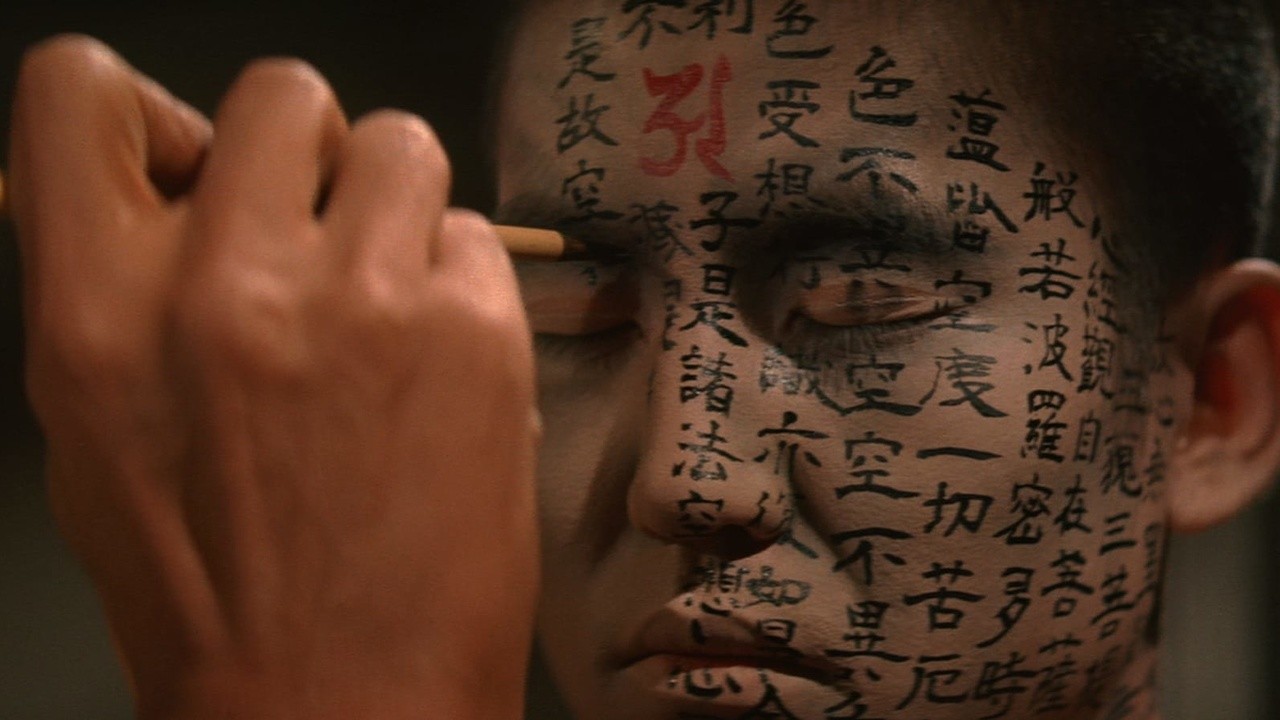
Winner of the Special Jury Prize at Cannes, Kwaidan features four nightmarish tales in which terror thrives and demons lurk. Adapted from traditional Japanese ghost stories, this lavish, widescreen production drew extensively on Kobayashi’s own training as a student of painting and fine arts. —The Criterion Collection
Masaki Kobayashi (小林 正樹, Kobayashi Masaaki, February 14, 1916–October 4, 1996) was a Japanese director.
Among his films is Kwaidan (1965), a collection of four ghost stories drawn from the book by Lafcadio Hearn, each of which has a surprise ending.
Kobayashi also directed The Human Condition, a trilogy on the effects of World War II on a Japanese pacifist and socialist. The total length of the films is over 9 hours. Other notable films include Harakiri (1962) and Samurai Rebellion (1967). Harakiri won him an award at the 1963 Cannes Film Festival, solidifying his place in the history of cinema.
He was also a candidate for directing the Japanese sequences for Tora! Tora! Tora! (1970) but instead Kinji Fukasaku and Toshio Masuda were chosen.
Kobayashi, himself a pacifist, was drafted into the Imperial Japanese Army during World War II, but refused to fight and refused promotion to a rank higher than private. —Wikipedia
I adored it, quite a staggering achievement. The Woman in the Snow and Hoichi the Earless are certainly the two best, but the more I think about Black Hair the more I like it, In a Cup of Tea was good but that ending was slightly unfortunate, but again, the more I think about it the more I like it. Visuals are sublime, a great film.
definitely enjoyed 'Hiochi the Earless' and 'The Woman in the Snow' most, of the 4 vignettes. All in all, it was a stunning compilation. ☽ ☾ Read my full review here: http://liveforfilm.tumblr.com/post/34687211570/kwaidan-1965
Oh! the mysteries found in a cup of tea. Mysteries by Kobayashi and Ruiz.
Takemitsu’s dread score distorts the director’s abundant visual imagination into something more like superstition.
As if to convey the sentiment that spirits are a part of every day life, in Kwaidan there is no rhyme or reason as to why spirits appear or go away. For this reason alone, much of the horror is psychological… read review
There are ghost stories and there are horror movies, and Kwaidan (1964) is emphatically the former. It has not come to jolt or thrill, but to haunt. The ghosts in Kwaidan are words, thoughts, and… read review