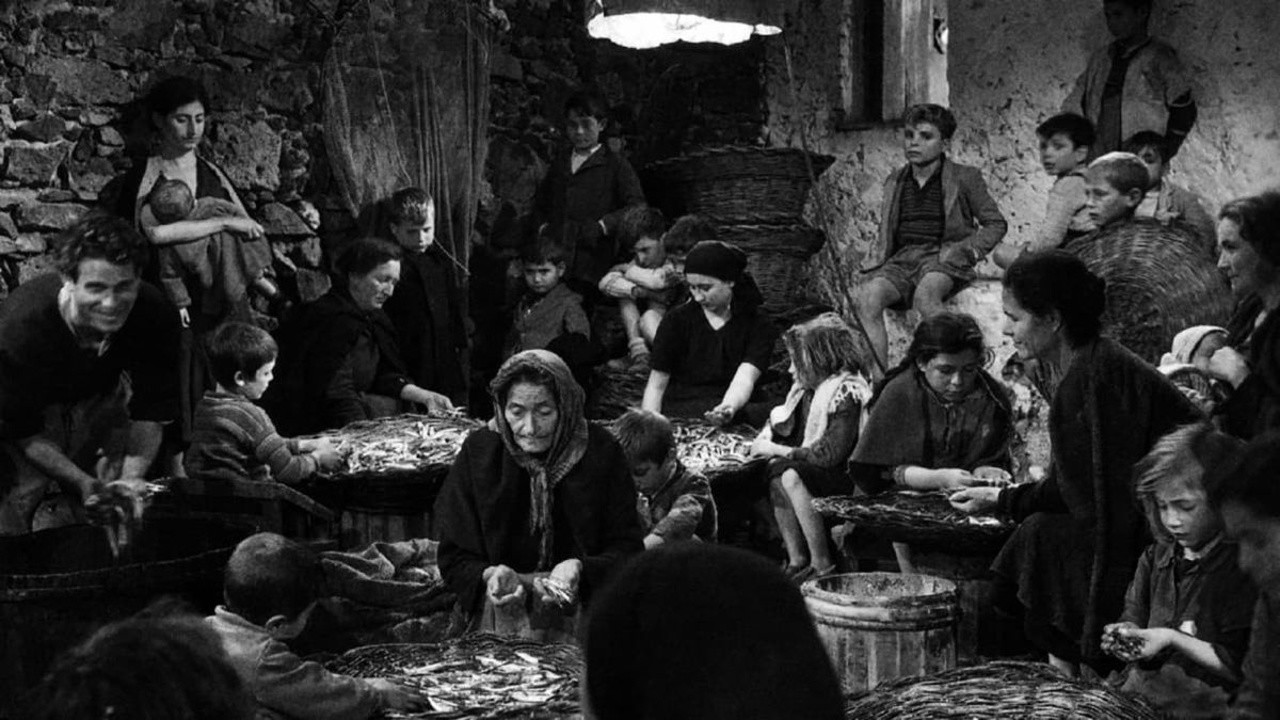
La terra trema is a work of uncompromising realism that is universally acknowledged as a masterpiece of post-war Italian cinema. Entirely set and shot in a small village on the east coast of Sicily and using non-professional actors, it tells the story of a fishing family which attempts to escape from poverty and exploitation by becoming the owner of its own boat.
To acquire the boat the family is forced to mortgage its house but the boat is destroyed in a storm and the family is ruined. However, the film ends on a hopeful note, with the community able to learn from the events and succeed together in overthrowing exploitation.
Upon the film’s release, the Valestro family, who were the main participants, wrote to Visconti expressing deep gratitude to him for telling their story to Italy and the world. We are profoundly grateful for the experience we underwent together, from which we have reaped the highest hopes for our future.
La terra trema instantly reveals the quality of Visconti’s direction, particularly in the sheer beauty of the images and the vibrant performances he achieved from the villagers. Many of its themes recur in Visconti’s later work but nowhere else are they so firmly anchored in realism and respect for life. —BFI
As Martin Scorsese notes in My Voyage to Italy, no 20th Century film-maker can lay claim to the unique disposition of Count Don Luchino Visconti di Modrone, the final heir to one of Europe’s oldest aristocratic families. For much of his youth, Visconti exulted in the privileges of his lifestyle. His house was a frequent retreat for the likes of Arturo Toscanini, Gabrielle d’Annunzio and Giacomo Puccini. His lifelong engagement in theatre and opera was imbibed from an early age along with brief passions such as raising horses and maintaining stables. It wasn’t long before Visconti began questioning the limitations of his lifestyle. Inspired by his intellectual yearnings, Visconti wandered away from his comfortable shelter and visited Paris. This would be a turning point in his life. Through his friendship with Coco Chanel, Visconti met French director Jean Renoir. He served as assistant director on some of Renoir’s best films from the 30s, including Toni, Partie de campagne and The Lower… read more
one of the very first intense ensemble-films in history that I have seen. As the camera slowly walks past the groups, one can see individuals argueing about prizes, while others watch, argue on different matters. everything quite natural, as long as one manages to everhear the repetitive lines they keep saying, but on a closer look also quite specifically choreographed. definately overwhelming!
It'd ironic that this may be my fave Italian neo-realist film since its by a director whose sensibilities don't really fit the genre and could only be contained within the confines of it for his 1st few films before his operatic style took over. One of Visconti saddest films and one of the best about the degradation of poverty.
Visconti wasn't one of the key figures of Italian neo-realism but five years after his debut masterpiece Ossessione he delivered the purest, most definitive example of the genre. The film records the lives of a poor Sicilian fishing family and focuses on their attempts to become self-sufficient. Austerely shot with fabulous use of deep focus photography, Visconti's most understated work is a magnificent achievement..
Criminally overlooked as both one of the neo-realist masterpieces and as the greatest film of Visconti's
Luchino Visconti’s La Terra Trema is a masterpiece of world cinema and a shining example of the Italian neo-realist style. Essentially a film about the exploitation of fishermen by ruthless wholesalers… read review
Un film sincero, e degno di nota. La perseveranza, e ultimamente il renunciare di ’Ntoni e la sua famiglia fa per una delle storie piu memorabili del cinema italiano. Una cinematografia magica, particolarmente… read review