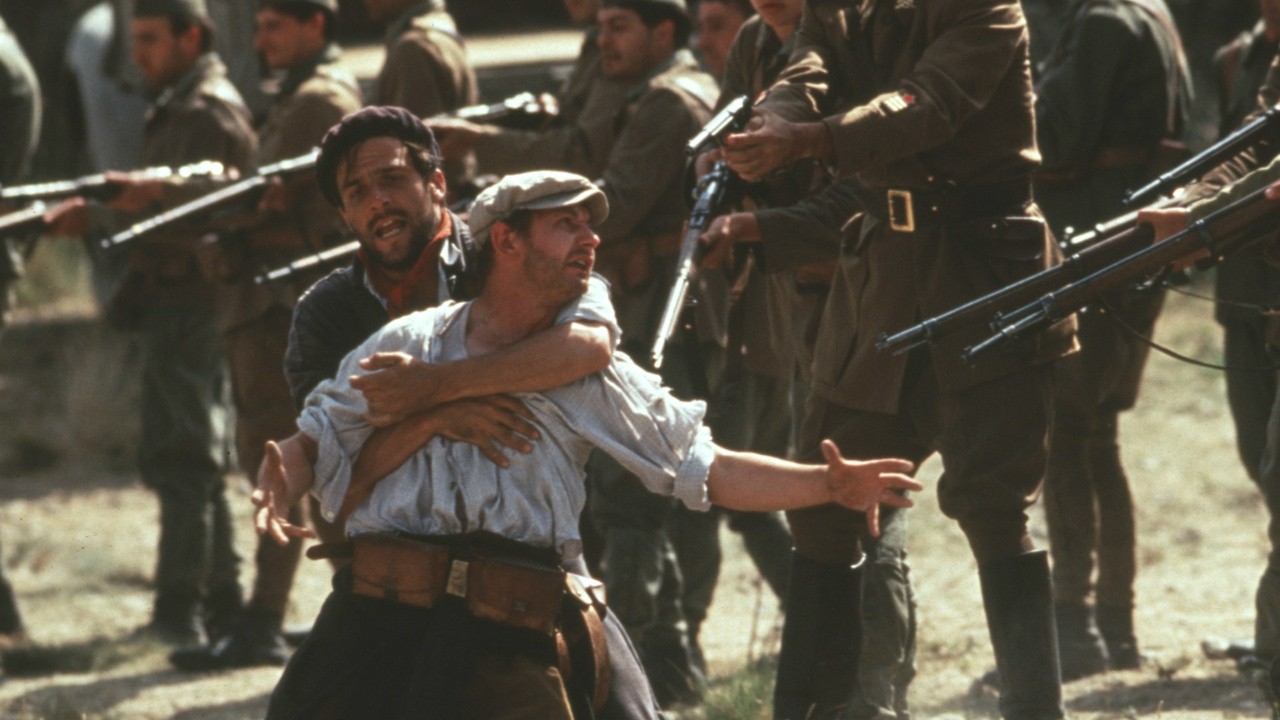
David Carr has died at an old age and his granddaughter discovers old letters, newspapers and other documents in his room. Persuaded of the necessity of helping the Spanish Republicans in their fight against the fascist Nationalist rebellion, Carr, a young unemployed worker and member of the Communist Party, leaves Liverpool and travels to Spain to join the International Brigades. He crosses the Catalan border and ends up enlisted in a POUM militia on the Aragon front. In this company, as in all POUM militias, men and women — such as the young and enthusiastic Maite — fight together. In the following weeks and months he becomes friends with other foreign volunteers, like the French Bernard, and he falls in love with Blanca, a member of POUM, who is also the ideologue of his group.
After being wounded and recovering in a hospital in Barcelona, he finally joins — in accordance with his original plan and against the opinion of Blanca — the government-backed International Brigades, and he witnesses first-hand the Stalinist propaganda and repression against POUM members and anarchists; he then returns to his old company, only to see them rounded up by a government unit requiring their surrender: in a brief clash Blanca is killed. After her funeral he returns to Great Britain with a red neckerchief full of Spanish earth.
Unlike virtually all his contemporaries, Ken Loach has never succumbed to the siren call of Hollywood, and it’s virtually impossible to imagine his particular brand of British socialist realism translating well to that context. After studying law at St. Peter’s College, Oxford, he branched out into the theater, performing with a touring repertory company. This led to television, where in alliance with producer ‘Tony Garnett’ he produced a series of docudramas, most notably the devastating “Cathy Come Home” episode of “The Wednesday Play” (1964), whose impact was so massive that it led directly to a change in the homeless laws. He made his feature debut Poor Cow (1967) the following year, and with “Kes”, he produced what is now acclaimed as one of the finest films ever made in Britain. However, the following two decades saw his career in the doldrums with his films poorly distributed (despite the obvious quality of work such as The Gamekeeper (1968) (TV) and Looks and Smiles (1981… read more
Just watched "Land and Freedom" by Ken Loach. Very good. Must watch more of his films.
Celebrated socialist filmmaker Ken Loach (“Kes” & “Riff-Raff”) in his final collaboration with screenwriter Jim Allen (“Hidden Agenda” & “Raining Stones”) heads to Spain for this epic tale… read review