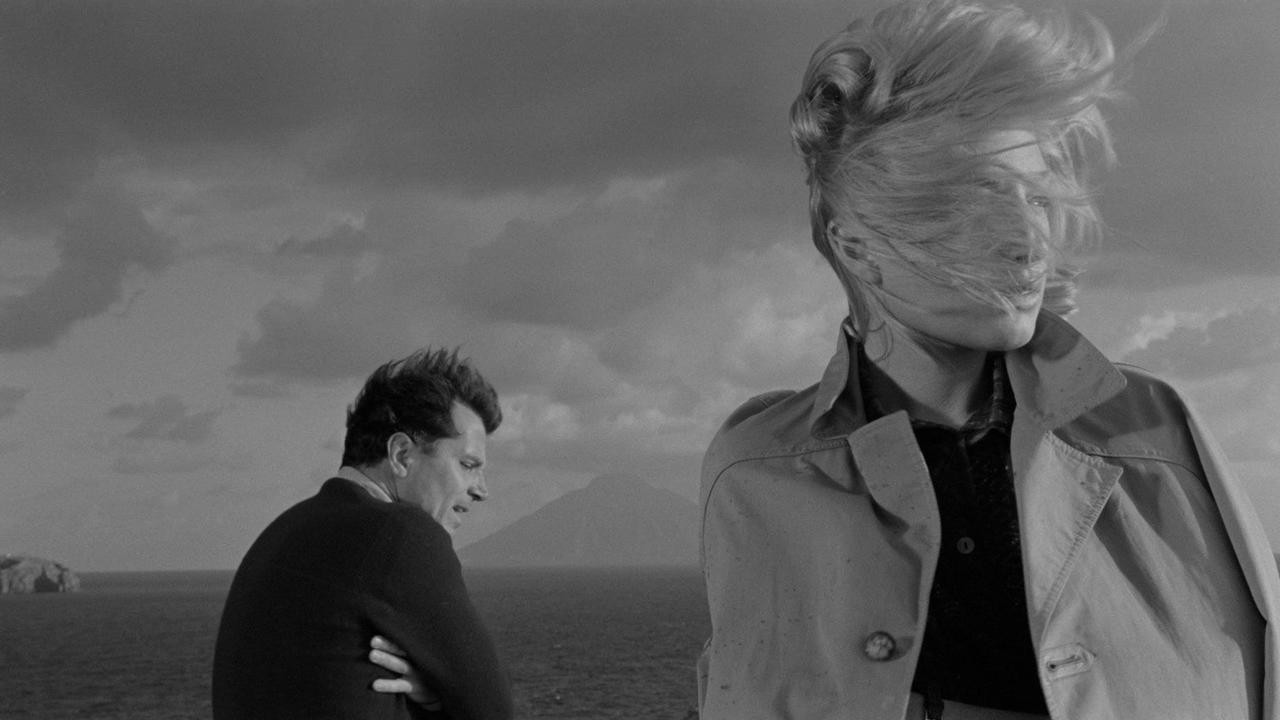
A girl mysteriously disappears on a yachting trip. While her lover and her best friend search for her across Italy, they begin an affair. Antonioni’s penetrating study of the idle upper class offers stinging observations on spiritual isolation and the many meanings of love. —The Criterion Collection
Michelangelo Antonioni once described his work as “archeological research” which sifted through “the arid remains of our times”. If Fellini claimed to treat the past as science fiction, Antonioni gazed deeply into the future already visible in the present (L’Eclisse) or a past which uneasily hung onto a present that had outlived it (L’Avventura). Born in an upper-middle class family in Ferrara in 1912; Antonioni studied economics at the University of Bologna, where he staged works by Luigi Pirandello as well as original work written by himself. Antonioni’s time as a film critic for the Roman Cinema magazine brought him in contact with Cesare Zavattini, Federico Fellini, Roberto Rossellini, Luchino Visconti and others. For Rossellini, he would co-write Un pilota ritorna and with Fellini, he collaborated on the screenplay of his first feature The White Shiek.
Antonioni, however, yearned to begin his own career in film. To this end, he enrolled at the Centro Sperimentale di Cinemografia… read more
A beautiful film! I wish this was the first Antonioni film I watched Since it is a better introduction to his work then both La Notte and Blow-Up. Great film!
A very human, honest film that portraits and captures true human emotions (like guilt for instance), confusion and the difficulties of love. All that had to happen was the disappearance of one person. What if it never happened, would they all end up being happy? Or was this the only way for them to find the truth, or even true love... tragic.
The first Antonioni movie to really resonate with me, instead of just leaving me bored and unsatisfied. Monica Vitti is great in the film, playing a woman who's conflicted about her love for her missing friend's fiancé. There isn't much of a plot besides that, but if you're looking for an interesting character study about alienation that has absolutely stunning visuals and a great ending, than look no further.
A look at the influence of Polish movie posters on the work of the renowned twin animators the Quay Brothers.
Antonioni’s 1960 masterpiece gets animated—and is now playing on MUBI.
Critic-filmmaker Luc Moullet pens a provocative, previously unpublished take on the difference between the B&W and color work of Antonioni.
The poet and screenwriter worked with Antonioni, Fellini, Angelopoulos, Tarkovsky, Rosi and many others.
"Ivo van Hove's Roman Tragedies was one of the theatrical highlights of 2009," writes Maxie Szalwinska for the Guardian. "A six-hour mash
"When a director dies, he becomes a cinematographer." That softly devastating one-liner, initially applied, I believe, to Josef von Sternberg
"Following her 2003 debut The Forest for the Trees, 32-year-old German writer-director Maren Ade's trenchant, funny, and sensitive Everyone
Bergman never understood why Antonioni was held in high esteem.
Antonioni let the visuals do the work – one must watch it all.
Relative to Antonioni, Bergman’s films could be ‘watched’ on… read review
This is cinematic art at its finest. The visuals tell the story, not the dialogue. Thoroughly gripping from beginning to end. Probably too subtle for the avg filmgoer, that’s merely one characteristic… read review
Antonioni conducts his existentialist symphony in bleak minor, showing us that film can be as mysterious in it’s workings on our senses as music, stirring up responses in the way an elegant harmony… read review
Although he made five films before this, L’Avventura was Michelangelo Antonioni’s breakout film, a modernist masterpeice of filmmaking that progresses the language of film from then on (in much the… read review