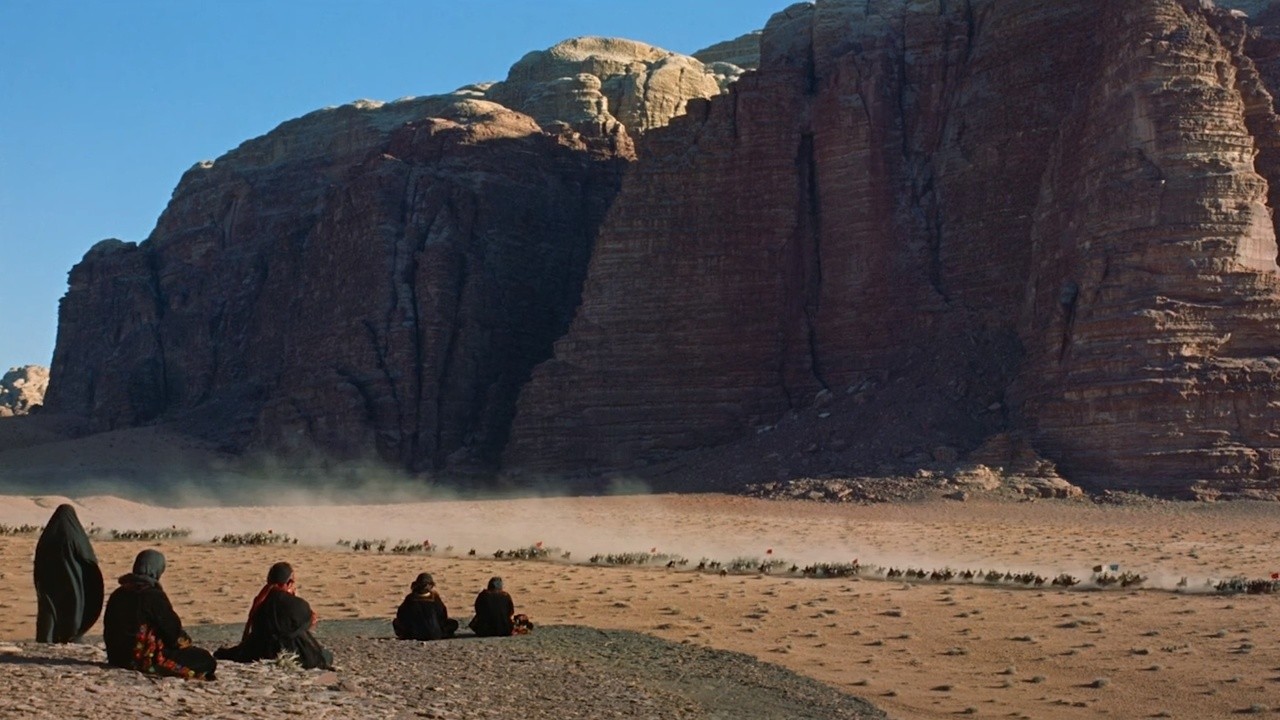
In 1916 British Intelligence supports the Arab rebellion against the Turkish-German alliance. Dryden, a civilian member of the Arab Bureau, selects Lieut. T. E. Lawrence, an enigmatic 29-year-old scholar, to evaluate the Arab revolt. Enthusiastically undertaking this assignment, the officer contacts Prince Feisal, a rebel leader, and persuades Feisal to lend him a force of 50 men. With this skeleton band, accompanied by Sherif Ali, Lawrence crosses the Nefud Desert. At the journey’s end, however, Lawrence learns that one of his men is missing. Undeterred by Arab assertions that the missing man’s death had been divinely decreed, Lawrence returns to the desert and rescues him, earning thereby Ali’s friendship and the respect of his subordinates. At a well Lawrence is confronted by the sheikh Auda Abu Tayi, whom he persuades to join the assault on Agaba, a Turkish port at the desert’s edge. The Turks, surprised by the overland attack, are routed, and the victory revitalizes the Arab rebellion. Arab unity, however, is undermined by internecine warfare. When one of his troop slays one of Auda Abu Tayi’s henchmen, Lawrence in expiation executes the murderer, who proves to be the Arab he had saved in the desert. Unnerved, Lawrence returns to Cairo. Delighted by Lawrence’s military success, however, General Allenby provides him with arms and money for future victories. Lawrence launches a series of successful guerrilla raids, which, as reported by American journalist Jackson Bentley, establish his international reputation. While on a scouting mission with Ali, Lawrence is captured and tortured by the Turks. He returns to Cairo, where General Allenby persuades him to spearhead an attack on Damascus. After the battle, Lawrence leads his men in the massacre of the retreating Turks. Upon entering Damascus the British Army is met by victorious Arab forces. Lawrence relinquishes control of the city to an Arab Council, but soon factionalism threatens to destroy it. On May 19, 1935, Lawrence dies in a motorcycle crash in Dorset, England, and is commemorated in services at St. Paul’s. —Turner Classic Movies
Director, writer, and producer David Lean, grew up in a strict religious background in which movies were forbidden, to become one of the world’s most celebrated filmmakers. Beginning as a tea boy in the mid-‘20s, he was lucky enough to move into editing just as sound films were coming on the scene. By the mid-’30s, he was regarded as one of the top in his field. Lean turned down several chances to make low-budget films, and got his first directing opportunity (unofficially) on Major Barbara (1941), one of the most celebrated movies of the early ‘40s. Noel Coward hired Lean as his directorial collaborator on his war classic In Which We Serve (1943), and, after that, Lean’s career was made. For the next 15 years, he became known throughout the world for his close, intimate, serious film dramas. Some (This Happy Breed 1944, Blithe Spirit 1945, and Brief Encounter 1945) were based upon Coward’s… read more
THE CAMERA NEVER FLIES A squat black ruin lours from a massy clifftop. Ridiculously fake wind effects whoop and whoosh beneath the throbbing
Barack Obama lists these films as some of his favorites. We usually think one's personal tastes are an insight into who they are. Do these
Upon telling several friends that I had plans to view this four hour-long epic, they sighed, telling me that it was too long and tedious to possibly be enjoyable. (I guess this is just the standard… read review
The film is so grand in scope, That you can’t help but be swept away by it. Even it’s running time is long. There is little subtlety in this film everything seems larger then life including it’s theme… read review
It may be the definitive epic film, with its long run time, sweeping visual scope and huge canvas of battles and varying peoples. What makes it so unusual is that all of that epic trapping is put in… read review
David Lean won the second of his two Best Director Oscars for this sweeping desert classic – part war film, part bio-pic, part poli-social commentary – about the adventures of T.E. Lawrence and his… read review