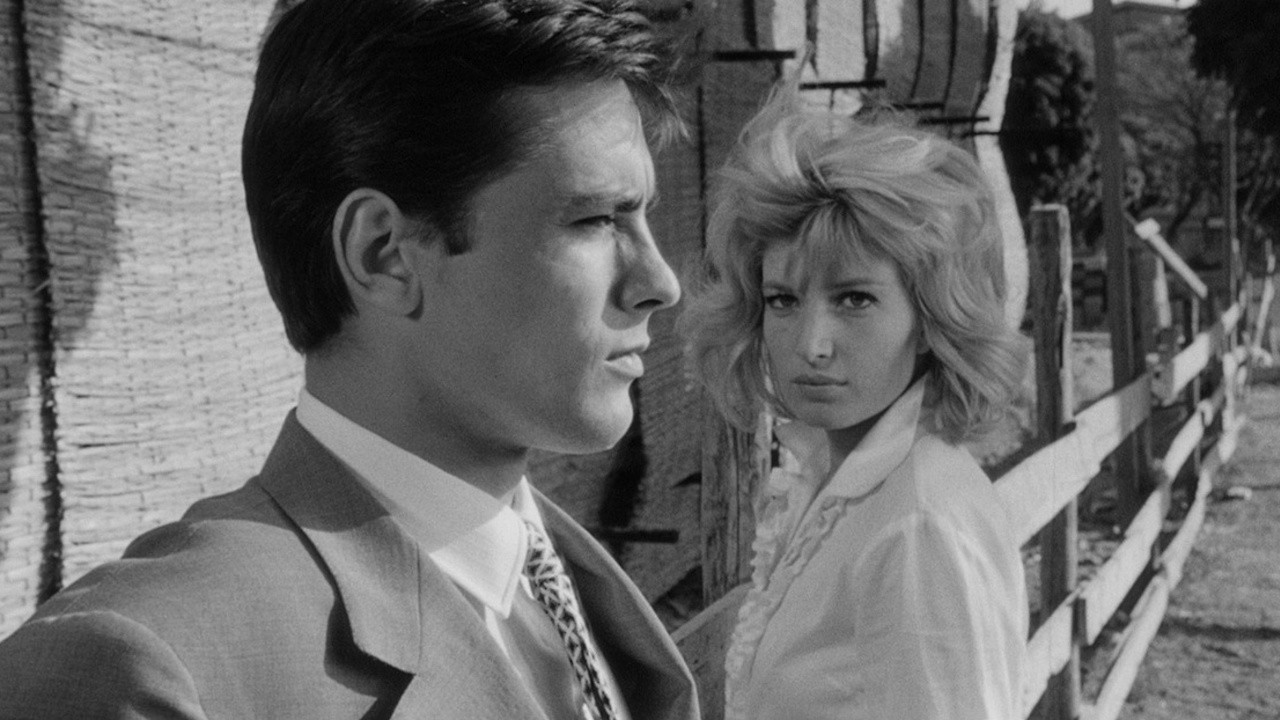
The conclusion of Michelangelo Antonioni’s informal trilogy on modern malaise, L’eclisse (The Eclipse) tells the story of a young woman (Monica Vitti) who leaves one lover (Francisco Rabal) only to drift into a relationship with another (Alain Delon). Using the architecture of Rome as a backdrop for the couple’s doomed affair, Antonioni reaches the apotheosis of his modernist style, returning to his favorite themes: alienation and the difficulty of finding connections in an increasingly mechanized world. —The Criterion Collection
Michelangelo Antonioni once described his work as “archeological research” which sifted through “the arid remains of our times”. If Fellini claimed to treat the past as science fiction, Antonioni gazed deeply into the future already visible in the present (L’Eclisse) or a past which uneasily hung onto a present that had outlived it (L’Avventura). Born in an upper-middle class family in Ferrara in 1912; Antonioni studied economics at the University of Bologna, where he staged works by Luigi Pirandello as well as original work written by himself. Antonioni’s time as a film critic for the Roman Cinema magazine brought him in contact with Cesare Zavattini, Federico Fellini, Roberto Rossellini, Luchino Visconti and others. For Rossellini, he would co-write Un pilota ritorna and with Fellini, he collaborated on the screenplay of his first feature The White Shiek.
Antonioni, however, yearned to begin his own career in film. To this end, he enrolled at the Centro Sperimentale di Cinemografia… read more
Amazing film, unbelievably interactive use of camera to elicit meaning. One of the finest film's I've ever seen.
Whatever you think of Antonioni it's hard to resist falling for this sere masterpiece. That shot of Vittoria looking at the line of rattling poles at night shares a lot with Conradian nihilism: "Down below in the quiet, narrow street measured footsteps approached the house, then died away, unhurried and firm, as if the passer-by had started to pace out all eternity, from gas-lamp to gas-lamp in a night without end"
Everything I have looked at so far is "not available in your area". What iis the point of this site?
Critic-filmmaker Luc Moullet pens a provocative, previously unpublished take on the difference between the B&W and color work of Antonioni.
THE THREE FACES OF EVE I tre volti (Three Faces of a Woman, 1965) is, among other things, the Antonioni film you're least likely to have seen
I saw this film in a company where we talked and had fun; I wasn’t very concentrated on the film. That said, in that moment, I think everything was perfect to see this film, where plot is – as in “L’Avventura”… read review
English Title: L’Eclisse
Original Title: L’eclisse
Year: 1962
Language:
Country:
Genre: Drama, Romance
Director: Michelangelo Antonioni
Writers:
Michelangelo Antonioni… read review
Many people find it difficult or even boring to watch Antonioni’s movies. But it wasn’t until I watched all three pieces+Red Desert, analysing various aspects,and I comed to conclusion that Antonioni’s… read review
The Steppenwolves – Being somewhat miffed by the current crop of DVD releases I’ve been going through the Criterion Collection catalog by directors as I know of them. Antonioni did The Passenger and… read review