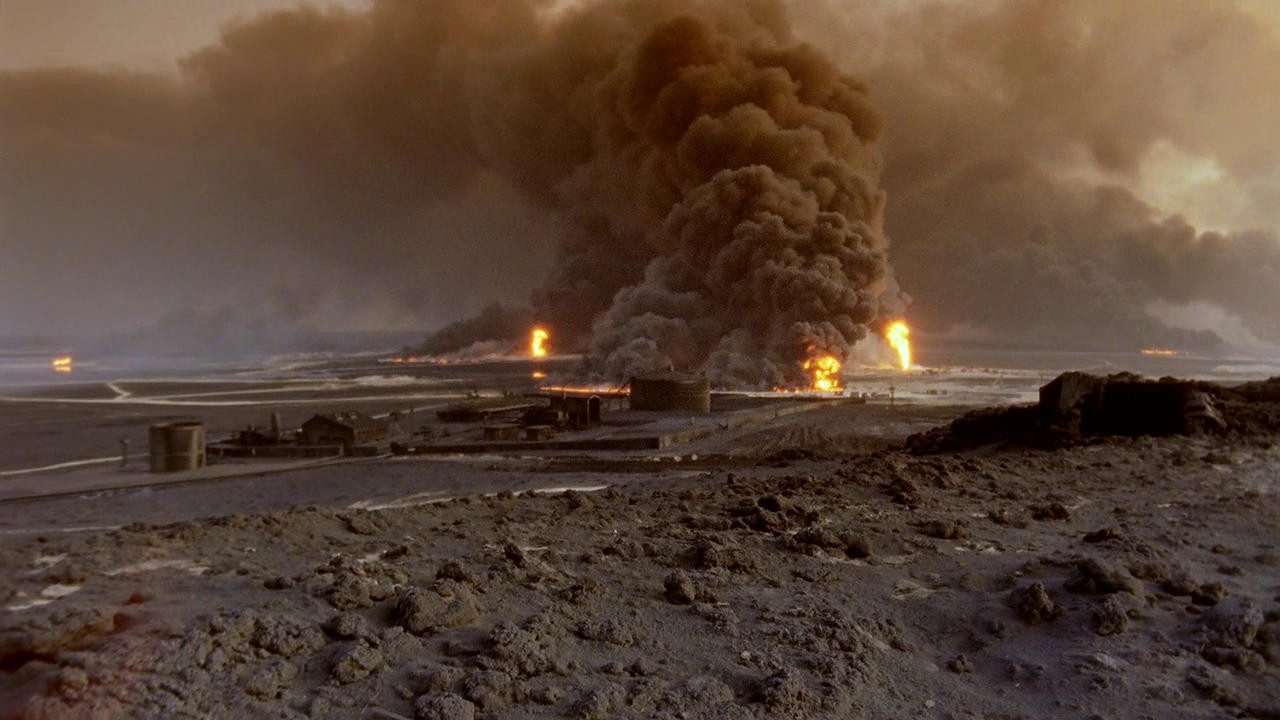
Lessons of Darkness might be the greatest, most beautiful anti-war film ever made, and yet, there are no substantial images of war making, just post-war horror and aftermath. With elongated elegies of aerial shots, it transcends current affairs and factual programming. This is the universal war. Although this film was filmed in Kuwait in the wake of King George Bush’s First Gulf Mother of All Wars against Madman Sadman Insane Hussein, this could be any war and any country. Like Fata Morgana, in fact it is a science-fiction film. We feel like aliens landing upon some exotic strange planet, yet cannot recognize our earth. But logically, we know it could only have been shot here. In this, the film is most subversive. Although denounced as apolitical and spat upon for aestheticizing war at the Berlin Film Festival, the Kuwaiti government expelled Herzog because they knew that Herzog was prying into the deepest wounds of war. We must question what madness in their minds can drive men to mutilate humanity, disfigure democracy, and destroy civil society. The entire planet is in flames and this film is a requiem for our self-destruction. In the debris-strewn desert landscapes, in the oil-light of current realities, this is a last post call for a beautiful planet in a solar system where the vultures of war make all nations into torture chambers or national theme parks for Satan’s playground. It is in this pre-apocalyptic struggle through 12 stations of a pan-religious crusade that Lessons serves as an evocative tone poem to make us work harder to extinguish the flames of oil-war, a black substance which is, after all only the extracted ancient juices of dead dinosaurs and ancient plant matter. —One World Film Festival
One of the most influential filmmakers in New German Cinema and one of the most extreme personalities in film, Werner Herzog quickly gained recognition not only for creating some of the most fantastic narratives in the Film history, but for pushing himself and his crew to absurd and unprecedented lengths, again and again, in order to achieve the effects he demanded. Born Werner Stipetic in Munich on September 5, 1942, Herzog came of age in Sachrang, Bavaria, amid extreme poverty and destitution. After Herzog turned seventeen, a German film producer optioned one of his screenplays, then promptly destroyed the contract when he discovered the author’s age. Circa 1962, 20-year-old Herzog enrolled in the University of Munich as a history and literature student, and produced his first motion picture, the twelve minute Herakles, his second short Game in the Sand, and his third, the pacifist tract The Unprecedented Defense of Fortress Deutschkreuz.In 1963, he established his own production… read more
literally in awe. i'm writing a paper about this so i had to watch it a few times. it just gets more powerful with each viewing.
The very first Herzog "documentary" I saw, and a good example of Herzog's sensible cinematography and sense of broader scope. Described as an anti-war film, the way Herzog portrayed the violence of wildfire and deserted tarpits seem to almost glorify it with its mistifying photography.
Featuring not one but two Herzog gems, a Moonrise Kingdom short, a talk about Twin Peaks and words of discouragement from Richard Brody.
Four documentaries, at least two of them worth your while evidently and Hollywood junk dominate this week's theatrical releases. Linkage
Se até agora Vertov era o documentarista que mais respeitava (tendo realizado o documentário que mais impressão me fez: “O Homem da Câmara de Filmar”), este foi possivelmente ultrapassado por Herzog… read review
This must be one of the most beautiful movies I’ve ever seen. Every shot of the film is a work of art in itself. I find it being a successor to Alain Resnais’s Nuit et brouillard in the way they both… read review