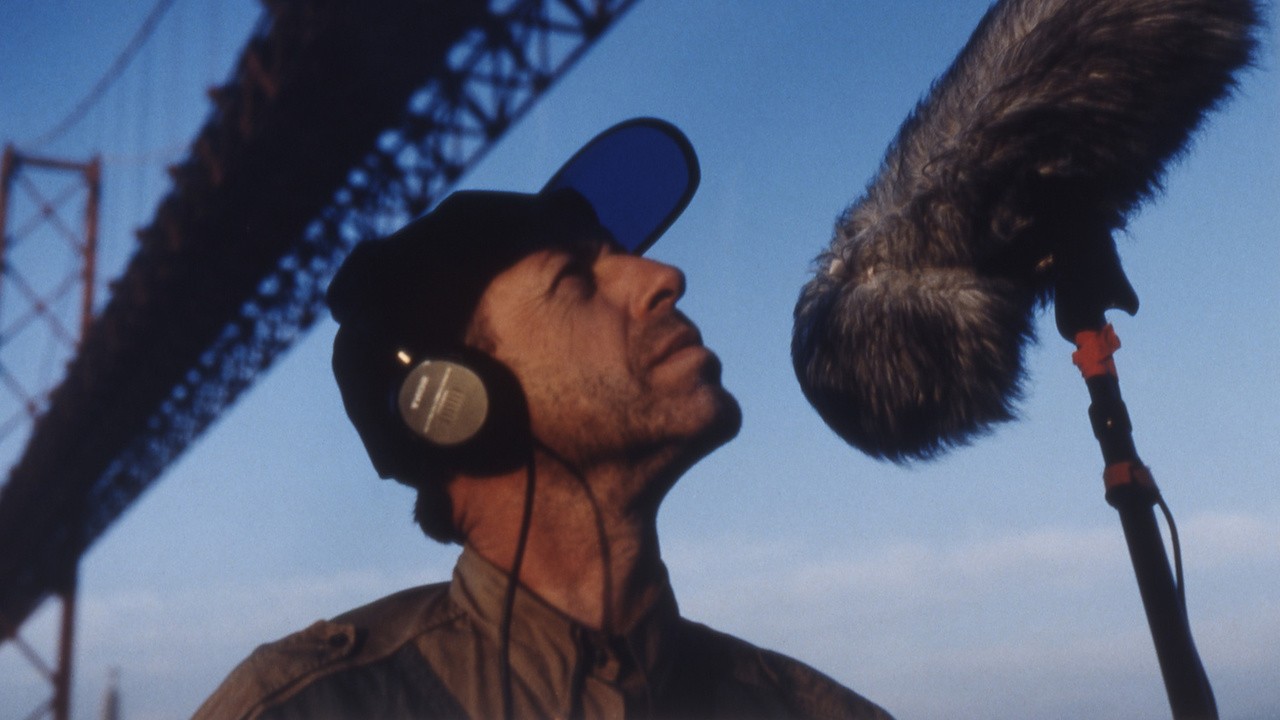
The director Friedrich Monroe has trouble with finishing a silent b&w movie about Lisbon. He calls his friend, the sound engineer Phillip Winter, for help. As Winter arrives Lisbon weeks later, Monroe is disappeared but has left the unfinished film. Winter decides to stay, because he is fascinated of the city and the Portuguese singer Teresa, and he starts to record the sound of the film. At the same time Monroe cruises through the city with a camcorder and tries to catch unseen pictures. Later they meet and Winter convinces Monroe of finishing the film. –IMDb
Born in Dusseldorf just after the end of World War II, German film director Wim Wenders grew up with an insatiable appetite for American movies. Not all that interested in big-budget products, he, instead, developed a fascination with B-movies, notably melodramas and Westerns. After studying Medicine and Philosophy in his native country, Wenders took up art in Paris (a mecca for viewing American films), and then returned to his homeland to attend Munich’s Academy of Film and Television. Like many of his French movie-fan brethren, Wenders began his career writing film criticism before directing a few short subjects of his own, and, in 1970, he and several other young filmmakers formed a production-distribution firm, Filmverlag Der Autoren. Summer in the City (1970) was Wenders’ first feature film, but it was his 1973 adaptation of Nathaniel Hawthorne’s The Scarlet Letter that first brought him attention outside of Germany. The film included many accomplishments, most notably coaxing… read more
Wenders is back on his travels, this time to the capital of Portugal. He resurrects his on-screen alter ego of Philip Winter for a film that evolved from a documentary into a fiction film, albeit one with a very slight story. Vogler played the Winter character several times for Wenders and this time he's a sound engineer who makes his way to Lisbon to help a filmmaker on his latest project, only to find him missing..
A very corny work of love about Lisboa. At some point there's a brief but lovely tribute to "sound design" ('sonoplastia'). However, the film was - IMO - a very dull experience in general. The scenes with Madredeus (except the musical playbacks) were actually agonizing. The old footage of the city was refreshing. Well, it's probably best consumed if born and raised elsewhere.
Saudade! I watched this film on one of the last nights I was living in Lisbon last year, told to watch it in fact by a crazy Italian 'lesbica', my housemate. Primarily set in Alfalma, the old Moorish district by the Sé on the Tejo, it's a wonderful fim about nothing. Filmed in '94 and set earlier than that it really shows how resistant the Portuguese capital is to change. My favourite part is the rickety 28 tram.