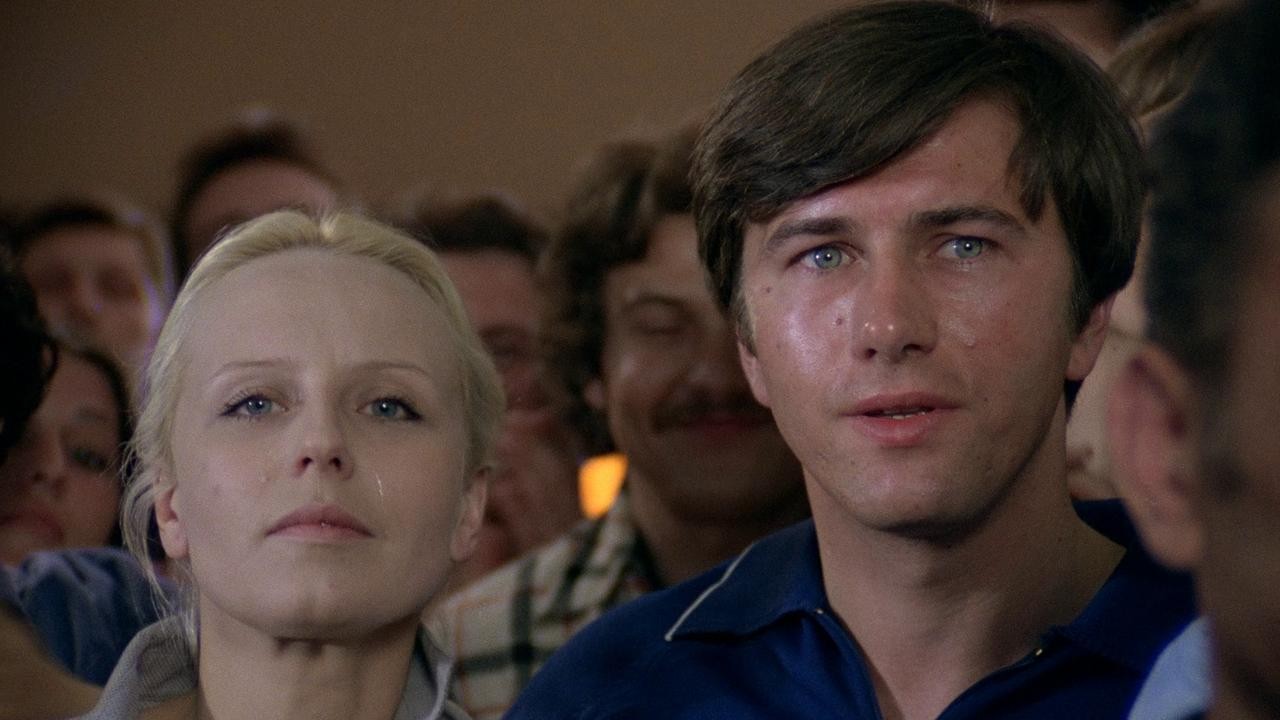
The film is a continuation of the story of Maciej Tomczyk, the son of the protagonist of Wajda’s earlier film, Man of Marble. Here, Maciej is a young worker involved in the anti-Communist labour movement, described as “the man who started the Gdańsk Shipyard strike”, and a journalist working for the Communist regime’s radio station, who is given a task of slandering Maciej. The young man is clearly intended as a parallel to Lech Wałęsa (who appears as himself in the movie).
The film was made during the brief thaw in Communist censorship that appeared between the formation of Solidarity in August 1980 and its suppression in December 1981, and as such it is remarkably critical of the Communist regime. The film won the Palme d’Or and the Prize of the Ecumenical Jury at the 1981 Cannes Film Festival. —Wikipedia
A major figure in the world of post-World War II Eastern European cinema, Polish director Andrzej Wajda has chronicled his country’s political and social evolution with sensitivity, fervor, and a refusal to make compromises in dealing with his difficult subjects. The son of a Polish cavalry officer who was killed early in World War II, Wajda fought in the Resistance movement against the Nazis when he was still a teenager. After the war, he studied to be a painter before entering the Lodz film school. On the heels of his apprenticeship to director Aleksander Ford, Wajda was given the opportunity to direct a film on his own. With A Generation (1955), the first-time director poured out all his bitterness and disillusionment regarding blind patriotism and wartime heroics, using as his alter ego a young, James Dean-style antihero played by Zbigniew Cybulski. The Wajda/Cybulski team went on to make two more films of escalating brilliance, which further developed the antiwar theme of A Generation… read more
A truly well done film. Great presentation of life at that time, and of course.. great acting by Krystyna Janda!