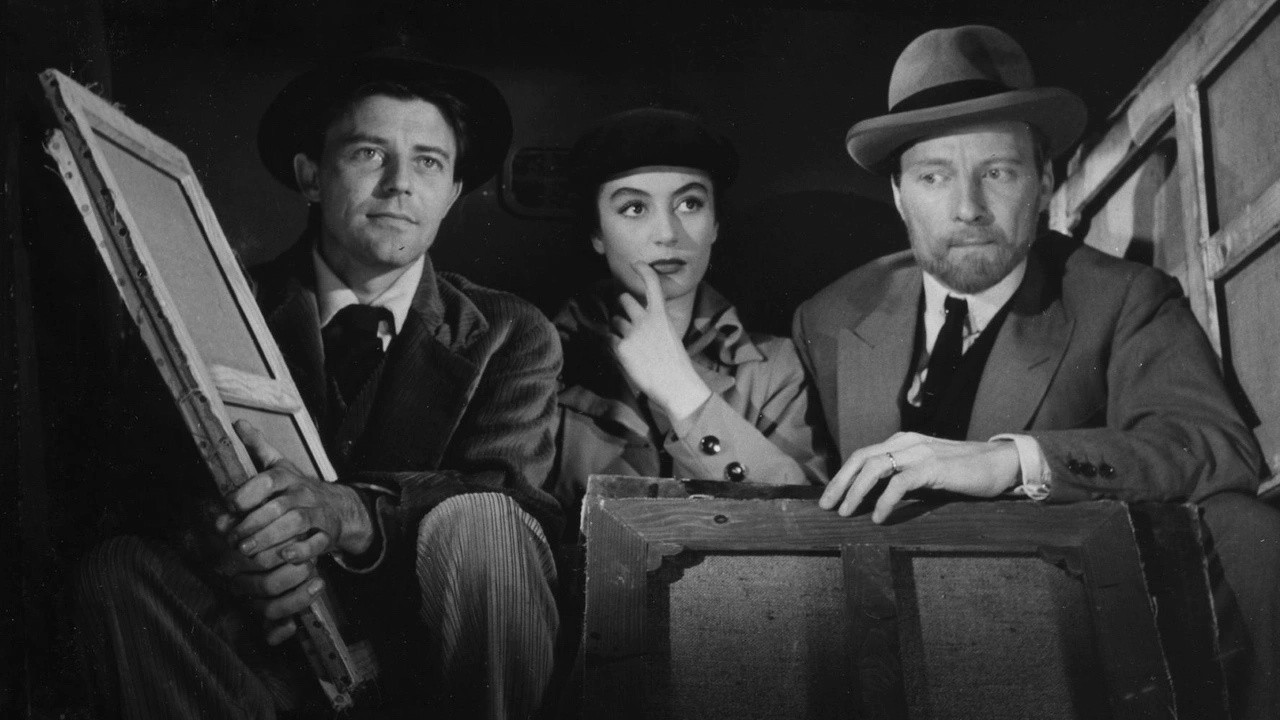
This 1958 French-Italian drama film chronicles the last year of the life of the Italian painter Amedeo Modigliani who worked and died in abject poverty in the Montparnasse Quarter of Paris, France.
It was originally directed by Max Ophüls, but he died of rheumatic heart disease while shooting interiors on the film, so his name was credited as dedicatee; his friend Jacques Becker took over after Ophüls’s death and completed filming.
His interest in films was stimulated by a meeting with King Vidor, who offered him employment in the US as actor and assistant director. However, he remained in France and became assistant to Jean Renoir, a friend of the family, during that director’s peak period (1932-39). In 1934 he ventured briefly into independent production, co-directing with Pierre Prévert a short film, Le commissaire est bon enfant, le gendarme est sans pitié (1935). In 1935 he turned out a five-reeler, Tête de turc (1935), which he later refused to acknowledge as his.
In 1939 he began shooting a feature film, L’or du Cristobal (1940), but walked out after three weeks, leaving the film to be finished by Jean Stelli. In 1942, after a year in a German prisoner-of-war camp, he began his career as director. His entire output consisted of only 13 films, but they include some of the most artistically and technically substantial in French cinema. He is one of the few Old Guard directors done honor by the New… read more
Max Ophüls (born Maximillian Oppenheimer, 6 May 1902, Saarbrücken, Germany – 25 March 1957, Hamburg, Germany) was an influential German-born film director who worked in Germany, the United States and France. He made nearly thirty films.
He started his career as a stage actor in 1919 but moved into theatre production in 1924. Two years later, he became creative director of the Burgtheater in Vienna and, having had 200 plays to his credit, turned to film production in 1929, when he became a dialogue director under Anatole Litvak at UFA in Berlin. He worked throughout Germany and directed his first film in 1931, the comedy short Dann schon lieber Lebertran (literally In This Case, Rather Cod-Liver Oil).
Of his early films, the most acclaimed is Liebelei (1933), which included a number of the characteristic elements for which he was to become known: luxurious sets, a feminist attitude, and a duel between a younger and older man.
Predicting… read more
What a wonderful Misraki's musical theme! Such an amazing piece of minimalism. And thank you, Lilli Palmer! She was a really beautiful
Yves Allégret is part of that generation of French filmmakers it's no longer safe to ignore, despite their dismissal by Cahiers du Cinema
Over at Shadowplay, I'm hosting a little blogathon on "late films," but it was coincidence that found me screening a fan-subtitled, from