Watch unlimited films online for $6.99.
Try MUBI for FREE.
 

Synopsis

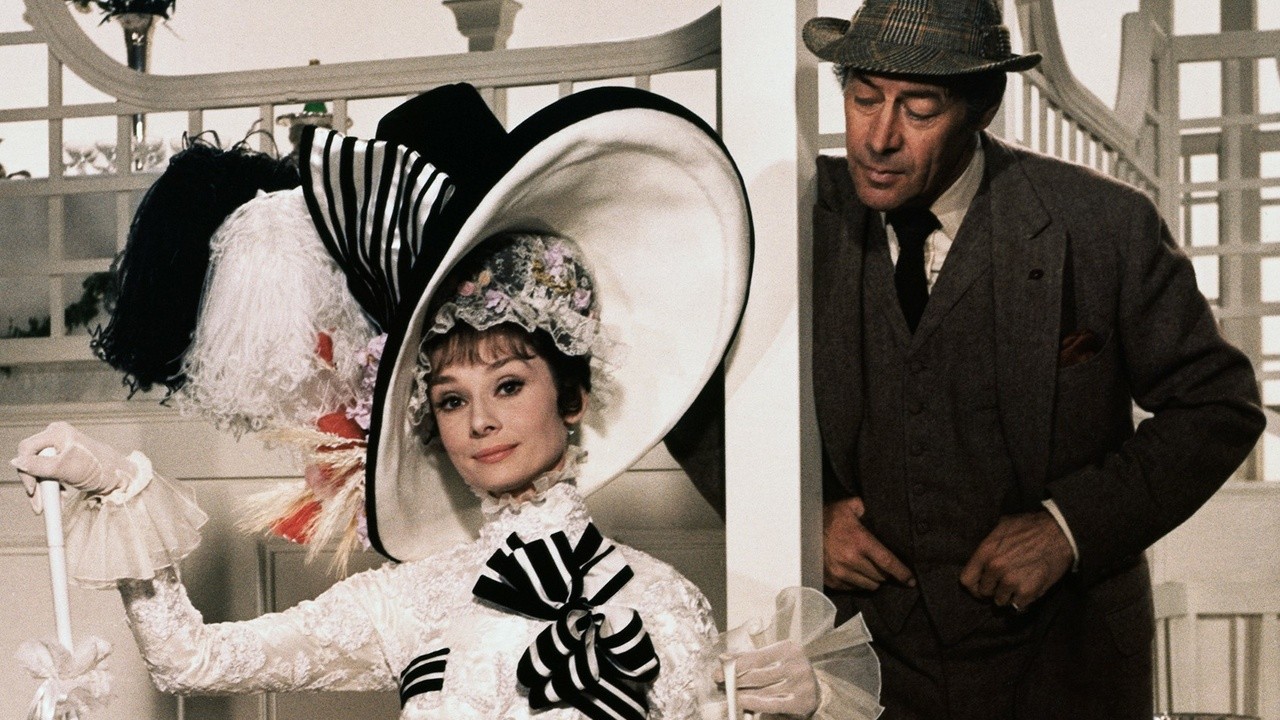
At one time the longest-running Broadway musical, My Fair Lady was adapted by Alan Jay Lerner and Frederick Loewe from the George Bernard Shaw comedy Pygmalion. Outside Covent Garden on a rainy evening in 1912, dishevelled cockney flower girl Eliza Doolittle (Audrey Hepburn) meets linguistic expert Henry Higgins (Rex Harrison). After delivering a musical tirade against “verbal class distinction,” Higgins tells his companion Colonel Pickering (Wilfred Hyde-White) that, within six months, he could transform Eliza into a proper lady, simply by teaching her proper English. The next morning, face and hands freshly scrubbed, Eliza presents herself on Higgins’ doorstep, offering to pay him to teach her to be a lady. “It’s almost irresistable,” clucks Higgins. “She’s so deliciously low. So horribly dirty.” He turns his mission into a sporting proposition, making a bet with Pickering that he can accomplish his six-month miracle to turn Eliza into a lady. This is one of the all-time great movie musicals, featuring classic songs and the legendary performances of Harrison, repeating his stage role after Cary Grant wisely turned down the movie job, and Stanley Holloway as Eliza’s dustman father. Julie Andrews originated the role of Eliza on Broadway but producer Jack Warner felt that Andrews, at the time unknown beyond Broadway, wasn’t bankable; Hepburn’s singing was dubbed by Marni Nixon, who also dubbed Natalie Wood in West Side Story (1961). Andrews instead made Mary Poppins, for which she was given the Best Actress Oscar, beating out Hepburn. The movie, however, won Best Picture, Best Director, Best Actor for Harrison, and five other Oscars, and it remains one of the all-time best movie musicals. —Paramount

Director

Original

George Cukor

George Cukor (July 7, 1899 – January 24, 1983) was an Academy Award-winning American film director who mainly concentrated on comedies and literary adaptations. His career flourished at RKO and later MGM, where he directed a string of impressive films including What Price Hollywood? (1932), A Bill of Divorcement (1932), Dinner at Eight (1933), Little Women (1933), David Copperfield (1935), Romeo and Juliet (1936), and Camille (1937).

His career suffered a temporary setback when he was replaced as the director of Gone with the Wind (1939), but he continued to direct classic films with The Philadelphia Story (1940), Adam’s Rib (1949), Born Yesterday (1950) and A Star Is Born (1954). His last major success was My Fair Lady (1964), but he worked into the 1980s.

He was born George Dewey Cukor on the Lower East Side of New York City, the younger child and only son of Hungarian Jewish immigrants Victor, an assistant district attorney, and Helen Ilona (née Gross) Cukor. His parents… read more

Wall

Displaying 4 of 21 wall posts.
Picture of Burkhan

Burkhan

11Mar12

A funny film with theatrical scenes with sound characters, e.g., the noble ones, the professor ones, the ones in the street, the philosophical drunks. She, as a poor, sweet, simple and beautiful street girl smiles sweetly to the noble people who lives in noble white dressings and noble black tuxedos. She is poor, simple, sweet and very beautiful, however, she finds the happiness under the sword of the proffesor.

Picture of Elisou

Elisou

4Mar12

Not a very good movie but it's worth seeing for Audrey Hepburn. Her accent is a bit annoying and it's a pity they dubbed her voice in some of her singing parts but I think I had never seen her look more beautiful. Wow!

Picture of nadira tania

nadira tania

16Jan12

what a simply boring movie

Picture of Syarafina Alfiansyah

Syarafina Alfiansyah

27Nov11

If it weren't for the fashion references, again, I would not want to watch this twice. Simply disappointing.

Related Films

Fans

Displaying 5 of 362 fans.

Articles

Our roundup of essays and articles on this film.
W184

Daily Briefing. Guy Maddin in New York, Dave Kehr on George Cukor

By David Hudson on November 19, 2011

Also: Live reading of The Apartment, what Cronenberg’ll do after Cosmopolis and more.

read article

Lists

Displaying 5 of 149 lists.

Reviews

Displaying 1 of 1

Funny, sweet, simple and poor Lady

By Burkhan on March 11, 2012

A funny film with theatrical scenes with sound human characters, e.g., the noble ones, the professor ones, the ones in the street, the philosophical drunks. Sweet Audrey fights sweetly with poverty…  read review

Forum

Displaying 0 discussion topics.