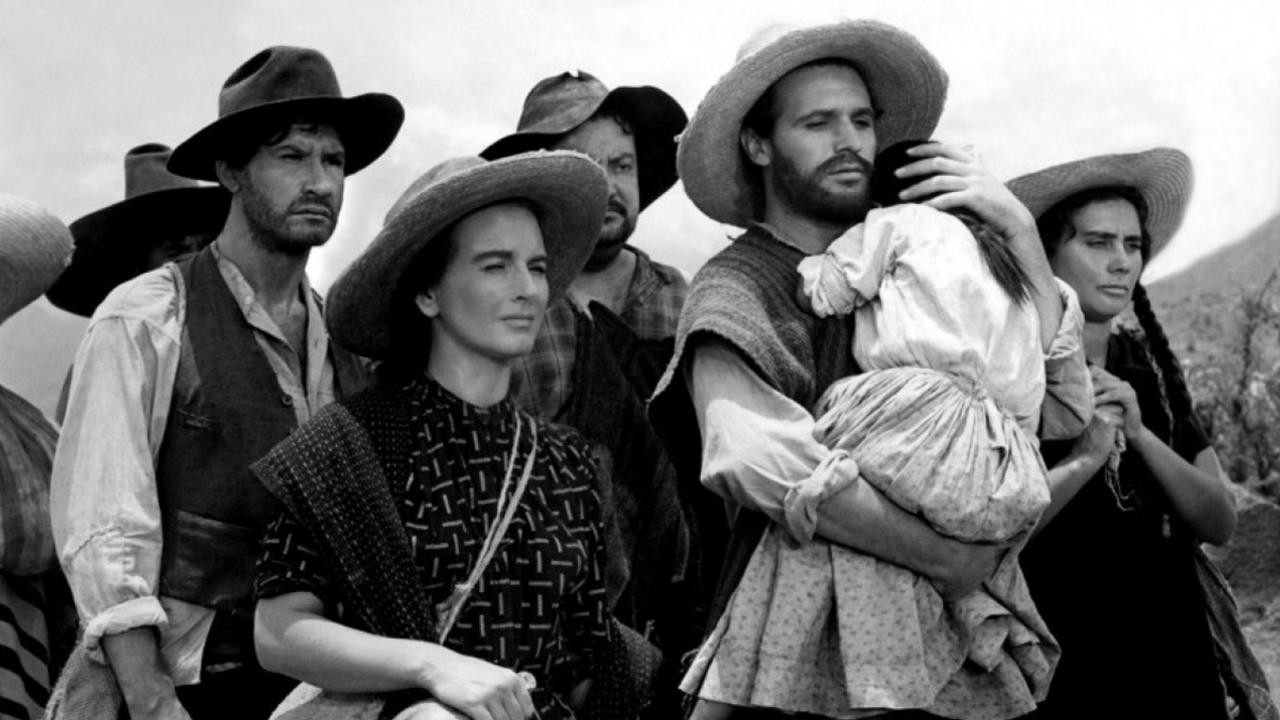
Nazarin is a priest, attempting to living a pure and honest life strictly according to Christian principles – but others only show him distrust and hatred, apart from the local prostitute… —IMDb
Sent off for a Jesuit education by his prosperous Spanish parents, Luis Buñuel went on to attend the University of Madrid, where he first became interested in the burgeoning European film industry. Upon graduating from Paris’ Academie du Cinema, his first movie job was as an assistant to French-based directors Jean Epstein and Mario Nalpas. In partnership with an old friend, Spanish painter/sculptor Salvador Dali, Buñuel put together the three-reel surrealist masterpiece Un Chien Andalou (1928), the film that features dead donkeys on a piano, a razor slashing an eyeball, and other deliberately shocking images that cineastes have either praised or damned for the past seven decades.
Buñuel’s first feature film, L’Age d’Or, was banned from public exhibition almost immediately from the moment of its 1930 premiere; its principal opponents were high-ranking members of the Catholic church, who condemned the film as savagely sacrilegious. After 1932’s Land Without Bread, an uncompromising… read more
Fantastic film, antoher gem from Buñuel. This is not only a brilliant and sharp commentary on organized religion but also a study about the human being, hence the open interpretation about the ending with the pineapple and wheter the people caring about mundane subjects rather than the indulgences of a jealous god were the wrong ones. The breathtaking Paco Rabal in a career defining role, a unforgettable masterpiece.
Buñuel in Mexico is a topic so often ignored you would think that he didn't make 20 films while he was there. However, this film is delicious proof that he did, in fact make great films. Buñuel exploring religion is always good. The photography by Figueroa is perfect, as always. The performances are even better, and that's not an easy thing to beat. Hopefully by watching, some'll venture to watch his Mexican period.
This film is quite possibly Buñuel's finest hour. His mise-en-scene is absolutely outstanding, his scenario is simply brilliant, and Francisco Rabal turns in one of the greatest performances of all time. A vastly under-seen, vastly underrated masterpiece, to be sure.
Bunuel’s Gospel? In “Nazarin” Bunuel goes beyond theological, dogmatic or historical Christ. He imagines the existential Christ through Christ-like figure of our own times (as Anne-Marie Mieville a“Nazarin” by Luis Bunuel nd Godard imagine existential Mary in “Book of Mary” and “Hail Mary” correspondingly). In Bunuel’s analysis (and Francisco Rabal’s performance) Father Nazario’s virtuous life cannot be separated from Christ’s protection but as soon as he steps out of religious conventionality it becomes obvious that Christ’s help was in reality Church’s power. As soon as Nazarin appears in the world alone with Christ he opens himself to the danger of being abused by various categories of people and by the system. What is left for Nazarin is the way of martyrdom, exactly like it was for Christ vis-à-vis God and the world. The Cavalry of deprivations, physical assaults and humiliations became for Nazarin a return to the truth of human condition for those who don’t dare to protect themselves by their own individual power, power of the group or by belonging to the powerful social institutions. The ultimate lesson of Christ for Nazarin is to accept the human, without protection of power, destiny. Identification with Christ is for him identification with the mortal human body, not with a protecting God, with modesty and humility, not with super-human glory. Read article about Bunuel’s film “The Fundamentalist Believers, the Scapegoated Outsiders, the Virtuous Followers and the Humiliated Martyrs” and analysis of shots from the film (posted on Feb. 28, 2010) at: www.actingoutpolitics.com by Victor
Mark Kermode and Martin Scorsese had so much ground to cover in the 22-minute interview posted at the Guardian's site on Friday — Michael
In “Nazarin” Bunuel goes beyond theological, dogmatic or historical Christ. He imagines the existential Christ through Christ-like figure of our own times (as Anne-Marie Mieville a“Nazarin” by Luis… read review