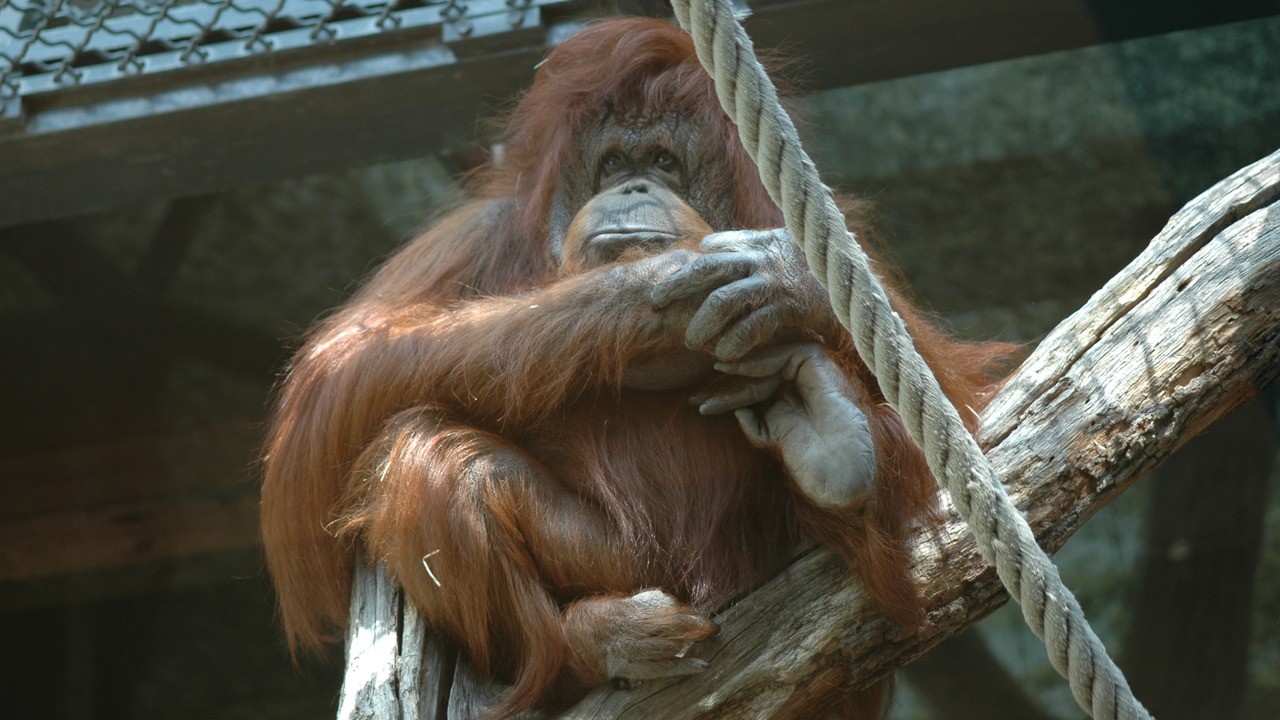
After three husbands and four kids, 40-year-old Nénette is settling into retirement quietly, spending much of her time staring out the window. On the other side of the glass, zookeepers and visitors regularly observe and comment on her appearance and behavior. They watch her; she watches them. A gentle redhead with black fingernails, saggy breasts and soulful eyes, Nénette is an orangutan, who has resided at the Jardin des Plantes in Paris since 1972. But documentarian Nicolas Philibert isn’t interested in anthropomorphizing his hairy subject. In the unadorned cinema verité style of his previous films, such as the masterful To Be and to Have (2002), Philibert remains intent simply on observing and listening to Nénette and the microcosmic world on either side of her viewing window. For a brief moment, the reflection of some inquisitive child visitors can be seen in the glass, but for the most part it is just Nénette, and every so often her roommate and son Tübo, who occupy the frame. Visitors comment in various languages on her size, her hair, the amount of space she occupies. They wonder aloud if she misses her Borneo homeland and what she might be thinking. Is she sad? Lonely? Bored? Two of her keepers, one who has been with her for 35 years, provide gentle off-screen insights into her life, her history, her personality and their personal bonds with the inscrutable primate. Ultimately, you will forge your own connection with Nénette and may start to wonder who is really observing who. —Joanne Parsont
Nicolas Philibert was born in 1951 in Nancy (France). After studying philosophy, he turned to film and became an assistant director, notably for René Allio, Alain Tanner and Claude Goretta. In 1978, with Gérard Mordillat, he co-directed his first documentary feature, « His Master’s Voice » (La voix de son maître) in which a dozen bosses of leading industrial groups talk about control, hierarchy and power, gradually sketching out the image of a future world ruled by the financial sector…From 1985 to 1987, Nicolas Philibert shot various mountaineering and sports adventure films for television, then started directing documentary features that would all obtain a theatrical release: « Louvre City » (La Ville Louvre, 1990), « In the Land of the Deaf » (Le Pays des sourds, 1992), « Animals » (Un animal, des animaux, 1995), « Every Little Thing » (La Moindre des choses, 1996), as well as a film essay pitched between documentary and fiction: « Who Knows? » (Qui sait ?, 1998)In 2001, he directed… read more
This documentary about an elderly orangutan both benefits and suffers from being composed solely of shots of the apes from outside their cage. It both humanizes and distances us from the apes. The flat visual style is distracting from the apes' inherent beauty. By only shooting the apes from outside the glass mostly from the same angle, it puts a strange distance between subject & audience.
"The crippling and cruel, not to mention pretty foolish, response to Sofia Coppola's Marie Antoinette (2006) was perhaps inevitably going to