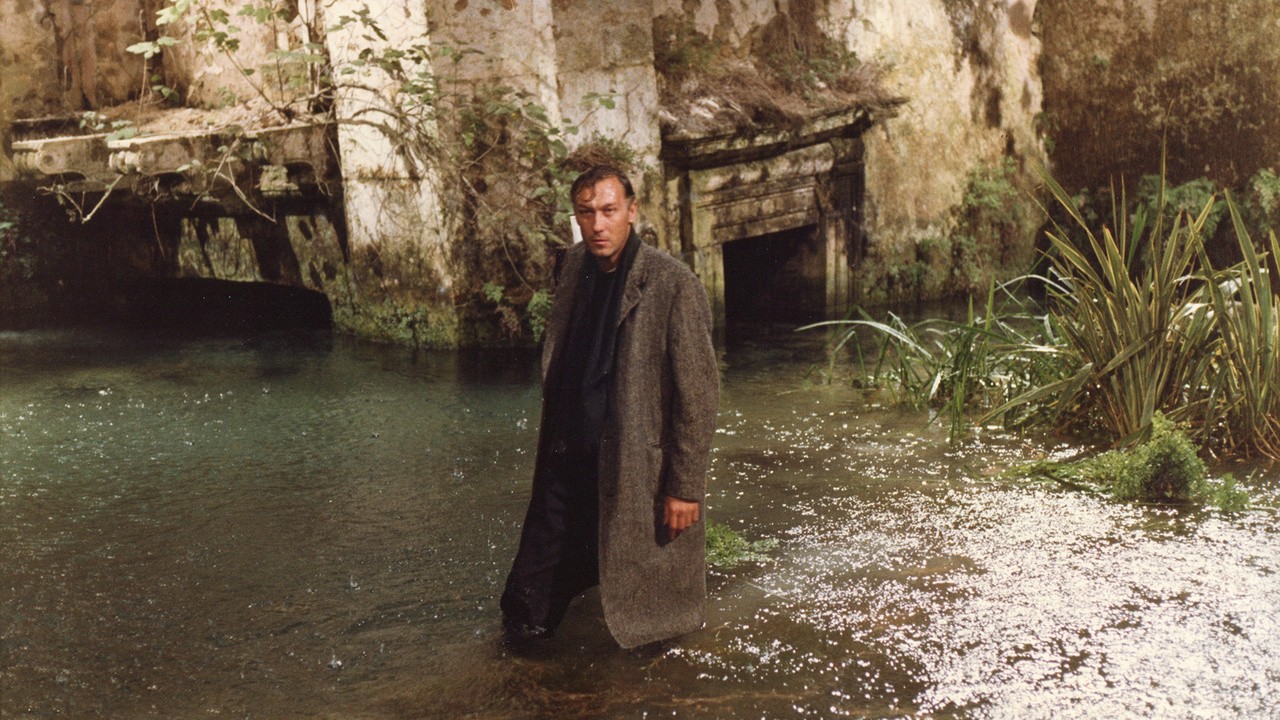
A haunting, enigmatic film directed by Andrei Tarkovsky, his first made outside of the Soviet Union. It is a portrait of a misanthropic poet, Gorchakov (Oleg Yankovsky), an expatriate in Italy who is researching the life of an exiled Russian composer who committed suicide. Gorchakov finds himself crippled by a melancholy nostalgia for his Russian homeland and memories of his wife and children.
At St. Catherine’s pool – a sacred site near a Tuscan village – Gorchakov encounters local mystic and pariah, Domenico (Erland Josephson), who offers Gorchakov a glimpse of redemption through his belief that if one can travel across the pool with a lit candle, one can save all of humanity. Nostalghia won the Grand Prix de Creation and the International Critics Prize at the 1983 Cannes Film Festival.
One of the most important artists of the second half of the twentieth century, Tarkovsky was one of the few unqualified masters in the history of film. While he certainly wasn’t the only great director of his generation of Soviet filmmakers, he was, like Eisenstein was to an earlier generation, its most renowned and most influential.
The son of artists- actress Maria Ivanovna and poet Arseni Tarkovski— he studied both Arabic and geology before turning to film. He enrolled at VGIK in 1959, directed the acclaimed short The Steamroller and the Violin in 1960 and won the Golden Lion at the Venice International Film Festival for his first feature, Ivan’s Childhood, in 1962. By the time he completed his second feature, Andrei Rublev, he was regarded by many as “a poet of the cinema” – and by the Soviet censors as dangerously esoteric. Unreleased in the Soviet Union until 1971 (and then only in a truncated version), Andrei Rublev was seen first at international festivals and widely… read more
O tempo é matéria-prima essencial de Tarkovsky. Reorganizado a partir da lógica interna de suas narrativas, em "Nostalgia" viajamos tanto pelo presente objetivo' da personagem principal quanto pelo seu 'presente subjetivo' - trânsito de memórias várias e dispersas. A dedicação do espectador é essencial para dar sentido a um conjunto visual (de)marcado pelo teatro, poesia e pintura - cuja soma engendra um filme único!
Tarkovsky's personal yearning of wanting to return to his home country after being ostracized. A dream-like, metaphysical diary of his world.
A cumulative work: thematically linked to his Rublyov - attainment of spirituality amidst the formation of art, through the gaze of an artist in exile, his diaspora - while aesthetically to the dreamlike recollection of The Mirror, its nostalgic overtures and requiem for his homeland. While it lacks as clear a synthesis of pacing, musing and emotionality - making it appear ponderous by comparison - Nostalghia still retains its own reverential power and melancholia, particularly during its moments of such clarity and essence.
On the occasion of what would have been Andrei Tarkovsky’s 80th birthday, Adrian Curry looks back on the best posters for his films.
With the recent passing of screenwriter Tonino Guerra and all the discussion of Geoff Dyer’s Zona, he’s been on our minds lately.
The poet and screenwriter worked with Antonioni, Fellini, Angelopoulos, Tarkovsky, Rosi and many others.