Watch unlimited films online for $6.99.
Try MUBI for FREE.
 

Not Reconciled

Nicht versöhnt oder Es hilft nur Gewalt wo Gewalt herrscht

West Germany

1965

55 Min
Black and White
German
  • Currently 3.9/5 Stars.
  • 1
  • 2
  • 3
  • 4
  • 5

   |   

DIR Jean-Marie Straub

PROD Danièle Huillet, Jean-Marie Straub

SCR Danièle Huillet, Heinrich Böll, Jean-Marie Straub

DP Christian Blackwood, Gerhard Ries, Wendelin Sachtler, Jean-Marie Straub

CAST Heinrich Hargesheimer, Carlheinz Hargesheimer, Martha Staendner

ED Jean-Marie Straub, Danièle Huillet

Cannes (La semaine de la critique)

Synopsis

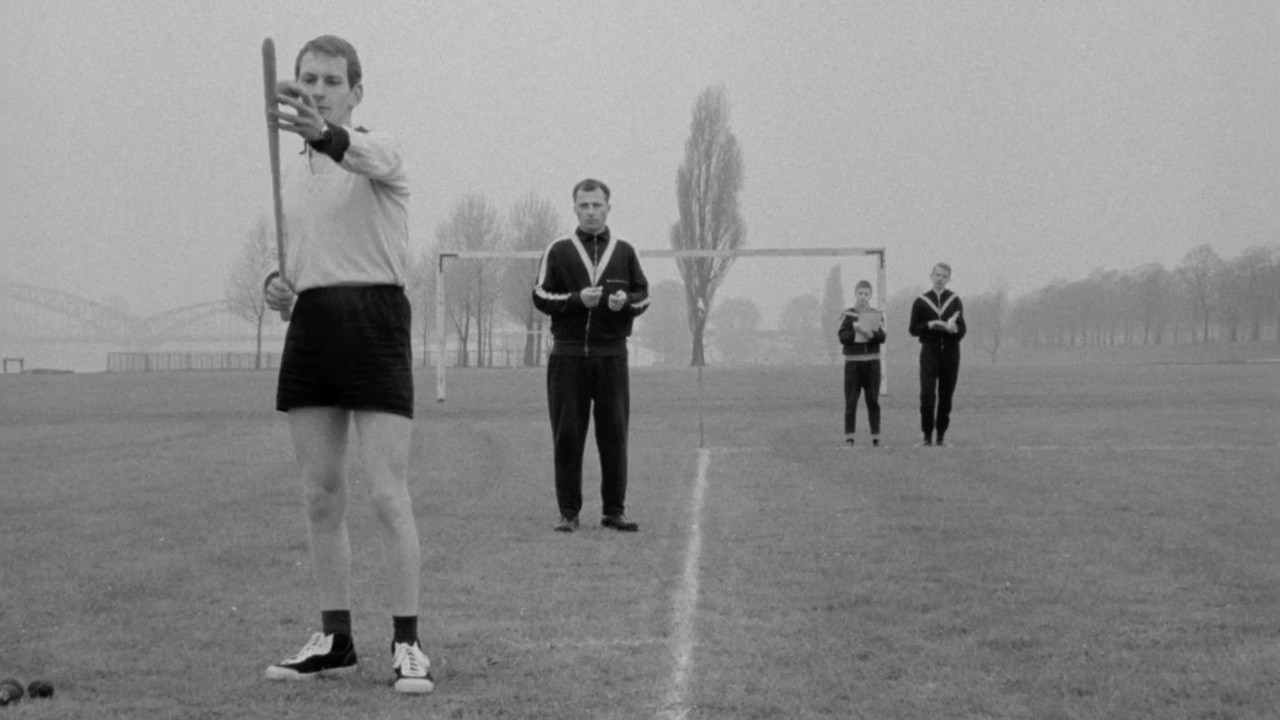
Not Reconciled, the title of the Straubs’ first feature-length film, is engraved on their work like an inscription. It is a story about the continuity and collapse of history, the power of suppression, and the terror of reconciliation; loyalty, treason and revenge. In a brave cinematic game, Heinrich Böll’s story Billiards at Half-Past Nine is split up into cracks, blocks, breaks and sudden turns, as the life story of a German family, covering numerous generations, is propelled forward. Terms such as “interwar period” and “post-war period” are blown up with a single cut, word or click of a billiard ball. Not Reconciled remains one of the most important German film of the past fifty years. —BAFICI

Director

Original

Jean-Marie Straub

Filmmaker Jean-Marie Straub and Daniele Huillet, his wife and co-director, have become leading figures in New German cinema. Their films are not for passive viewers seeking light entertainment; films such as Not Reconciled or Only Violence Helps Where Violence Rules (1965) are intellectually demanding, and yet are among the most haunting films of German cinema. Prior to teaming up with Huillet, the French born Straub worked as an assistant to French directors such as Abel Gance, Jean Renoir, and Robert Bresson. He met and teamed up with Huillet in 1954. To avoid the draft, he fled to Munich, Germany in 1958 where they got involved with radical theater groups. By the early sixties he and his wife had become a prominent directors. They made their debut with the short Machorka-Muff in 1963. In 1968, their long-time friend Fassbinder appeared in The Bridegroom, the Comedienne and the Pimp. Straub and Huillet’s most famous film is Chronicle of Anna Magdalena Bach (1968). By the late ’60s… read more

Wall

Displaying 4 of 8 wall posts.
Picture of sam

sam

30Jan12

Cigarettes and beverages unite and divide.

Picture of House of Leaves

House of Leaves

9Jun10

A fantastic film overall, but hampered by two horrible performances.Still 4/5.

Picture of Blue K, Custodian of the Cinema

Blue K, Custodian of the Cinema

15May10

OK, this was my second viewing and I'm convinced that this is the best Straub/Huillet film I've seen.

Picture of Jose Sarmiento Hinojosa

Jose Sarmiento Hinojosa

21Apr10

Mmm, I don't know... "Chronicle of Anna Magdalena Bach", "Dalla nube alla resistenza", "Lothringen", "Sicilia" , "A Visit to the Louvre", "Quei Loro Incontri".... I really don't know, maybe I'll try to come up with a list somewhere in the future.

Related Films

Fans

Displaying 5 of 45 fans.

Articles

Our roundup of essays and articles on this film.
W184

Politics and Aesthetics in the Straubs’ Films

By Ted Fendt on November 7, 2011

Jacques Rancière, Philippe Lafosse and the public in conversation about Straub-Huillet after a screening of their films.

read article

Lists

Displaying 5 of 34 lists.

Reviews

No reviews yet — Write the first

Forum

Displaying 1 discussion topic.