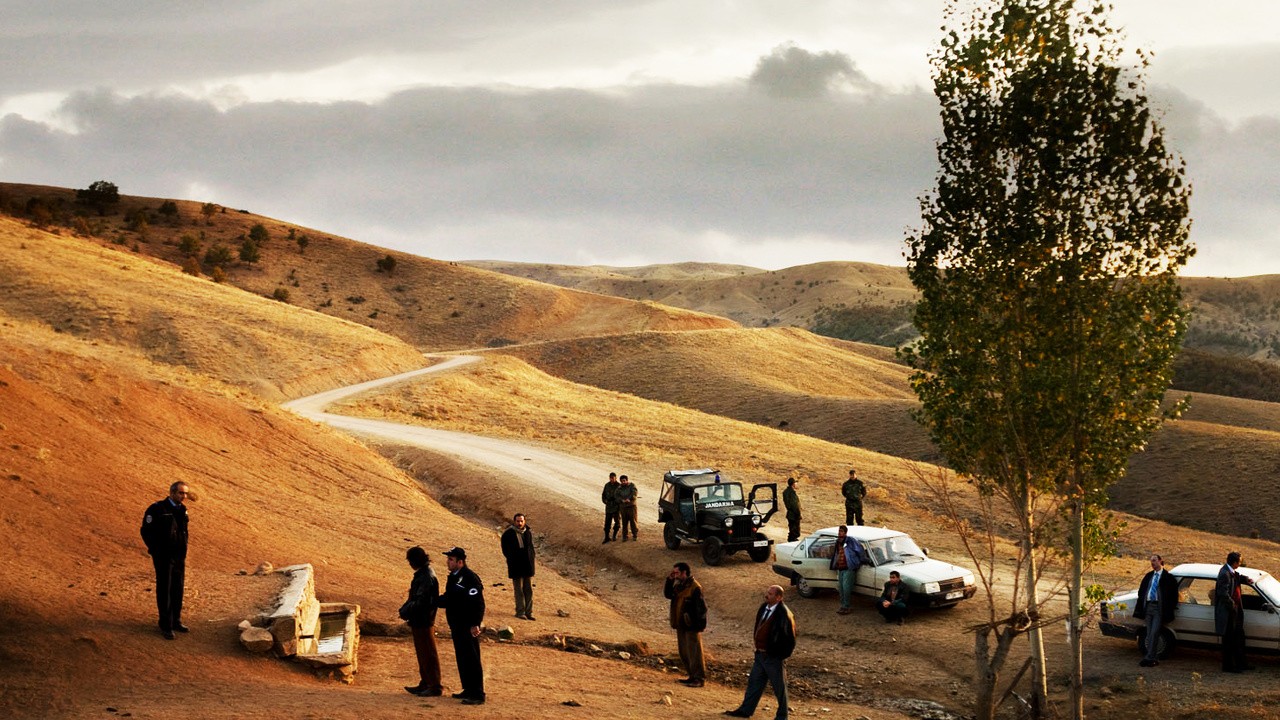
What appears to be on the surface a police procedural film is anything but in Ceylan’s hands. As the confessed killer tries to lead the authorities to the place where he buried the body, a series of clues are laid as to what has actually happened.
Turkish master Nuri Bilge Ceylan has made a film that demands great patience, but that patience is magnificently rewarded as the narrative moves toward its conclusion. Although the title is a nod to Sergio Leone, Ceylan is very much his own man, determined to create a mythology around a subject that defines an era and a country.
The plot follows the outline of a routine police procedural, but as one would expect from this distinctive filmmaker, Once Upon a Time in Anatolia is far from routine.
A murder has been committed and a man has confessed; all that remains is for him to lead police to the body so they can wrap the case. In the dead of night, two cars and a Jeep carrying the murderer, the police chief and the prosecutor set out to find the burial spot. As the small convoy inches its way through the darkness of the deserted countryside, it becomes clear that the killer can’t locate the place where he left his victim. Cigarettes are smoked; conversations occur and refreshments are served in a local village; nothing significant seems to happen. Yet whether we are aware of it or not, small clues are being planted along the way.
Like a game of chess, the grand design of this subtle and disturbing film comes increasingly into focus as events progress. Things are not always as they appear to be, and in Kafka-like gestures, people, emotions and events are developed in different and deeper ways. Once Upon a Time in Anatolia is ambiguous enough that we must concentrate on all the details of the canvas before the full story becomes apparent — or does it? A number of doors open teasingly, creating a labyrinthine world that mirrors our present incomprehension at so many contemporary events. What is truth and how we find it are some of the questions Ceylan raises in this superior exploration of a crime and its investigation. –TIFF
Nuri Bilge Ceylan (born 26 January 1959 in Istanbul) is a Turkish photographer and film director. He is married to the filmmaker, photographer, and actress Ebru Ceylan, his co-star in İklimler.
Ceylan learned photography at age 15, and developed an interest in film at 22. After graduating from Boğaziçi University with a BSc degree in Electrical and Electronics Engineering, he went on with his studies on cinema for two years at Mimar Sinan University.
Ceylan’s first short film Koza (Cocoon) was screened in the Cannes Film Festival in 1995. He received many awards with his debut feature Kasaba (Small Town). His third feature Uzak (Distant) received many awards including the Grand Jury Prize and the Best Actor Prize at Cannes, and was praised internationally. His 2006 film Iklimler (Climates) won the FIPRESCI Movie Critics’ Award at the 2006 Cannes Film Festival and received international praise by critics and experts. The film won 5 awards at the 2006 Antalya Golden Orange… read more
I thought it was a great film. I can understand why some might not want to watch a film this slow or long compared to others but I don't think it has to justify its style either.
I'm pretty sure I really liked it. Many people seem to think it's a masterpiece. I think it might be, but I'd probably have to watch it again to confirm. Not sure I've got the stamina for that though.
"You're bored now, but this will make a good story later," says one of the characters. Nice try.
In our annual poll, we pair our favorite new films of 2012 with older films seen in the same year to create fantastic double features.
We begin CLOSE-UP, a new series of essays spotlighting films available on MUBI, with Once Upon a Time in Anatolia—now playing in the UK.
“A few days into 2012, and we already have a favorite for the New Year’s best movie” — J Hoberman, Voice.
“Our film of 2011 is The Tree of Life (by a country mile).”
The word “masterpiece” is dropped pretty often this time around — but not lightly.
Drawing attention to notable reviews as they come in from the festival.
Updated through 5/23. The Jury of the 64th Cannes Film Festival, presided over by Robert De Niro, and further comprised of Martina Gusman
Updated through 5/23. "On Friday, the 64th Cannes Film Festival presented a selection that grabbed critics and could nab the Palme d'Or on
The end of the world will be beautiful, or so says the Polish poster for Lars von Trier’s Melancholia, quite fittingly on the eve of
This is not a review but a reaction and a self-justification for not rating the film higher. Once Upon a Time in Anatolia has a lot going for it, not the least of which is the fact that it’s absolutely… read review
A Review in 5 Parts:
01. “Once upon a time in Anatolia” – The line, not the film. At one point in the film, a character says, "you can one day tell your child this story and start it with ‘Once… read review
The rewards may be insufficient for some, but I found this homicide investigation both fascinating and beautiful. Long takes, beginning with distant shots of automobiles driving through the Turkish… read review
My presence at the 2011 New York Film Festival wasn’t as dominant as ‘09 (life during wartime, trash humpers, the white ribbon) or 2010 (uncle boonmee, another year, black venus and certified copy… read review